Call for Contributions:
Critically Mediterranean: Aesthetics, Theory, Hermeneutics, Culture
ed. by Yasser Elhariry (Dartmouth College) & Edwige Tamalet Talbayev (Tulane University)
Deadline: 15 December 2014
This is a call for contributors for Critically Mediterranean: Aesthetics, Theory, Hermeneutics, Culture, a peer-reviewed edited volume co-edited by Yasser Elhariry (Dartmouth College) & Edwige Tamalet Talbayev (Tulane University).
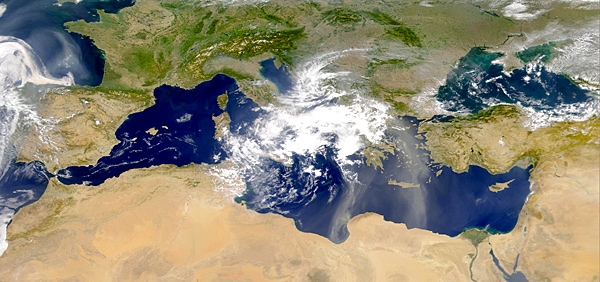 Pointing to the crux of much debate and scholarship in Mediterranean Studies, W. V. Harris has defined Mediterraneanism as “the doctrine that there are distinctive characteristics which the cultures of the Mediterranean have, or have had, in common” (1). A pervasive approach to the region in the disciplines of history and anthropology, the concept has fruitfully brought to light the presence of “common denominators” underlying the region’s past that warrant a comparative reading of local history across broad spans of time and space. Based on excavating millennia-old histories of ever-shifting interactions at the micro-level (Horden and Purcell’s “connectivity”), this approach has striven to move the focus away from the myriad local histories unfolding across the Mediterranean’s coastlands to bring the space of the sea as a principle of integration into relief. Highlighting wide-ranging forms of mobility, interconnectedness, and analytical fluidity in their adjustable Mediterranean model, these conceptions have emphasized the material flows running across the sea and its shore-lands, and the human activities that they have supported. As Peregrine Horden observes in his and Sharon Kinoshita’s Companion to Mediterranean History, “There seems to be no limit to the ways in which the Mediterranean region may be reimagined, as a sea, as an area involving physical movements, maritime spaces, territorial arrangements, and political processes that seek to transcend national boundaries and enmities” (5).
Moving the chronology and critical purviews of the field forward, this volume seeks to interrogate how theories and methodologies of Mediterranean Studies may bear on the modern period. Beyond the dominant mapping of the region in ancient, medieval and early modern contexts, there are important questions to be answered about our critical understandings of the modern Mediterranean and its arts and cultures that have a direct bearing on our understanding of the modern/contemporary world. This volume probes the critical cut of the Mediterranean as a theoretical entity, as an aesthetic, theoretical, and hermeneutic category for the interpretation and analysis of culture, and as a space of artistic and linguistic density and coterminous symbolic geographies. We propose to examine its critical potential in the age of nationalistic projects, global capitalism, colonial modernity, and postmodernism.
With these guiding principles in mind, we encourage contributions that explore material, visual, literary and linguistic cultures of “the Mediterranean as a spatial constellation undergoing recurring formation and dissolution,” in order to “make the notion of a modern Mediterranean plausible and reveal its structural similarities and connections with the sea’s previous lives” (Ben-Yehoyada 107). Teetering between the unenviable status of romantic delusion and the nefarious influence of residual (self)orientalizing dynamics, the Mediterranean as a conceptual tool first needs to liquidate its fraught exoticist heritage. With the advent of European imperialism in the Mediterranean in the 19th century, dealing with the legacy of globalization also requires attending to the fractures, inequalities, and forms of disenfranchisement that the new world order has engendered (what Ian Morris has dubbed “winners and losers” in relation to Mediterraneization). Alongside Iain Chamber’s “interrupted” paradigm, concepts of critical/ alternative modernities anchored in the sea are relevant to scrutinizing the fruitfulness of the Mediterranean construct to these theorizations.
We are thus seeking contributions that (1) present readings of an original, modern Mediterranean archive or corpus, and (2) rigorously, even polemically, argue what constitutes the archive/corpus’ Mediterraneanism.
We especially encourage proposals that address a combination of the following possible lines of inquiry:
- Origins and genealogies. Sharon Kinoshita has aptly suggested that “Mediterranean studies is less a way of defining or delimiting a geographic space (as in the famous formulation of the Mediterranean as the region of the olive and the vine) than a heuristic device for remapping traditional disciplinary divides” (602). What are the material, visual, literary and linguistic limits to our grasping of the Mediterranean? What are the needs and natures of disciplinary, cross-disciplinary, and interdisciplinary work? What is the role of competing genealogies within field formation? In turn, how may the births and beginnings of disciplines inform our critical understandings of the modern Mediterranean and its arts and cultures?
- Mediterranean representations. How do cultural formations, historical processes, and elements of style develop? How do considerations of genre and intertextuality inform their emergence? What artistic and intellectual tropes and turns (for example: nostalgia, cosmopolitanism, religion and mysticism) inflect the Mediterranean as a rhetorical tool or figure within their respective genealogies?
- Mediterranean translations. What roles does language perform in the modern Mediterranean? What and where are the untreatable, untranslatable dimensions of Mediterranean expression? How do linguistic codes intersect with the visual, the sonic, and the (inter)medial? What are the specificities of—or relationships between—literature, visual culture, cinema, music, media and intermediality?
- Philosophy, phenomenology and the poetics of space and time. Edgar Morin reports that it is in the 16th century that the Mediterranean was given its name, which meant sea-at-the-center-of-the-lands (33), but what if the Mediterranean in fact decenters and disorients? How do modern representations of the Mediterranean treat the nature of the sea? Beyond dialectics of change and permanence, how does the incursion of the Mediterranean into time evoke discrepant temporalities (plural, unpredictable, ephemeral, internally experienced, immanent or dormant)?
- (Bio)politics. Chakrabarty has pointed how the Mediterranean “environment […] had an agentive presence in Braudel’s pages” (205). Does the modern Mediterranean still play “an agentive presence” in contemporary politics? In an era where “the Marxist critique of capitalism” and “Marxist internationalism undermined the idea of the nation” (Morin 38-39), what is the Mediterranean’s relationship to la raison d’état, or the nation-state as a heuristic core of critical practice? What becomes of the relationship between nation-states and languages, between identities and affiliations? How does it call into question national literary languages? How would (bio)political questions concerning revolution, democracy, migration, transnationalism, and minority and second-generation human rights be articulated and addressed within these discourses?
- Mediterranean identities and self-identification. How do we key in the elaboration of local identity and community formation? What are the attendant regional politics and polemics? What are the dialectical relations to forms of being in the world ensconced in the discreteness of micro-localities? How may identity markers be uniquely declined beyond the dominant rhetoric of the right to difference? How may this entail the emergence of a transnational consciousness or of a specific ethos? How may we think beyond subjective experiences of the Mediterranean?
- The Mediterranean/Mediterraneans. How do we balance the focus on the micro with the need for the macro (Abulafia, 2006) and the relation to other sea-centered logics? What are the geographical limits of the modern Mediterranean? What is the place of the critical Mediterranean within reflections on “new thalassology” (Horden and Purcell, 2006) and “thalassocracies” (Abulafia, 2014)? Should the model be applied beyond the region? What is its intellectual currency across geographical divides?
Detailed abstracts (500 words) are due by December 1, 2014 to Edwige Tamalet Talbayev (etamalet@tulane.edu) and Yasser Elhariry (yasser.elhariry@dartmouth.edu). Contributors will be notified of acceptance by December 15, 2014. Completed manuscripts (6,000 words) are due byJune 1, 2015. Manuscripts will be rigorously edited prior to submission to the press. Although final placement of the volume will be contingent on the outcome of the press’ peer-review process, Brian Catlos and Sharon Kinoshita, the editors of Palgrave Macmillan’s new Mediterranean Studies series, have expressed interest in the volume.
References
Abulafia, David. “Mediterraneans.” Rethinking the Mediterranean. Ed. W. V. Harris. Oxford: Oxford UP, 2006. 64-93.
———. “Thalassocracies.” A Companion to Mediterranean History. Ed. Peregrine Horden and Sharon Kinoshita. Oxford: Wiley Blackwell, 2014. 139-153.
Ben-Yehoyada, Naor “Mediterranean Modernity?” A Companion to Mediterranean History. Ed. Peregrine Horden and Sharon Kinoshita. Oxford: Wiley Blackwell, 2014. 107-121.
Chakrabarty, Dipesh. “The Climate of History: Four Theses.” Critical Inquiry 35 (2009): 197-222.
Chambers, Iain. Mediterranean Crossings: The Politics of an Interrupted Modernity. Durham: Duke UP, 2008.
Harris, W. V., ed. Rethinking the Mediterranean. Oxford: Oxford UP, 2006.
Horden, Peregrine. “Introduction.” A Companion to Mediterranean History. Ed. Peregrine Horden and Sharon Kinoshita. Oxford: Wiley Blackwell, 2014. 1-7.
Horden, Peregrine and Nicholas Purcell. The Corrupting Sea: A Study of Mediterranean History. Oxford: Wiley Blackwell, 2000.
———. “The Mediterranean and ‘the New Thalassology.’” The American Historical Review 111.3 (2006): 722-740.
Kinoshita, Sharon. “Medieval Mediterranean Literature.” PMLA 124.2 (2009): 600-608.
Morin, Edgar. “Penser la Méditerranée et méditerranéiser la pensée.” Confluences Méditerranée 28 (2009): 33-47.
Morris, Ian. “Mediterraneanization.” Mediterranean Historical Review 18.2 (2003): 30-55.

 are soliciting 20-minute papers that examine the problems which pre-modern masons commonly encountered – and the solutions they developed – in the process of design and construction. Evidence may be drawn from a variety of sources, but we encourage studies based on the analysis of well-preserved buildings.



 Medieval Art Research