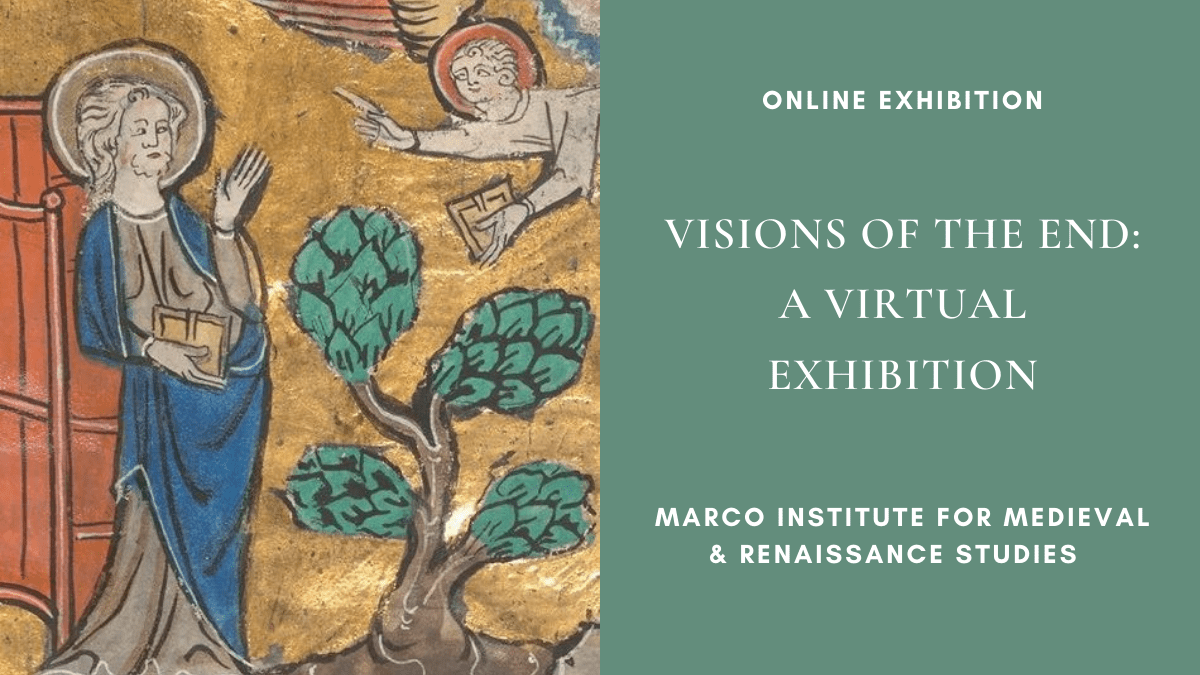
Online Exhibition: ‘Visions of the End: A Virtual Exhibition’, Marco Institute for Medieval and Renaissance Studies

The Marco Institute for Medieval and Renaissance Studies presents a virtual exhibition, ‘Visions of the End’, curated by Jay Rubenstein and Gregor Kalas. Visitors can view pre-modern art and objects relating to ideas of the apocalypse, salvation and revelation. The exhibition features illuminated manuscripts, stained glass, sculpture, and enamelwork amongst other media. The artefacts are organised under three headings: The Culture of the Apocalypse, Conflict and Hope, and The Era of Peace.

Pictures of the artworks are accompanied by a description of their provenance, subject matter, and relevance to the exhibition’s key themes and ideas. You can even take a virtual tour of the physical exhibition, which was on temporary display at the McClung Museum of Natural History and Culture, with commentary from Curator of Academic Programs Katy Malone.

This exhibition was an important part of a broader array of classes and events at the University of Tennessee, Knoxville during the spring of 2020. “Apocalypse Semester,” as it came to be known, included courses in departments across the humanities on themes such as hell, climate change, zombies, visions of the end in early English literature, and apocalypticism in Medieval and Reformation Europe.

‘Visions of the End’ brings together artefacts from:

  • The Metropolitan Museum of Art
  • Glencairn Museum
  • The Morgan Library and Museum
  • Free Library of Philadelphia
  • The Walters Art Museum
  • National Gallery of Art

Explore the exhibition now via this link.

Online Lecture: ‘Reimagining a Hieronymite Choir Book from Seville’ with Matthew Westerby, The Maius Workshop, 23 March 2021, 17.00 GMT

The Maius Workshop welcomes Dr Matthew Westerby to discuss his latest research via Zoom on the 23rd March at 17.00 (GMT). This work-in-progress talk will present some new findings on the iconography and provenance of a series of cuttings from a richly illuminated choir book. Dr Westerby argues that the parent manuscript, a Gradual, was probably created in the late fifteenth century for the Observant Hieronymites of San Isidoro del Campo in Santiponce, near Seville. As used by this Hieronymite community, and later pasted into an album of cuttings by William Stirling Maxwell after 1849, he explores the continued production of meaning of these cuttings and their digital remediation.

Dr Matthew Westerby is Robert H. Smith Postdoctoral Research Associate for Digital Projects at the Center for Advanced Study in the Visual Arts (CASVA), National Gallery of Art, Washington DC.

The event will take place on Zoom. Please register here to join. After registering, you will receive a confirmation email containing information about joining the meeting.

Call for Submissions: New Book Series: Reinterpreting the Middle Ages: From Medieval to Neo

A new book series, Reinterpreting the Middle Ages: From Medieval to Neo, co-edited by Dr Claire Kennan (University of Reading) and Dr Emma J. Wells (University of York) and published by Brepols, was announced earlier this week. The series warmly welcomes volume proposals for both monographs and thematically coherent essay collections.

The aim is to provide a new publication platform for interdisciplinary studies of the Middle Ages; that is, research which analyses the impact and approaches to the study of the medieval era from its origins to the present day to create a unique dialogue between scholars, professionals, and practitioners. In moving away from traditional approaches and towards the inter- and multi-disciplinary, the premise is to gain a snapshot of how (and why) the Middle Ages have been formed and are perceived across fields as well as over vast periods of change and countries, boundaries, and borders; to continue driving and moulding this innovation through examinations of the phenomenon/movement (in traditional or ‘neo-’form), its historiography, representation, image, presentation, and pedagogies.

The Series offers radical, exciting, informed, and innovative readings of the importance and prominence of the Middle Ages in the twenty-first century, how and why its significance has endured since the post-medieval era, and, most importantly, how critical curiosity of the era has been received, imagined, invoked, used, abused, and refashioned in the Medieval, Early Modern, Modern and Contemporary periods (so to speak). Rich collisions and fresh perspectives reveal ideas and exercises across centuries of practice and provide a new set of reference points that reframe the ‘medieval’ itself thereby presenting a fresh, broad, and representative picture of the deep connections between the modern and pre-modern world.

Titles will cover all forms of engagement with the more emerging field of neo-medievalism—at least as a revivalist subdiscipline over the last two generations—from the academy to modern pedagogies and constructs in popular culture from a multitude of fields, including history, art, architecture, archaeology, literature, musicology, public engagement and interpretation, digital humanities/heritage. Welcoming burgeoning topics such as film & TV, video games, social media, performing arts/cinema/drama, and particularly education, race, gender and decolonisation, as well as traditional approaches including historiography and renaissance/revival studies, it is based on the premise that the Middle Ages should be cultivated within and expanded beyond the academy, thereby bringing the media, education, popular, historical, and political discourses, into an engagement and dialogue with the past.

Fields of interest
History, art, architecture, literature, performing arts, media, digital humanities, teaching, archaeology, music, languages, archives, heritage, museums, philosophy, education, religious studies, theology, anthropology, sociology.

Method of Peer Review
Double-blind undertaken by a specialist member of the Board or an external specialist.

Publishing Manager
Jirki Thibaut – jirki.thibaut@brepols.net

General Editors
Claire Kennan, University of Reading – c.m.kennan@reading.ac.uk
Emma J. Wells, University of York – emma.wells@york.ac.uk

Editorial Board

  • Jaume Aurell, University of Navarra 
  • Richard Utz, University of Northern Iowa 
  • Allison Gulley, Appalachian State University 
  • Oleg Benesch, University of York 
  • Peter Frankopan, University of Oxford 
  • David Matthews, University of Manchester 
  • Simon Trafford, The Institute of Historical Research (IHR) 
  • KellyAnn Fitzpatrick, Affiliated Researcher at Georgia Tech
  • Katherine Lewis, Huddersfield University 
  • Kavita Mudan Finn, Massachusetts Institute of Technology 
  • Vincent M. Ferré, Université Paris Est Créteil 
  • Kenna Olsen, Mount Royal University 
  • Guy Halsall, University of York 
  • Michael Fordham, University of Cambridge 
  • Nadia Altschul, University of Glasgow

Author Information
Brepols Publishers’ general guidelines in English and a proposal form for authors and editors are available here.  

All volumes in this series are evaluated by an Editorial Board, strictly on academic grounds, based on reports prepared by referees who have been commissioned by virtue of their specialism in the appropriate field. The Board ensures that the screening is done independently and without conflicts of interest. The definitive texts supplied by authors are also subject to review by the Board before being approved for publication.

Why Publish with Brepols?

  • Authors work closely with and benefit from the expertise of the Editorial Board. 
  • Comprehensive peer review ensures books published with Brepols have a reputation for high-quality scholarship. 
  • Continuity of care – authors work with the same publishing manager throughout the publication process. 
  • We offer comprehensive copyediting by experienced editors with a background in Classical, Medieval or Early Modern Studies. 
  • All volumes published with Brepols are distributed and marketed worldwide
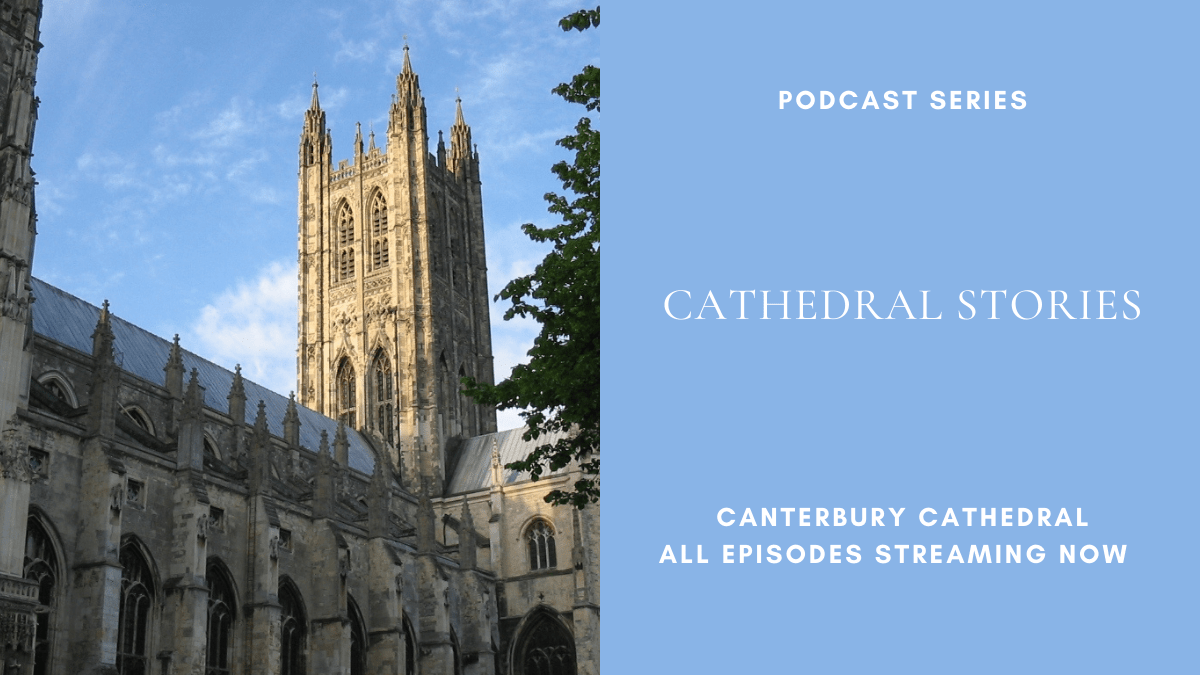
Podcast Series: Cathedral Stories by Canterbury Cathedral

Canterbury Cathedral created this special podcast series during lockdown to give you a sense of what makes the site so special and to learn something of its unique and colourful history.

UNESCO World Heritage Site, Seat of the Archbishop of Canterbury, and The Mother Church of the Worldwide Anglican Communion, the Cathedral has been a place of worship for 1,400 years. This podcast will give you an insight into the events and people who have helped to shape and mould it, the moments it has witnessed, and how what you see at the Cathedral today reflects all the people and ideas that have gone before.

The series celebrates the Cathedral’s history and heritage, art and architecture, as well as the personal experiences of those living and working on site today. Particular highlights from the series include the episodes on the Ancestors of Christ stained glass windows, the Black Prince, and the work of the Cathedral’s medieval masons.

All episodes streaming now on the Canterbury Cathedral website.

Online Course: Mosques in Sub-Saharan Africa with Aga Khan University, 21 and 28 May 2021, 13:30 – 16:30 (GMT)

This two-day online course introduces participants to Muslim architecture in Sub-Saharan Africa. Following an introduction on Islamic architecture and mosques, the first session will explore mosques in West Africa, from the Sahara to the tropical forests. The second session will look at the mosques in East Africa, from the Nile valleys to the Swahili coast. This day will be based on Professor Stephane Pradines’ extensive knowledge and fieldwork in Egypt, Ethiopia and the Swahili coast.

This short course provides the basis for understanding and critically examining the development of Islam in Sub-Saharan Africa. It approaches architecture through building materials and African construction techniques, from earthen monuments to coral stone buildings. Two important themes will be developed: first, the diffusion of ideas, people and material cultures across the Sahara Desert; second, the role of Islam in the building of maritime regional identities, international trading networks and urbanisation of the Swahili coast.

Learning Outcomes

This course presents Muslim architecture in a very specific context: Sub-Saharan Africa during the Medieval and Modern Ages. Following this short course, participants will be able to:

– Differentiate between mosques in Sub-Saharan Africa from their counterparts in North Africa and the Middle East.
– Recognise the different types of African mosques by geographical areas and by chronological phases.
– Learn about the importance of cultural exchanges across the Sahara Desert and the Indian Ocean.
– Receive a methodological background on archaeology, history, and the history of architecture in Sub-Saharan Africa.
– Distinguish between different types of building materials and natural resources in Africa.
Study the impact of the past to understand the political tensions in West Africa today.

Course Convenor

Professor Stephane Pradines is an archaeologist and Professor of Islamic Art and Architecture at the Aga Khan University’s Institute for the Study of Muslim Civilisations (AKU-ISMC) in London. Professor Pradines was the Director of the excavations of the Walls of Cairo (Egypt) and many other excavations in the Indian Ocean and East Africa. Currently, his main excavation project is at Lahore Fort in Pakistan. He is a specialist of Islamic archaeology in Sub-Saharan Africa, Indian Ocean medieval trade and Muslim material culture of war. Professor Pradines is the Founding Editor of the Journal of Material Cultures in the Muslim World (MCMW). He has published many articles and books on Swahili architecture, urbanism, and mosques. Professor Pradines is a mosque expert on the Indian Ocean region for UNESCO and the WMF. He has excavated several mosques in Ethiopia (Nora), Kenya (Gede), Tanzania (Songo Mnara, Sanje ya Kati and Kua) and the Maldives (Fandiyaaru and Bodha Miskiy, Koagannu, Hulhumeedhoo, Addu Atoll and Fenfushi, Ari Atoll). Professor Pralines’ latest book Historic Mosques in Sub-Saharan Africa, from Timbuktu to Zanzibar, by Brill Publishers, is due this summer.

Date and Time

21 and 28 May 2021, 13:30 – 16:30 ( London Time).

Tickets and Booking

Tickets: £75 professionals | £45 students, AKU alumni and AKU and AKDN staff.

For African professionals and institutions, please enquire for further information by contacting: ismc.marketing@aku.edu.

*The course will be delivered via Zoom. Readings and further details will be provided later upon registration.

More information can be found here.

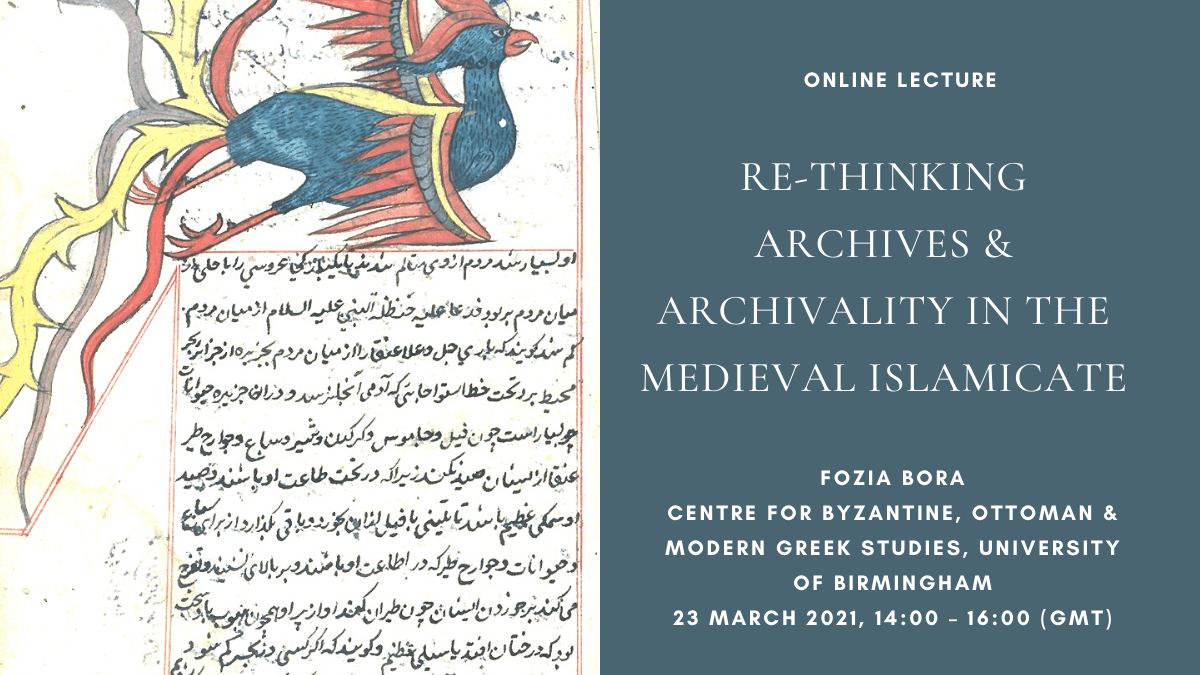
Online Lecture: ‘Re-thinking Archives and Archivality in the Medieval Islamicate’ with Fozia Bora, Centre for Byzantine, Ottoman & Modern Greek Studies University of Birmingham, 23 March 2021, 14:00 – 16:00 (GMT)

Find out more information here.

Please get in touch with Dr Klaus Richter (k.richter@bham.ac.uk) if you would like to be added to BRIHC’s Canvas page.

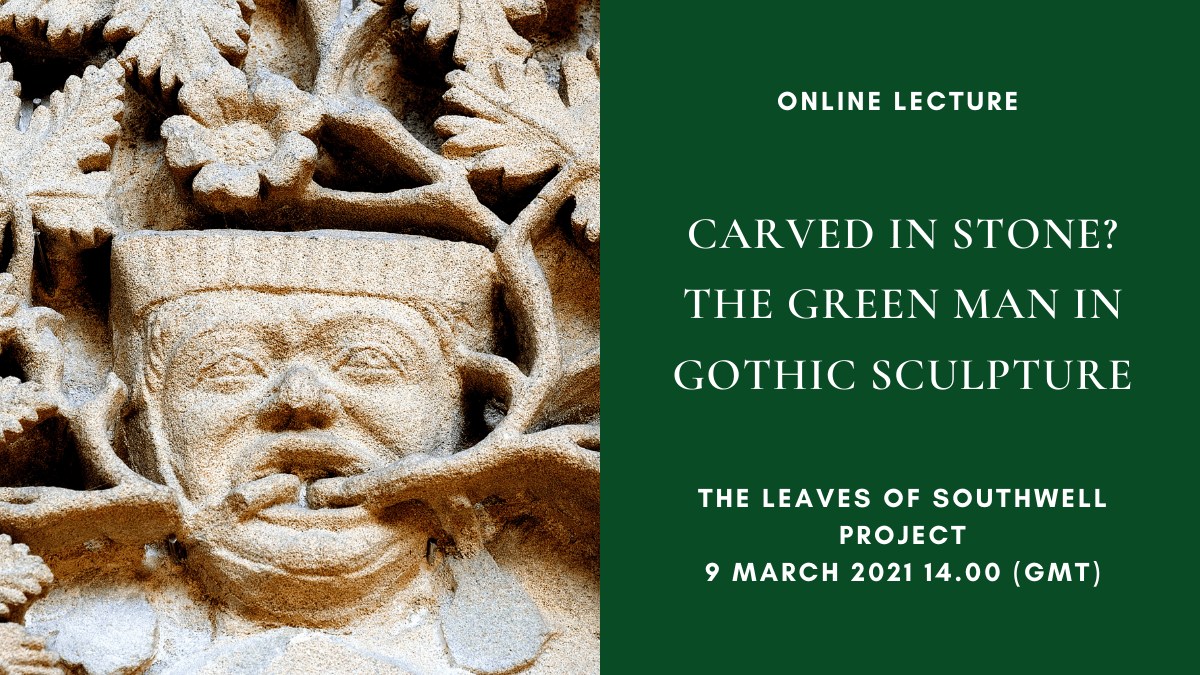
Online Lecture: ‘Carved in Stone? The Green Man in Gothic Sculpture’ with Cassie Harrington, The Leaves of Southwell Project, 9 March 2021 14.00 (GMT)

Southwell Minster will host a talk by Cassie Harrington as part of the Leaves of Southwell Project. The event will take place on 9 March 2021 at 2pm, via Microsoft Teams.

Flourishing in the margins of medieval visual culture, foliate heads and masks enriched manuscripts and buildings. Painted on the page, and carved on corbels, ceiling bosses, capitals, tympana, fonts, and misericords, these so-called ‘Green Men’ permeated both the public and private spaces of Gothic Europe. Such foliate carvings are a ubiquitous and familiar part of the architectural framework of medieval cathedrals and church buildings. However, despite their popularity, little attention has been paid to them by medieval art historians and much of their contemporary implications have been lost or forgotten.

From enchanting early Gothic survivals at the Basilica of Saint-Denis in the Ile-de-France, to the celebrated chapter house carvings at Southwell Minster in the British Midlands, this talk will examine how recovering and piecing together the historical context of foliate head iconography can shed light on its significance during the High Gothic period. It will explore the cultural and symbolic importance of these enigmatic images, their place in the intellectual history of the thirteenth century, the roles that imagination and knowledge had in their dissemination and development, and consider how they had a didactic, and not merely decorative, function.

To book your place, please visit the Southwell Minster website.

About Cassie Harrington
Cassandra Harrington is a medieval art historian and PhD Candidate at the University of Kent. She has research interests in sculpture, manuscripts and illumination, architecture, the transmission and reception of ideas, and the dialogue between visual and textual modes in medieval Europe. Cassie currently teaches at Kent as an Assistant Lecturer in the School of History, and is working on a reappraisal of Gothic ‘foliate head’ iconography for her PhD.

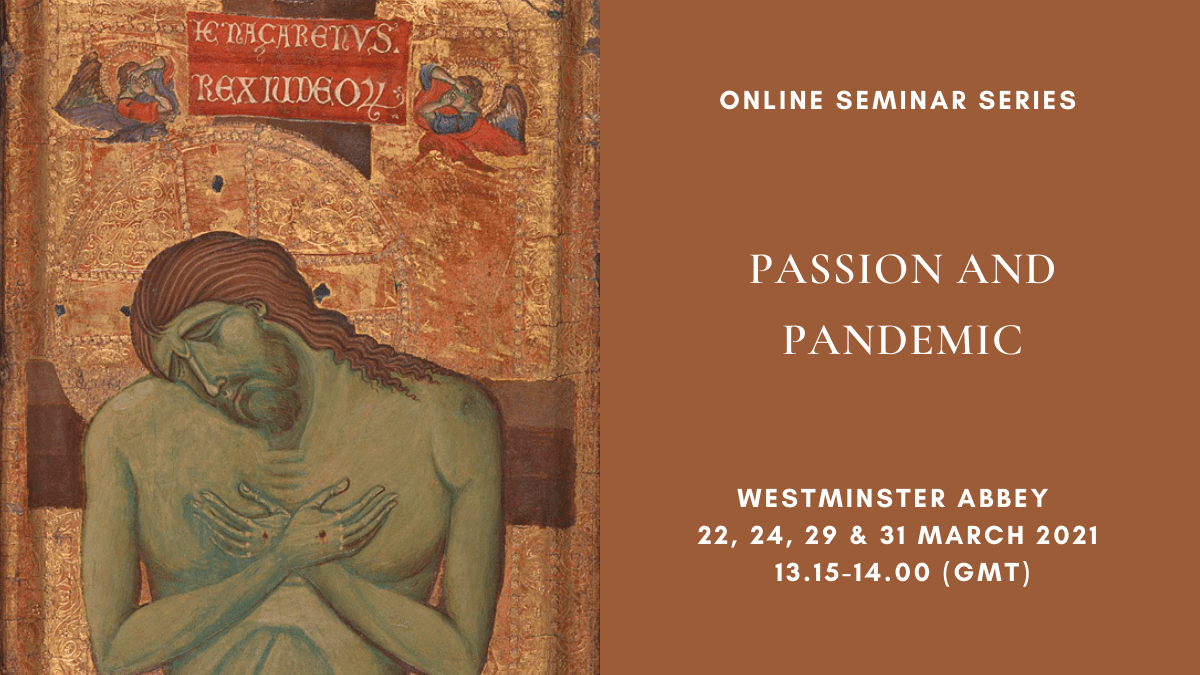
Online Seminar Series: Passion and Pandemic, 22, 24, 29, 31 March 2021, 13.15-14.00 (GMT)

Westminster Abbey presents a specially-curated series of contemplative lunchtime seminars for Passiontide and Holy Week. At each seminar, a different art historian and theologian will focus on pictures from the National Gallery’s collection and explore themes of salvation, frailty, isolation, and sickness.

In the first seminar (22 March), Professor Joanna Cannon (Courtauld Institute) and the Reverend Dr Jamie Hawkey (Westminster Abbey and Clare College, Cambridge) will introduce a diptych of the Virgin and Child and Man of Sorrows by the artist known as The Master of the Borgo Crucifix. Registration for this seminar closes at 4:00pm on Wednesday 17th March.

On the 24 March, Professor Alison Wright (UCL) and the Reverend Dr Ayla Lepine (King’s College, Cambridge) will introduce Antonio and Piero del Pollaiuolo’s Martyrdom of St Sebastian.  Registration closes at 4:00pm on Monday 22nd March.

On the 29th March, Dr Jennifer Sliwka and Professor Ben Quash (KCL) will introduce Andrea Mantegna’s Agony in the Garden. Registration closes at 4:00pm on Wednesday 24th March.

In the final seminar (31 March), Dr Greg Bryda (Barnard College, Columbia University) and Dr Rowan Williams (former Archbishop of Canterbury) will explore the Isenheim Altarpiece. Registration closes at 4:00pm on Monday 29th March.

To register, please visit the Westminster Abbey website. After initial broadcast, all seminars in this series will be available to watch on the Abbey’s YouTube channel.

Online Lecture: Ravenna: Crucible of Europe, Tuesday, 16 March 2021, 5:30pm GMT

Join the Centre for Medieval Studies (University of York) for a lecture by Professor Judith Herrin (Professor Emerita, King’s College London). Dr. Herrin will explore the role of Ravenna, imperial capital from AD 402, until its fall to the Lombards in 751, as a catalyst in the development of what we can now identify as European features. Gothic rulers, imperial governors from Constantinople and local bishops all contributed elements to its particular culture, which drew on the integration of Germanic and Roman traditions within a Christian framework. Under the influence of Byzantium, diffused through Ravenna, ideals of efficient government sanctioned by law, policies of acculturation and religious toleration were embedded in the early medieval West. While Charlemagne was later hailed as the father of Europe, this novel identity had first taken form in Ravenna.

Please register in advance for this lecture here.

The York Medieval Lecture is co-sponsored by the Centre for Medieval Studies at York, the Department of History of Art at York, the Centre for Medieval Studies at Fordham, the Henri Pirenne Institute for Medieval Studies at Ghent and the Centre for Medieval Literature (Southern Denmark and York).

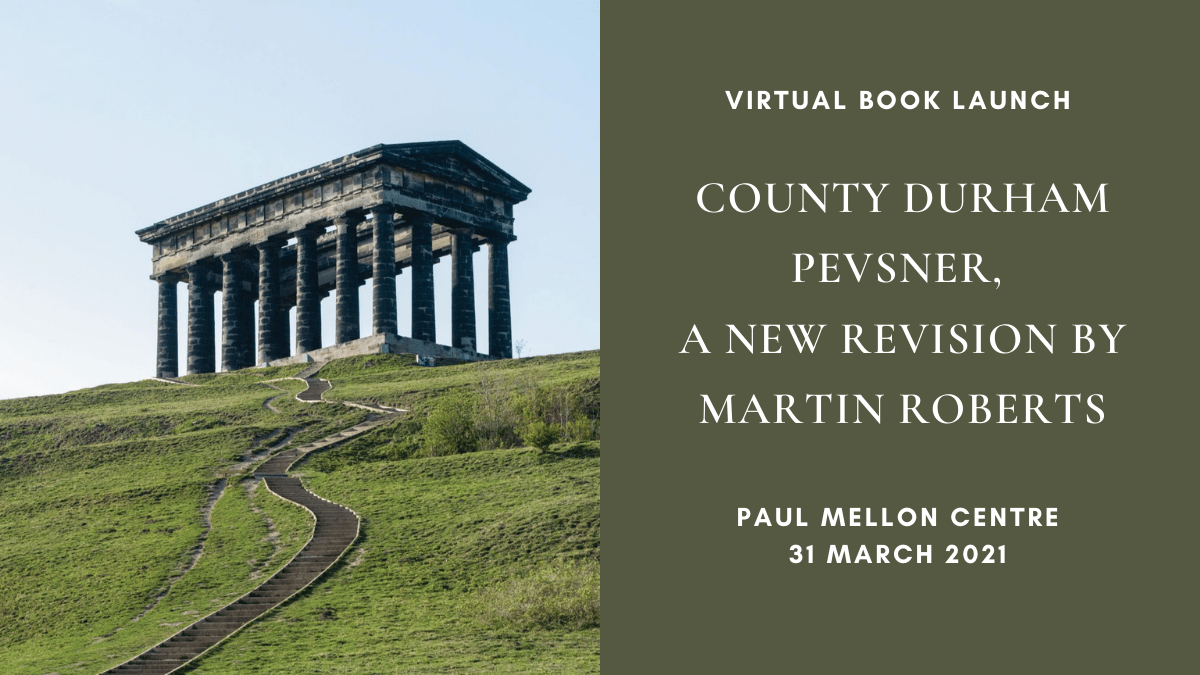
Virtual Book Launch: County Durham Pevsner, a new revision by Martin Roberts, 31 March 2021

The Paul Mellon Centre at Yale University present an online launch of Martin Roberts’ new revision of the County Durham volume of the Pevsner Architectural Guides. The event will take place on 31st March 2021, 6-7.30pm, via Zoom.

The author will discuss the project in conversation with Simon Bradley, joint editor of the Pevsner Architectural Guides, exploring the challenges of adapting and expanding Nikolaus Pevsner’s original text of 1953 and its interim revision of 1983. The new edition incorporates fresh insights from many fields of scholarship, especially the crucial Anglo-Saxon and Romanesque periods, and the revaluation of many of the county’s castles and fortified houses. Wider themes include questions of regional identity, the legacies of post-war planning and post-industrial change, and the challenges and adventures of fieldwork for a book that aims to embrace, in Pevsner’s words, ‘all ecclesiastical, public and domestic buildings of interest’ in this diverse and historically rewarding county.

To book tickets, and for more information, please visit the Paul Mellon Centre website.

County Durham can be purchased at Yale Books.

About the speakers

  • Martin Roberts was born in Chester but has lived in the North East for over fifty years. A qualified architect, he worked as Conservation Officer for Durham City Council for many years, later becoming a Historic Buildings Inspector with English Heritage. A keen interest in the region’s vernacular buildings led him to establish the North East Vernacular Architecture Group in 1991. He also initiated the restoration of Old Durham Gardens, and has written books on the buildings of Durham city (1994) and its university (2013).
  • Simon Bradley is joint editor of the Pevsner Architectural Guides, and author or co-author of four volumes in the Buildings of England county series. Born in the North East, he first encountered the Pevsner guides when exploring the buildings of Northumberland and Durham as a teenager.