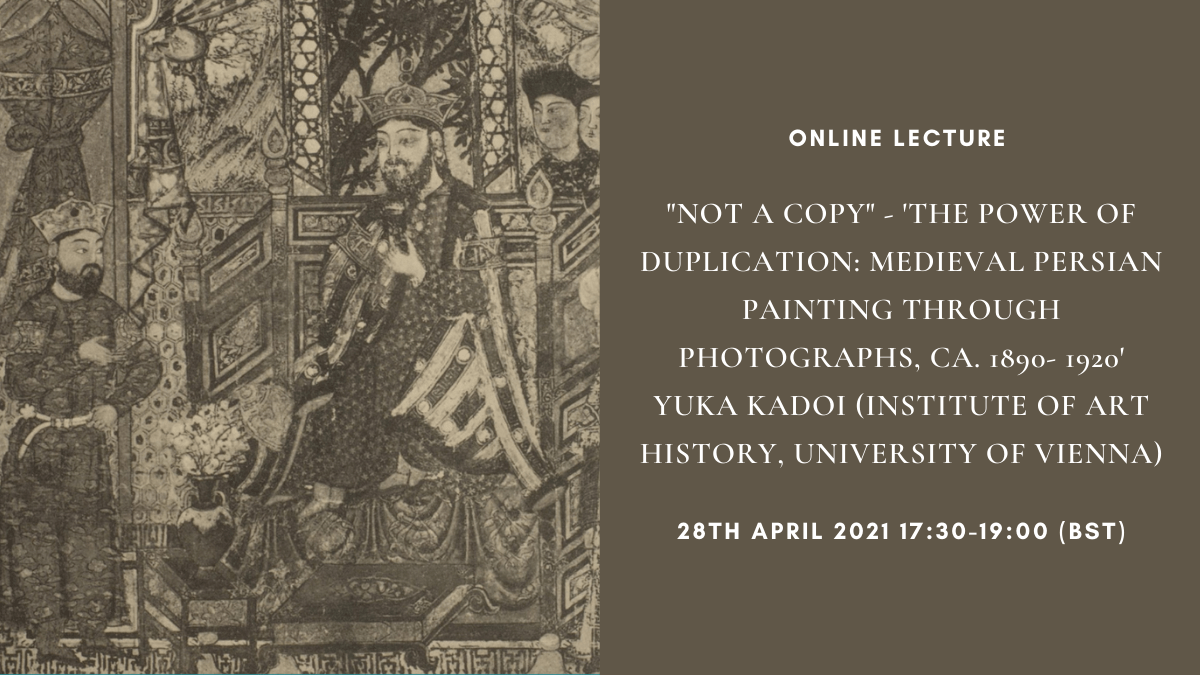
During the formative period of Persian art history in the late nineteenth and early twentieth centuries, photographic reproductions played a key role in the construction process of chronological and iconographical narratives. This paper explores an alternative history of medieval Persian painting by looking at the production and distribution of photographic reproductions. Often commissioned by dealers, such visual materials were widely circulated and distributed across collectors and scholars for identification, authentication and comparative research purposes. While the power of photographic reproductions in the early scholarship and connoisseurship of European art history is widely acknowledged, this should also be the case with non-European art history, including Persian art history, a topic which this paper wishes to address.
This annual lecture series is organised by the international research project Bilderfahrzeuge: Aby Warburg’s Legacy and the Future of Iconology. Entitled “Not A Copy,” this year’s series seeks to discuss the advent of new forms of visual expression in response to preceding artefacts and following from an interplay with their materiality and mediality. Humanities tend to reduce these dynamics to a dichotomy of a supposed ‘original’ and its ‘copy’. By doing so, the productive quality of transformation is often overlooked, whereas terms such as imitation, emulation, repetition, transmission, translation or recording are in continuous need of critical re-evaluation.
To book your tickets, click here.
Online Conference: Textiles and the Revelation of the Sacred, Université Paris 1 Panthéon-Sorbonne and EHESS-CRH, 6th-7th May 2021
Be they part of the composition of an image or gathered around the altar, textiles, as pliable and movable material, played a crucial part in the revelation of the invisible. Since the middle of the thirteenth century, the Real presence of Christ in the Eucharist became physically exalted and devotional images flourished in churches and in domestic interiors. It led to a genuine visual appetence, an intense desire to see the sacred. The image itself, powerful instrument of mediation between the visible and the invisible, is often compared to a veil, as it is able to suggest the presence or the absence of what is represented.
As garments, textiles adorned and transformed bodies. As dossals, they were the backdrop for adoration. As veils, they delineated the frontier between the human and the divine. As lifted curtains, they participated in a visual theophany and emphasized a supranatural presence. By this workshop, we want to explore the roles of textiles – be they real, fictional, material, painted or feigned – in the manifestation of the sacred, understood in its broadest sense, beyond the strictly religious sphere. Their diverse forms, their multiple functions and their metaphorical potential will be the core of our reflections.
How were textiles seen in a liturgical or devotional context ? What were their roles in the figured or sacramental revelation of the divine ?
To register for this event, please follow this link. After registration, an email will be sent to attendees with more information on how to access the video conference.
Contact: textiles.rituelimage@gmail.com
PROGRAMME
6th May 2021
9h00: Accueil et présentation des journées – Juliette Brack, Julie Glodt, Nicolas Sarzeaud
9h30: Conférence inaugurale – Paul Hills (Courtauld Institute of Art)
Textiles and Touch: Depicting the Sacred
10h10: Discussion et pause
Session 1 : Dévoilement et monstration – Unveiling and Exhibiting
Présidence de séance : Alain Rauwel
10h30: Hector Ruiz Soto (Sorbonne Université)
Le retable-machine à l’espagnole : le dévoilement comme fabrique d’images de culte au XVIIe siècle
11h00: Julie Glodt (Université Paris 1 Panthéon-Sorbonne)
Cercle blanc sur fond noir. Le rideau de l’élévation et la visibilité de l’hostie (XIVe-XVIe siècles)
11h30: Nicolas Sarzeaud (EHESS)
On n’en montre jamais trop, jamais assez : exposer les linges du Christ dans la liturgie, le théâtre religieux et les images à la fin du Moyen Âge
12h00: Discussion
12h30: Pause
Session 2 : Images et ornements – Images and Ornaments
Présidence de séance : Astrid Castres
14h00: Helen Wyld (National Museums Scotland)
Flesh and Blood: The Fetternear Banner
14h30: Laurent Hablot (EPHE)
Les enseignes vexillaires militaires et le sacré au Moyen Âge
15h00: Discussion et pause
16h00: Evelin Wetter (Abegg-Stiftung, Riggisberg)
Liturgical Visualization and Devotion: Textile Strategies of Pictorial Corporal Cases
16h30: Juliette Calvarin, (Harvard University, Cambridge)
Umbral : L’amict et l’Annonciation au Moyen Âge tardif
17h00: Ralph Dekoninck et Caroline Heering (Université catholique de Louvain)
L’ornementalisation des Ornamenta Sacra dans les anciens Pays-Bas des XVIIe et XVIIIe siècles
17h30: Discussion
7th May 2021
9h15: Accueil
Session 3 : Vêture et performance – Clothing and Performance
Présidence de séance : Maximilien Durand et Marlène Albert-Llorca
9h30: Diana Pereira (University of Porto, CITCEM)
Layered in secrecy and ritual: miraculous sculptures of the Virgin and the clothing of statues in Early Modern Portugal
10h00: Valeria E. Genovese (chercheuse indépendante, Naples)
Statues habillées : corps vivants ou nouvelles icônes ?
10h30: Discussion et pause
11h30: Laura Stefanescu (University of Sheffield)
Habiller les anges dans la Florence du XVe siècle : Des costumes pour le théâtre aux choix iconographiques
12h00: Rembrandt Duits (Warburg Institute, University of London)
Framed in Fabric. Liturgy in the Private Chapel of the Medici
12h30: Discussion
13h00: Pause
Session 4 : Révéler et honorer – Revealing and Glorifying
Présidence de séance : Ralph Dekoninck
14h30: Lisa Monnas (chercheuse indépendante, Londres)
The Virgin’s veil in Tuscan Painting, 1250-1400
15h00: Victor Schmidt (University of Utrecht)
Curtains sculpted and depicted: the case of the Chapel of the Cardinal of Portugal, San Miniato al Monte, Florence
15h30: Discussion et pause
16h30: Juliette Brack (Université Paris 1 Panthéon-Sorbonne)
Le dais marial dans le retable florentin : liturgie et ecclésiologie (XVe-XVIe siècles)
17h00: Valentine Langlais (Université Paul Valéry, Montpellier 3)
Révélation et glorification du Saint-Sacrement : de l’usage du rideau dans l’iconographie flamande de la Cène (XVIe-XVIIe siècles)
17h30: Discussion
18h00: Échanges finaux et conclusion des journées
—
Responsables scientifiques : Philippe Morel (Université Paris 1 Panthéon-Sorbonne, HiCSA-CHAR), Philippe Plagnieux (Université Paris 1 Panthéon-Sorbonne, HiCSA), Alain Rauwel (Université de Bourgogne, CéSOR), Étienne Anheim (EHESS-CRH, Ahloma)
Online Lecture: Water Blood and Wine – Iconography of the Old Testament on Medieval Portable Altars, Sarah Luginbill, University of Colorado Boulder, April 22nd 2021 4pm PST/7pm EST
Sponsored by the Society for Ancient Mediterranean Religions, Sarah Luginbill will deliver a lecture online from the University of Colorado Boulder on the iconography of the Old Testament on medieval portable altars. They will present their dissertation research on iconography of Abraham, Abel and Melchisedech that feature on the lids of several portable altars made in German lands c.1000-1250 CE.
For more information on Luginbill’s research on medieval portable altars, please click here.
To see updates on how to access tomorrow’s Zoom, head to Luginbill’s twitter account (@salu1292) or Society for Ancient Mediterranean Religions website for updates.
New Journal Issue: IKON – Afterlife of Antiquity, Volume 30, 2020
The 2020 issue of IKON journal is available online via Brepols. Click here to read.
Table of Contents:
Foreword
Claudia Cieri Via
Aby Warburg and the Afterlife of Antiquity
Morphology and History
Han Lamers
Afterlife of Antiquity: Historical Maenderings
Katia Mazzucco
Nachlebende, Nachleben
Vehicles of Afterlife in (Some) Images and Words of the Warburg Library
Rebeka Vidrih
Triple Martyrdom at Notre Dame de Mouzon
Doron Bauer
Reused Roman Sarcophagi and the Emergence of Romanesque Sculpture in Northern Spain
Romana Rupiewicz
The Motion of Celestial Bodies in Medieval Iconography. Christian Assimilation of Ancient Cosmology
Fabio Tononi
Andrea Mantegna and the Iconography of Mourners. Aby Warburgs Notion of Pathosformeln and the Theory of Aesthetic Response
Barbara Baert
Afterlife Studies and the Occasio Grisaille in Mantua (School of Mantegna, 1495-1510)
Mauro Salis
When did Amphitrite Cross the Tyrrhenian Sea? Some Reflections on the Appearance of Grisaille, Myth and the Classical Renaissance Style in the Periphery of the Crown of Aragon
Stephanie Heremans
Fritz Saxl as Reader of Aby Warburgs Sassetti Essay
Simona Drăgan
Ancient Survivals, Ingenious Meanings. Iconographic Echoes and Symbols of Dantes Iphigenia in the Sienese Art of the Early Renaissance
Thodoris Koutsogiannis
Ancient Greek Figures in Renaissance Germany via Italy. Cyriacus of Anconas Drawings and Their Distorted Perception
Giacomo Montanari
Da Ciriaco a Sandro. Modelli culturali e figurativi dellAntica Grecia dai viaggi del Pizzecolli ai dipinti di Botticelli
Alessandra Galizzi Kroegel
From War Hero to Slave to Love. On the Reception of Achilles on Scyros in the Renaissance
Giuseppe Capriotti – Francesca Casamassima
Hermaphroditus and Iphis. Texts and Images from two Ovidian Myths to Visualize Sexual Ambiguity in the Early Modern Age
Lasse Hodne
The Afterlife of Greece. Warburgs Nietzschean Critique of Winckelmann
Laura Stagno
Roman History Themes for Andrea Dorias Palazzo del Principe
Filipa Araújo
Love is a fire that burns unseen. The Reception of Greek Erotic Representations in Alciatos Emblemata and Camoes
Jasenka Gudelj
Resemiotization of Eastern Adriatic Antiquities. Uses and Abuses of the Ancient Past
Antun Baće – Maja Zeman
Ancient Water-God in the Residences of Early Modern Dubrovnik
Agnieszka Skrodzka
Antique Inspirations in the Ideological Programmes of Artworks of King Stanisaw Augusts Patronage (1764-1795)
Ylva Haidenthaller
Adapting Antiquity. References to Classical Literature on Early Modern Swedish Medals
Irena Kraševac
Classical Themes as Iconographic Motifs in Historical Allegorical Painting. Examples by Gustav Klimt in the Rijeka Municipal Theatre and Ivan Tiov at the University Library in Zagreb
Palma Karković Takalić
Maritime Parnassus and the Iconographic Program of the Main Faade of the Municipal Theatre of Rijeka
Claudio Zambianchi
Lost and Found: Archaeological Fragments and Contemporary Art
Rita Ladogana – Ciro Parodo – Marco Giuman
“The Infallible Sign of the Destiny”. Reflections on the Iconography of the Myth of the Foundation of Rome in the Art of the Fascist Era
Roberta Minnucci
Heaps of Rags and Double Visions. The Interpretation of the Classical Venus in Arte Povera
Anthi-Danaé Spathoni
Idyllic, Pastoral and Abstract. Cy Twomblys Reinvented Arcadia
Karen von Veh
Classical Mythology as Satire. The Realities of a New South Africa in Diane Victors Birth of a Nation Series
Jarosław Janowski
Existence and Transience. The Ancient Idea of Number in Conceptual Art
Online Lecture: Representing the Other-Assessing Indo-Byzantine Through Textual Sources, Aniket T. Chettri (North Bengal University), April 23rd 2021,6pm (Istanbul Time Zone)
This lecture is part of the Byzantium at Ankara April Mini-Seminar Series entitled “Byzantium and the Silk Roads.
The Byzantine Seminar Series “Byzantium at Ankara” is an event organized and hosted in collaboration by the Department of History at Bilkent University and the Department of History of Art at Hacettepe University which will be held over the entire 2020/21 academic year. It is organized by Assoc. Prof. Dr. Sercan Yandim (Hacettepe University) and Asst. Prof. Dr. Luca Zavagno (Bilkent University).
The object of the series of talks is to engage Byzantine scholars from different backgrounds and areas of expertise in a conversation on issues which relate and resonate with the current socio-political and economic situation. The importance of building these connections should put Byzantium in a global, modern and historical perspective.
All the sessions will be broadcasted via Zoom. Pre-registration at byzantiumatankara@hotmail.com is required. A link to attend the seminar will be sent one hour before the start of the meeting.
For more information, please click here.
Podcast Episode: Les Enluminures, Christine de Pizan’s Workshop with Inès Villela-Petit
Les Enluminures have released the 14th episode of their podcast, available online via this link.
Who is Christine de Pizan? Most know of her as a prolific medieval author, or at least know that she found a seat at Judy Chicago’s table. But how did she work and procure materials? Who worked for her and with her? How did she select her illuminators? Did she deal directly with the Queen? Find out with author and art historian Inès Villela-Petit and our host Sandra Hindman as they discuss the discoveries produced by Villela-Petit’s monograph on Christine de Pizan’s workshop, L’atelier de Christine de Pizan.
They uncover the material processes behind the scenes of Christinian creation, the social dynamics of the atelier and Christine’s relationship with the royal court. Through author’s drafts, pigment and parchment, traces and marks on the page, and the “stories” told in Christinian painting Inès Villela-Petit places Christine de Pizan’s workshop in its material context. Today Sandra Hindman and Inès Villela-Petit explore International Gothic society, discussing Villela-Petit’s realization of an “ideal” Christinian manuscript–– from the purchase of the raw materials through the delivery of the manuscript to the Queen.
Online Conference: Paper Religion: Affordances and Uses in Christian Practices 1400 – 1800, Rijksuniversiteit Groningen, May 27th–29th 2021
An international interdisciplinary scholarly symposium on the medium of paper, its affordances, and uses during a period of transition in early modern Christianity. Speakers bring into conversation different religious groups sharing a common dependency on paper for the distribution of new visual and textual cultures: from prints to drawings, from emblem books to sacred music.
The symposium will be held online and registration is free.
For the program, registration and other queries you can send an e-mail to paperreligion2021@gmail.com.
Program
27th of May
Keynote Speaker
David Morgan (Duke University) – Aura on Paper: Protestant Visual Piety in 19th-century United States.
First Panel
Orietta Da Rold (University of Cambridge) – The use of paper in clerical circles.
Daniel Bellingradt (Friedrich-Alexander-Universität Erlangen-Nürnberg) – The Paper Trade and Early Modern Paper Religions: On the hidden material flows of religious communication.
Megan Williams (Rijksuniversiteit Groningen) – TBA.
28th of May
Second Panel
Andrew Pettegree (University of St. Andrews) – Religious Publishing and the salvation of print. Interrogating the Universal Short Title Catalogue.
Arthur der Weduwen (University of St. Andrews) – Religion and the Periphery of Print. The emergence and viability of the print trade in Scandinavia and Eastern Europe.
Sabrina Corbellini (Rijksuniversiteit Groningen) – Reading religious texts in an age of transition: reading materials and reading techniques.
Third panel
Erin Giffin (Ludwig-Maximilians-Universität München) – Folding Visions of Faith into the Cult of Loreto through Print.
Nelleke Moser (Vrije Universiteit Amsterdam) – Paper, ink and the word of God: the disposal and repurposing of religious texts in 18th-century Dutch trompe-l’oeil books.
Mario Aschauer (Sam Houston State University) – Paper, Pen, and Pencil: Materiality in Sacred Works by German Composers around 1800.
29th of May
Fourth Panel
Benedetta Spadaccini (Veneranda Biblioteca Ambrosiana) – Federico Borromeo and His Collection of Prints.
Hubert Meeus (Universiteit Antwerpen) – Printers and artists as messengers of the Church.
Walter S. Melion (Emory University) – The Heart on Paper: Materiality and Artisanship in the Paradisus precum selectarum (1610) of the Cistercian Sub-Prior Martin Boschman.
Respondent – Ann-Sophie Lehman (Rijksuniversiteit Groningen)
Online Lecture: Painting Pairs: Collaborative Research in Conservation and Art History, Courtauld Institute of Art, Thursday 22 April 2021 2:00 pm – 4:00 pm (BST)
Painting Pairs presents collaborative research undertaken by graduates in conservation and art history focussing on paintings currently in the conservation studios at the Courtauld. The paintings that form the focus for investigation by each a pair of graduates are from different periods and pose a range of questions related to their history, conservation and display.
At the first Zoom webinar presentation on April 22nd the pairs will introduce their paintings and present the key questions that will be the subject of their research. The results of their investigations will be presented in May 2021. This program provides a unique opportunity for collaboration between conservators and art historians in object based art historical research.
Speakers
- Melissa Barton – The Courtauld
- Sarah Besson – The Courtauld
- Alice Copley – The Courtauld
- Charlie Spragg – The Courtauld
- Katherine George – The Courtauld
- Megan Levet – The Courtauld
- Christopher Lillywhite – The Courtauld
- Malina Mihalache – The Courtauld
- Alice Sherwood – The Courtauld
- Samantha Siegler – The Courtauld
Organised by
- Professor Aviva Burnstock – Professor of Conservation, The Courtauld
- Dr Pia Gottschaller – Senior Lecturer, Conservation, The Courtauld
- Dr Karen Serres – Curator of Paintings, The Courtauld Gallery
This is a live online event.
Please register for more details. The platform and log in details will be sent to attendees at least 48 hours before the event. Please note that registration closes 30 minutes before the event start time.
If you have not received the log in details or have any further queries, please contact researchforum@courtauld.ac.uk.
2020-21 Participants
Charlie Spragg (MA Architecture of Empire) with Melissa Barton (Conservation)
Portrait of Sir Ralph Bosville
Samantha Siegler (MA Documentary Reborn) with Sarah Besson (Conservation)
Portrait of Sir Henry Strachey and his daughter Charlotte by Daniel Gardner
Katherine George (MA Curating) with Alice Sherwood (Conservation)
Portrait of a Lady with children (unknown artist)
Malina Mihalache (MA Russian Art) with Alice Copley (Conversation)
Rite of Spring by Ethel Walker
Christopher Lillywhite (MA Continuity and Innovation) with Megan Levet (Conservation)
Noli me tangere by Ambrose McEvoy
New Publication: The Subject of Crusade: Lyric, Romance and Materials,1150 to 1500, by Marisa Galvez
In the Middle Ages, religious crusaders took up arms, prayed, bade farewell to their families, and marched off to fight in holy wars. These Christian soldiers also created accounts of their lives in lyric poetry, putting words to the experience of personal sacrifice and the pious struggle associated with holy war. The crusaders affirmed their commitment to fighting to claim a distant land while revealing their feelings as they left behind their loved ones, homes, and earthly duties. Their poems and related visual works offer us insight into the crusaders’ lives and values at the boundaries of earthly and spiritual duties, body and soul, holy devotion and courtly love.
In The Subject of Crusade, Marisa Galvez offers a nuanced view of holy war and crusade poetry, reading these lyric works within a wider conversation with religion and culture. Arguing for an interdisciplinary treatment of crusade lyric, she shows how such poems are crucial for understanding the crusades as a complex cultural and historical phenomenon. Placing them in conversation with chronicles, knightly handbooks, artworks, and confessional and pastoral texts, she identifies a particular “crusade idiom” that emerged out of the conflict between pious and earthly duties. Galvez fashions an expanded understanding of the creative works made by crusaders to reveal their experiences, desires, ideologies, and reasons for taking up the cross.
Contents:
Introduction The Courtly Crusade Idiom
Chapter One The Unrepentant Crusader: The Figure of the Separated Heart
Chapter Two Idiomatic Movement and Separation in Middle High German and Occitan Crusade Departure Lyric
Chapter Three The Heart as Witness: Lyric and Romance
Chapter Four Lancelot as Unrepentant Crusader in the Perlesvaus
Chapter Five Three Ways of Describing a Crusader-Poet: Adjacency, Genre-Existence, and Performative Reconfigurations
Chapter Six The Feast of the Pheasant as Courtly Crusade Idiom
Conclusion Toward a More Complex View of Crusade
Reviews:
Suzanne Conklin Akbari, Institute for Advanced Study, Princeton“This is a bold study that places literary forms, especially lyric and romance, into conversation with material culture to provide an account of ‘speaking crusade’: that is, the ways in which an ‘idiom’ was produced that communicates the ‘crusader subject,’ whether through poetics or the tangible form of the exotic sword, enigmatic inscription, or elaborate feast. Galvez moves smoothly across genres, as well as between theoretical framework and historical context, to produce a provocative book in which a body of literature conventionally read in terms of pilgrimage and inward penitence is instead placed in dialogue with the imagined—and real—frontiers of religious war.”
Niklaus Largier, University of California, Berkeley“Leaving us with the impression that we never really read and thought with most of the voices that emerged from the experience of the Crusades, Galvez presents an entirely new and astoundingly rich picture of lyric texts and their ethical engagements. What she calls a descriptive historical poetics is much more than that. In an exemplary fashion, and theoretically inspiring throughout, she demonstrates how sophisticated close readings bring back to life a complex range of ethical, affective, and cultural challenges, reflected in Crusader texts and materials that in their force of articulation come to resist simple ideological appropriation. Exemplary, that is, in drawing attention to the fact that only in this reconstruction of particular voices in the contexts and intricacies of their articulation we discover the possibilities of thoughts and feelings that specific historical moments bring to bear.”
New Publication: Machines of the Mind: Personification in Medieval Literature, by Katharine Breen
In Machines of the Mind, Katharine Breen proposes that medieval personifications should be understood neither as failed novelistic characters nor as instruments of heavy-handed didacticism. She argues that personifications are instead powerful tools for thought that help us to remember andmanipulate complex ideas, testing them against existing moral and political paradigms. Specifically, different types of medieval personification should be seen as corresponding to positions in the rich and nuanced medieval debate over universals. Breen identifies three different types of personification—Platonic, Aristotelian, and Prudentian—that gave medieval writers a surprisingly varied spectrum with which to paint their characters.
Through a series of new readings of major authors and works, from Plato to Piers Plowman, Breen illuminates how medieval personifications embody the full range of positions between philosophical realism and nominalism, varying according to the convictions of individual authors and the purposes of individual works. Recalling Gregory the Great’s reference to machinae mentis (machines of the mind), Breen demonstrates that medieval writers applied personification with utility and subtlety, employing methods of personification as tools that serve different functions. Machines of the Mind offers insight for medievalists working at the crossroads of religion, philosophy, and literature, as well as for scholars interested in literary character-building and gendered relationships among characters, readers, and texts beyond the Middle Ages.
Part I Prudentian Personification
Chapter 1 Consecratus Manu: Men Forming Gods Forming Men
Chapter 2 How to Fight like a Girl: Christianizing Personification in the Psychomachia
Part II Neoplatonic Personification
Chapter 3 Ex Uno Omnia: Plato’s Forms and Daemons
Chapter 4 Oh, Nurse! The Boethian Daemon
Part III Aristotelian Personification
Chapter 5 E Pluribus Unum: Abstracting Universals from Particulars
Chapter 6 Dreaming of Aristotle in the Songe d’Enfer and Winner and Waster
Chapter 7 A Good Body Is Hard to Find: Putting Personification through Its Paces in Piers Plowman
Review: Fiona Somerset, author of Feeling like Saints: Lollard Writings after Wyclif:
“Machines of the Mind persuades its readers to think more systematically about the types and uses of personification. Breen clears away some forty years of confusion about medieval philosophical positions on realism and so-called nominalism, clearly differentiating them from the postmodern nominalism of twentieth-century high theory and imaginatively reconsidering their implications for literary representation. Her schema will allow future scholars to differentiate Platonic, Neoplatonic, moderate realist, and nominalist strategies for personification while also recognizing that many medieval works may employ multiple types at once. This book will remain a reference point for many years to come.”