“ […] and that Giotto changed the profession of painting from Greek back into Latin, and brought it up to date.” Cennino Cennini, The Craftsman’s Handbook, Chapter I These words by the Italian artist Cennino Cennini, written just before the end of the fourteenth century, seem to testify to the definitive break between the Byzantine and theContinue reading “Exploring the Fourteenth Century Across the Eastern and Western Christian World (Leeds 2016 session)”
Category Archives: News
CfP: The Goldene Tafel from Lüneburg in context: Investigations on technology, shape and significance of altarpieces in northern Europe around 1400 (Hanover, 7-9 April 2016)
One of the highlights of Hanover’s Landesgalerie is the so-called Goldene Tafel, which once adorned the high altar of the Benedictine Abbey S. Michaelis in Lüneburg. Four wings house an extensive sculptural programme and valuable paintings which constitute important examples of the International Gothic around 1400. The shrine – unfortunately not preserved – is knownContinue reading “CfP: The Goldene Tafel from Lüneburg in context: Investigations on technology, shape and significance of altarpieces in northern Europe around 1400 (Hanover, 7-9 April 2016)”
Guiding the Mind of the Beholder – The Materiality of the Medieval Text as Determinant of its Meaning and Use (Leeds 2016 session)
International Medieval Congress 2016 University of Leeds, 4–7 July 2016 Call for Papers Guiding the Mind of the Beholder – The Materiality of the Medieval Text as Determinant of its Meaning and Use How we perceive and use a text is influenced by the way it is visualized and how it is intentionally or unintentionallyContinue reading “Guiding the Mind of the Beholder – The Materiality of the Medieval Text as Determinant of its Meaning and Use (Leeds 2016 session)”
Leeds 2016: Gender at the Feast (Hortulus sponsored session)
Call For Papers, International Medieval Congress at Leeds, 2016 Hortulus-sponsored session Gender at the Feast The roles of women and of gender in the Middle Ages have received particular attention in recent years with invigorating studies across multiple disciplines. Medieval women, such as Margery Kempe or Christina of Markyate, have been brought to the forefrontContinue reading “Leeds 2016: Gender at the Feast (Hortulus sponsored session)”
The Challenges and Opportunities of Medieval Difficulty (Kalamazoo 2016 session)
Session at International Congress on Medieval Studies (Kalamazoo, 12-15 May 2016) University of Western Michigan, Kalamazoo, May 12 – 15, 2016 Organizer: Beth Williamson, University of Bristol Deadline: Sep 15, 2015 “What is sought with more difficulty is discovered with more pleasure.” (On Christian Doctrine 2.6.8). In praising difficulty, Augustine reminds us of its roleContinue reading “The Challenges and Opportunities of Medieval Difficulty (Kalamazoo 2016 session)”
Spectacular Songs and Private Performances: Images in Musical Books (Kalamazoo 2016 session)
51st International Congress on Medieval Studies May 12-15, 2016 Western Michigan University Kalamazoo, MI DEADLINE: September 15, 2015 A wide variety of medieval manuscripts contain visual imagery that coexists with texts originally intended for oral or musical performance. From sacred Latin missals and choirbooks to the vernacular songbooks of the later Middle Ages, the interplay betweenContinue reading “Spectacular Songs and Private Performances: Images in Musical Books (Kalamazoo 2016 session)”
CFP: Speaking Sculpture: Images and Their Potency (ICM Kalamazoo 2016), deadline 15 September 2015
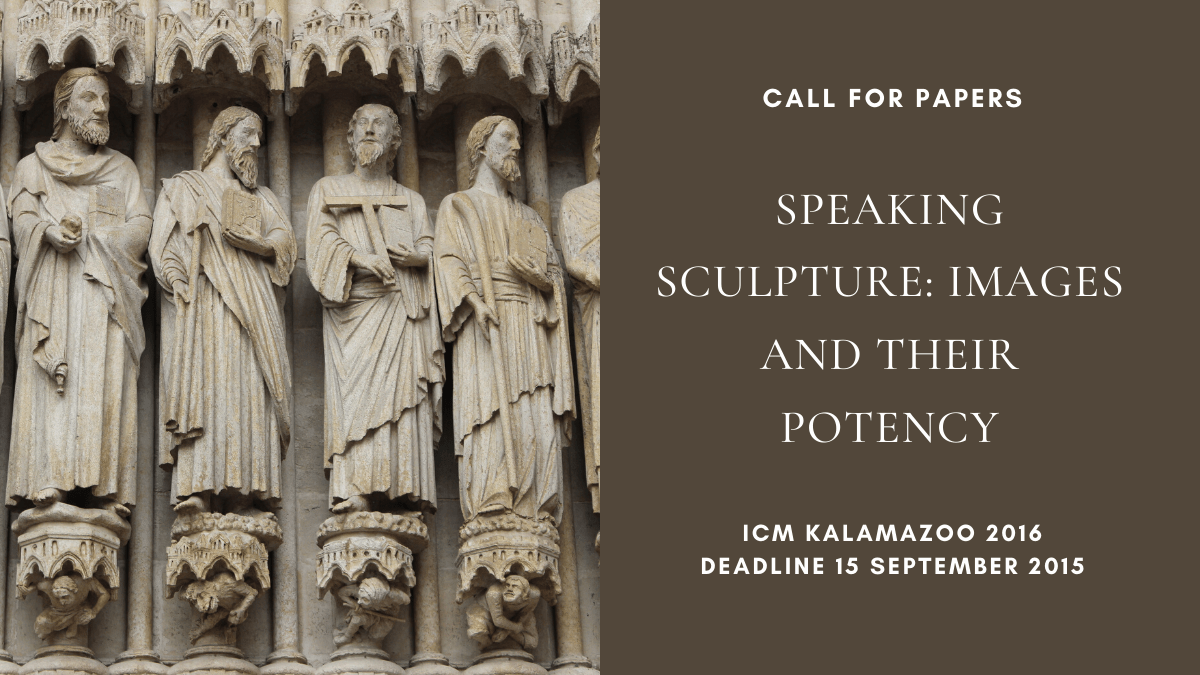
Do sculptures speak? Can they listen? Are they able to read, sing, and engage with other sculptures, or the architecture of their surroundings? If so, is this connected to their context and placement? How do these questions affect the way in which we view sculpture and its performativity?
Kalamazoo 2016: Gendered Spaces (sponsored by Hortulus)
CFP, ICMS (“Kalamazoo”) 2016: Gendered Spaces Hortulus-sponsored session Session organizer and presider: Melissa Ridley Elmes, co-editor of Hortulus The concept of gendered spaces—areas in which particular genders and types of gender expression are considered welcome or appropriate while other gender types are unwelcome or inappropriate—is a key element in the study of human geography. GenderingContinue reading “Kalamazoo 2016: Gendered Spaces (sponsored by Hortulus)”
Leeds 2015 Art History session: Grisaille, Shades of Meaning in Late Medieval Manuscripts
Session: 1702 Grisaille: Shades of Meaning in Late Medieval Manuscripts Thursday 9 July 2015: 14.15-15.45 Organiser Sophia Rochmes (Department of History of Art & Architecture, University of California, Santa Barbara) and Anna Russakoff (American University of Paris) Moderator/Chair Anna Russakoff, American University of Paris Grisaille, or imagery in monochrome tones of grey, proliferated in late-medievalContinue reading “Leeds 2015 Art History session: Grisaille, Shades of Meaning in Late Medieval Manuscripts”
Chiaroscuro as Aesthetic Principle, 1300-1600 (Bern, 29-30 April 2016)
Chiaroscuro since Leon Battista Alberti’s De pictura (1435) has been one of the central subjects characterising painting and sculpture in practice and theory in Italy. Primarily, it concerns the articulation of plastic qualities, the formulation of relief, both in painting and sculpture. In the northern tradition, too, chiaroscuro has been highly valued. Through chiaroscuro, the textures of materials and the structuralContinue reading “Chiaroscuro as Aesthetic Principle, 1300-1600 (Bern, 29-30 April 2016)”
 Medieval Art Research