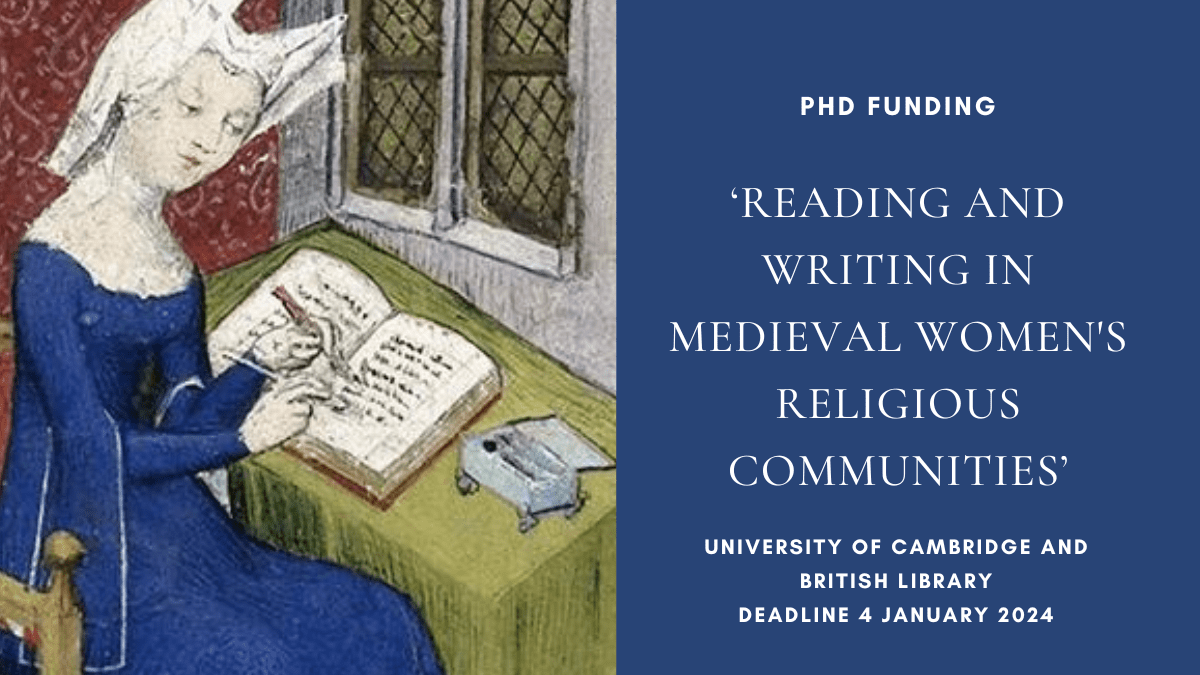
Essay Prize: Reginald Taylor and Lord Fletcher Essay Prize, British Archaeological Association, deadline 1 December 2023

Reginald Taylor was an active member of the British Archaeological Association for many years and acted as the Association’s secretary from 1924 until his death in 1932. With the agreement of his sister, Miss S. May Taylor, it was decided to use the monies he bequeathed the Association to found an essay prize in his memory. In 1996 a further decision was taken to combine this with a second legacy, one which had been left to the Association by Eric George Molyneaux Fletcher, Lord Fletcher, who died in 1990.

The Reginald Taylor and Lord Fletcher Essay Prize is a competitive award conferred biennially in recognition of an outstanding paper and consists of a bronze medal and cheque for £500. The paper should normally be no longer than 8,000 words (not including footnotes), be of high academic and literary quality and embody original and rigorous research. It should be appropriately footnoted. Essays should relate to the Association’s areas of interest, which are defined as the study of archaeology, art and architecture from the Roman period to the present day, principally within Europe and the Mediterranean basin. The core interests of the BAA are Roman to 16th century. We only entertain applications that cover the 17th to 21st centuries if they are of an historiographical, conservationist or antiquarian nature and link back to the BAA’s core interests. Papers submitted for publication in the Journal of the British Archaeological Association and those written expressly for the Prize competition are equally eligible. However, because the Prize seeks to recognise developing researchers (of any age), established scholars with a substantial list of publications to their name already are ineligible to apply.

The next closing date for submissions is 1 December 2023. The prize is now included in the British Archaeological Awards scheme, and candidates will be informed whether or not they have been successful in early 2024. The presentation of the award would follow at a time convenient to the recipient. The successful candidate will be invited subsequently to read their essay before the Association. Prize-winning essays are commonly published in the Journal of the British Archaeological Association (subject to approval via peer review).

The Association’s Council deals with all matters relating to the adjudication of essays, and the decision of its members shall be considered final. No award will be made unless the Council feels that a sufficiently high standard has been attained by at least one of the candidates.

Prospective candidates are advised they should send notification of the intended subject of their submission in advance by email to the Honorary Editor, Dr John Munns – editor@thebaa.org. A copy of the final text of the essay should then be sent as an email attachment so as to arrive with Dr Munns by 1 December 2023.

Call for Applications for 2024-2025 Predoctoral Research Residencies at La Capraia, Naples, deadline 31 January 2024

Founded in 2018, the Center for the Art and Architectural History of Port Cities “La Capraia” (Centro per la Storia dell’Arte e dell’Architettura delle Città Portuali “La Capraia”) is a collaboration between the Museo e Real Bosco di Capodimonte, the Edith O’Donnell Institute of Art History at the University of Texas at Dallas, Franklin University Switzerland, and the Amici di Capodimonte.

Housed in “La Capraia”, a rustic eighteenth-century agricultural building at the heart of the Bosco di Capodimonte, the Center engages the museum and the city of Naples as a laboratory for new research in the cultural histories of port cities and the mobilities of artworks, people, technologies, and ideas. Global in scope, research at La Capraia is grounded in direct study of objects, sites, collections, and archives in Naples and southern Italy.

Through site-based seminars and conferences, collaborative projects with partner institutions, and research residencies for advanced graduate students, La Capraia fosters research on Naples as a site of cultural encounter, exchange, and transformation, and cultivates a network of scholars working at the intersection of the global and the local.

The Advisory Committee of the Center for the Art and Architectural History of Port Cities “La Capraia” invites applications for Research Residencies for PhD students in the earlier stages of their dissertations. Projects, which may be interdisciplinary, may focus on art and architectural history, archaeology, music history, the digital humanities, or related fields, from antiquity to the present. Projects should address the cultural histories of Naples and southern Italy as a center of exchange, encounter, and transformation, and, most importantly, make meaningful use of local research materials including artworks, sites, archives, and libraries.

Research Residencies in the 2024-2025 academic year will run from 9 September 2024 through 2 June 2025. Research Residents are granted free lodging at La Capraia (private bedroom/study/bath and communal study/living/kitchen spaces) and a modest stipend of 7,000 EUR, administered by the Amici di Capodimonte, to help defray the cost of living. During their time in Naples, Research Residents are expected to work on their projects full time and in residence, and to participate in several scholarly programs that La Capraia organizes over the course of the year. La Capraia helps advise Research Residents on access to collections, sites, archives, and libraries as needed for their projects; at Capodimonte, we help arrange access to collections and research resources insofar as it is possible during the museum’s current partial closure for renovation. In the spring semester, Research Residents are expected to present their research in an informal seminar, gallery talk, or site visit. In the summer following the residency period, Research Residents are expected to contribute a short essay to the Center’s annual research report.

Residents are responsible for obtaining appropriate visas (the Center provides official letters of support) and for providing proof of health insurance. Residents must arrange their own travel to and from Naples. Because the Center is housed within an Italian institution, all residents are required to follow government COVID-19 regulations in effect during the residency period. We strongly recommend that all residents be fully vaccinated against COVID-19 before arriving in Naples.

We welcome applications from advanced doctoral students of any nationality. Applicants are invited to submit a letter of interest, a CV, and a research proposal of 1,000-1,500 words that frames the central questions, methods, and scholarly contributions of project, and describes the resources that will be used while on site in and around Naples. Materials should be sent in a single PDF file (with last name as the title of the file) to Center Coordinator, Dott.ssa Francesca Santamaria (francesca.santamaria@utdallas.edu). In addition, applicants must invite three recommenders to send letters of support directly to the same email address. All materials, including letters of recommendation, are due by January 31, 2024. Finalists will be invited to interviews held via Zoom with representatives from the O’Donnell Institute and Capodimonte.

Download a pdf of the Call at https://arthistory.utdallas.edu/port-cities/residencies/

Learn more about the Center for the Art and Architectural History of Port Cities “La Capraia” at https://arthistory.utdallas.edu/port-cities/, where you will also find digital editions of our annual research reports. Learn about our Research Residencies at https://arthistory.utdallas.edu/port-cities/residencies/. View past and upcoming scholarly programs at https://arthistory.utdallas.edu/port-cities/programs/.

Download an overview of La Capraia at https://arthistory.utdallas.edu/port-cities/La_Capraia_Overview.pdf.

CFP: ‘The Senses, Cognition, and the Body in Medieval Devotional Practices’, deadline 30 November 2023

Starting with the 12th century, the upsurge of interest in Christ’s humanity and the more intense focus on his corporeal nature fostered more individualized and embodied approaches to spirituality, as emphasized by Caroline Walker Bynum. The human body of the believers themselves became a focal point, as a tool through which individuals could aspire to connect with the divine. Mary Carruthers and Michelle Karnes have illustrated that the incorporation of Aristotelian theories into Christian thought by theologians such as Thomas Aquinas played a crucial role in shaping these changing paradigms. They provided a new framework for understanding the moral and spiritual interpretations of the senses, the body and cognitive processes. This intellectual shift created innovative avenues for communicating complex spiritual concepts through somatic experiences, making the divine more accessible and even tangible. Over the centuries, the dissemination of these ideas among the laity through sermons, as noted by Giuseppe Ledda, and devotional literature such as the Meditationes Vitae Christi, led to the creation of a widespread culture of sensation. As a result, the integration of sensory and bodily experiences into religious practices became a shared cultural phenomenon, shaping the way people perceived and interacted with their faith.

To better grasp the relations between the senses, the body and the mind we propose to incorporate recent developments in the field of cognitive sciences. The intersection between cognitive sciences and medieval studies is a very recent and still rare occurrence (Blud & Dresvina, 2010), yet it holds promise. For the purpose of the present conference, we are interested in the fact that in cognitive sciences, the dynamics of interaction among mind, body, and material world are now deemed crucial to understand mental states and processes. Cognition is indeed understood to be embodied (it does not depend solely on the brain but is also influenced by the body) and embedded, meaning it is inextricably linked to its social and material environment. This interpretative framework proves particularly useful in analyzing medieval religious practices, where material items, environments, and individual experiences were inextricably connected.

The interdisciplinary focus of this conference, integrating sensory studies, material culture studies, cognitive studies, and historical research, provides a rich platform for understanding the profound changes in religion during the medieval period. By exploring somatised spiritual experiences, the conference aims to shed new light on the intricate ways in which the senses, cognition, and the body were engaged in devotional practices, emphasizing the multisensory nature of medieval spirituality.

We welcome abstracts for 25-minute papers, in English or Italian. Desirable themes include (but are not limited to):

  • The intersection of material objects, the body, and immaterial practices in devotional contexts;
  • The role of the body, emotions and cognition in the sacred spaces and its perceptions;
  • Living and dead bodies in religious spaces and practices;
  • Touching and dressing bodies in sacred spaces;
  • The role played by the senses in cognitive processes, for example the use of the body and the senses as metaphors to facilitate the understanding of religious concepts;
  • Individual, collective, and gendered forms of embodied and embedded devotion;
  • The agency of objects in extended forms of cognition in religious contexts;
  • Theories (medical, physiological, theological, etc.) on the body and mind in medieval culture.

By November 30th please submit to the conference organizers Zuleika Murat (zuleika.murat@unipd.it), Pieter Boonstra (pieterhendrik.boonstra@unipd.it), Micol Long (micol.long@unipd.it) and Davide Tramarin (davide.tramarin@unipd.it):

  • full name, current affiliation (if applicable), and email address;
  • paper title of maximum 15 words;
  • abstracts of maximum 300 words;
  • a biography of maximum 500 words;
  • three to five key-words.
  • Notifications of acceptance will be given by December 18th.

Selected papers will be invited for publication in a collective volume in the Brepols series “The Senses and Material Culture in a Global Perspective’’.

This conference is organised by the ERC research project SenSArt – The Sensous Appeal of the Holy. Sensory Agency of Sacred Art and Somatised Spiritual Experiences in Medieval Europe (12th-15th century), Grant Agreement nr. 950248, PI Zuleika Murat, Università degli Studi di Padova (https://sensartproject.eu/)

Conference programme: ‘From Name to Space, and to Myth’, 17 November 2023

From Name to Space, and to Myth: Toponyms, Topographies, Representations, and How Places Become Mythical in the Pre-Modern Mediterranean Space and Beyond (7th–14th centuries)

This conference aims to ask a simple yet complex question: how can a (holy) place becomes mythical through the intersection of its name (echoed by pilgrims, travelers, “policymakers”, texts, and accounts), its topographical features, and its visual representations? Necessarily at the intersection of scholarly traditions and disciplines, this study day wishes to understand this phenomenon by crossing perspectives from scholars studying “Eastern” and “Western” – as far as these categories are relevant – case studies, from the legendary Mount Ararat, resting place of Noah’s Ark, to a series of places which are profoundly embedded in premodern collective memory. The mythicization of space is, of course, not only the result of these factors playing together: this workshop also wishes to investigate the purposeful fabrication of place by policymakers, from ruling powers to ecclesiastical authorities.

In person: University of Lausanne (Switzerland)

Online: https://unil.zoom.us/j/95408794847

Programme

9h30: Opening remarks (Cassandre Lejosne, University of Lausanne)

10h00: Adrien Palladino (Masaryk University, Brno)

Relictual Relics: Reflections on Nature, Placedness, and Ecologies of Holy Sites in Late Antiquity (4th–8th c.)

10h30 Coffee break

11h00: Mattia Guidetti (University of Bologna)

From Mount Moriah to al-Haram al-Sharif: Jerusalem in the Early Islamic Period

11h30: Chen Cui (University of Lausanne; Birkbeck, University of London)

Spatial Narrative and the Mandeville-Author’s Vision of World System: Reading Mandeville’s Travels as a Universal History

12h00 Lunch break

14h00: Nazénie Garibian (Institute of Ancient Manuscripts of Matenadaran; Academy of Fine Arts of Armenia, Yerevan)

From Name to Space and to a Sacred Topography: The Mount Ararat in the Armenian Christian Tradition

14h30 : Annalisa Moraschi (Masaryk University, Brno; École Pratique des Hautes Études, Paris)

The Epitome of Perfection: How a 13th-century Liege Family Came to Build the “Perfect Establishment”

15h00: Coffee break

15h30: Giorgos Papantoniou (Trinity College Dublin)

Reconsidering the Cypriot ‘extra-urban’ sanctuary in the context of Central Place Theory: Methodological Attempts from Earlier Periods

16h00: Final discussion

Lecture: ‘Birth, death and protective imagery in a rock-hewn church from tenth-century Cappadocia’, with Dr Niamh Bhalla, Courtauld Institute of Art, Vernon Square, Wed 15 November 2023, 5.30pm-7pm (GMT)

Life was unpredictable, and often precarious, for the people of medieval Byzantium. Life expectancies were low and mortality rates high, particularly for young children and pregnant women. The world was perceived as a fraught dialectic between good and evil forces as Christians awaited the full implementation of Christ’s victory at the Second Coming. Securing divine protection in the meantime could determine the outcome for you and your loved ones, particularly in the face of illness and the bearing of healthy children. Very often, all that remains of the cycles of existential threat, fear and trust in God experienced by medieval people are the objects of material culture through which they sought divine protection. In this paper, Dr Niamh Bhalla will explore the image of the Nativity in the tenth–century church of Eğri Taş, in the Peristrema Valley of Cappadocia in rural Turkey, as an indexical trace of the community that once came to secure God’s protection aided by the potent imagery there. The palpable emphasis on the theme of childbearing in this funerary church that hosted many graves, including those of women and children, through an unusual and extended infancy cycle along with the inclusion of powerful elements such as prophylactic names and the SATOR palindrome within images related to Christ’s birth, will be interpreted as the employment of persuasive visual analogies in response to the struggles that families faced in the community.  

Dr Niamh Bhalla is Associate Professor in Art History and Assistant Dean at Northeastern University – London. Niamh came to Northeastern in 2018, having previously lectured and worked on research projects at The Courtauld Institute of Art and the Victoria and Albert Museum. She is the author of Experiencing the Last Judgement (Routledge, 2021). She researches and publishes on the physical, emotional, mnemonic, analogical and gendered experience of late classical and medieval imagery. She also works on the modern reception of Byzantium.  

Find out more here.

Organised by Dr Tom Nickson (The Courtauld) as part of the Medieval Work in Progress Series

The Medieval Work in Progress Series is kindly supported by Sam Fogg.

Online Lecture: ‘The Wall Paintings of Angers Cathedral’ with Professor Paul Binski, Dr Emily Guerry, and Dr Lucy Wrapson, Monday 27 November 2023 5-7pm (GMT)

Join Professor Paul Binski, Dr Emily Guerry, and Dr Lucy Wrapson in this online lecture to hear about their work on the Gothic Wall Paintings in Angers cathedral as part of the Cambridge Medieval Art Seminars at the University of Cambridge.

Book your tickets for the online lecture here: https://www.eventbrite.co.uk/e/binski-guerry-wrapson-the-wall-paintings-of-angers-cathedral-tickets-742045757837?aff=oddtdtcreator

Online Lecture: ‘Chess and Skin Colour in the Global Middle Ages’ with Dr Krisztina Ilko, Wednesday 8 November 2023, 9am-10.30am (GMT)

Dr Krisztina Ilko, University of Cambridge

Wednesday 8 November 2023, 9am-10.30am GMT
World History Seminar, Chinese University of Hong Kong
Online via Zoom

How could the game of chess facilitate cross-cultural interaction? To perambulate this question, this talk explores medieval images of chess games between players of contrasting skin colour. Key pieces of medieval art, like the lavishly illuminated gaming manual commissioned by King Alfonso X of Castile, are brought into conversation here with little-known pieces, such as a fourteenth-century Mallorcan altarpiece. Despite chess often being perceived through the lens of western European chivalric culture, these examples highlight a much more diverse social and cultural spectrum for this ‘game of kings’. This talk investigates the crucial role of colour in the chequered world of chess, and highlights new avenues to refine our understanding of the representation of skin colour and diversity in the Global Middle Ages.

Follow the link to join through Zoom: https://cuhk.zoom.us/j/99088684183

Lecture: ‘Seeing and being seen in an illuminated Tractatus Moralis de Oculo (c. 1274-1289)’, with Roisin Astell, British Archaeological Association, Wednesday 1 November 2023, 5pm (GMT)

This month’s British Archaeological Association Lecture will occur in person and online, with our very own Dr Roisin Astell presenting on the relationship between text and image in an intriguing early fourteenth-century illuminated manuscript.

The lecture will take place at the Society of Antiquaries of London, Burlington House, Piccadilly, London W1J 0BE.

Tea is served from 4.30 p.m. and the Chair is taken at 5.00 p.m. 

You can also tune in to hear Roisin’s talk live on Youtube: https://www.youtube.com/watch?v=lnDiIFzhv_s&ab_channel=BritishArchaeologicalAssociation

CFP: ‘Ecologies of Visual Culture in the Global Middle Ages’, Association for Art History 2024 Annual Conference, University of Bristol, deadline 10 November 2023

2024 marks the fiftieth anniversary of the Association for Art History. We are delighted to announce that next year’s conference will be held in collaboration with the History of Art department at the University of Bristol.

Proposals are invited for the conference session ‘Ecologies of Visual Culture in the Global Middle Ages’.

The study of medieval art and visual culture has recently seen a flourishing of ecocritical and environmental approaches that invite us to explore new ways of thinking about objects, buildings and landscapes. Drawing on the material, spatial, and post-human turns in humanities research, these have highlighted the complex ways in which human creativity and acts of making are entangled with non-human processes and agency. One aspect emphasises the landscape as integral to sacred space, placing built structures within their topographical and ecological contexts, and attending to other kinds of material intervention. Another focuses on materiality, the ‘stuff’ of the natural world from which both buildings and objects were crafted, to better understand their making and meaning. Across the globe, such interactions were inflected by different environments and cultural frameworks. This panel thus aims to bring together new research on visual cultures of the natural world, as these relate to any medium and geographic region, c.500-1500.

Proposals for papers are invited on topics including, but not limited to: visual representations and perceptions of the natural world; the materiality of objects and buildings, whether animal, vegetable or mineral in origin; the impact of cultivating and extracting such materials on landscapes and ecosystems; lasting interventions in the natural world, from free-standing buildings and monuments to rock-cut structures and gardens; ephemeral engagement with natural environments, through ritual and performance, mobile objects and temporary creations; the relationship between the non-human world and the human body, including sensory experience; intersections between environmental science and visual culture. We welcome submissions that together represent a variety of methodologies and perspectives, and a range of cultural contexts.

To offer a paper:

  • Please email your paper proposals direct to the session convenor(s).
  • You will need to provide a title and abstract (250 words maximum) for a 20-minute paper, your name and institutional affiliation (if any).
  • Deadline for submissions: 10 November 2023

Session convenors:

Lecture:’Towers, travel, and architectural habits’ with Dr Tom Nickson, Courtauld Institute of Art, Wednesday 25th October 2023, 5.30pm-7pm (BST)

Art-historical studies of an inter-connected globe have understandably focused on mobile objects, materials, patrons, and artists. But how does architecture fit into discourses of globality, especially in periods before the widespread circulation of architectural drawings and designs? Scholars have long recognised the impact of Italian and northern European prints on the architecture of sixteenth-century Spain and colonial Latin America, or the movement of architects and ideas between Spain and Mexico, or Portugal and Goa. Yet focus on architectural producers or design similarities overlooks ways of using and experiencing architecture that leave little material trace but were nonetheless learnt in distant lands. In this paper, Dr Tom Nickson considers one such experience, an architectural ‘habit’ or behaviour familiar to modern tourists around the world: climbing tall buildings to enjoy the view. From the late fifteenth century onwards evidence multiplies that the great towers of medieval Europe were being climbed regularly by international travellers, who surveyed the cities from their summit and relished the view. This paper focuses principally on tall buildings in Europe and the Mediterranean, but expands to explore related phenomena in Mexico and China. To what extent does tower climbing relate to new methods of surveying and cartography? How do people behave in buildings, and how are expectations about behaviour shaped by encounters with other buildings? 

Tom Nickson is Reader in Medieval Art and Architecture at The Courtauld. His research and teaching focus on Spain and England from the 12th to the 16th centuries. 

The Medieval Lecture and Seminar Series is kindly supported by Sam Fogg. 

Register here.