
On 5 & 6 August 2021, University College London will be holding an online conference, in collaboration with the British Academy and Peterborough Cathedral, which uses the cult of Oswald of Northumbria as a case study to examine the mechanisms by which saints’ cults spread and also the manner in which veneration of the saints drove other forms of political, cultural and social expression.
Although online conferences have the great benefit of enabling participation by delegates from across the world, it is harder to reproduce the informal in-person opportunities for PhD students and Early Career Researchers to talk about their work, connect with peers and mentors, and exchange ideas. To facilitate awareness of PhD/ECR projects and help researchers gain visibility for their projects the conference committee are issuing this call for blog posts.
Blog posts will be hosted on the conference website and publicised over social media. They are currently exploring the possibility of producing a physical newsletter for delegates – if they do this then blog posts would be advertised in this too.
If your research touches on the broader themes of the conference, including but not limited to, medieval liturgy, historical writing, material culture, architecture, the cult of saints, music, literature, or religious communities, and you would like to explore your ideas and share them with an international audience of medievalists interested in similar topics, please consider submitting an abstract. Blog posts of c.600-800 words, with 3-4 accompanying images, will be published in late June / early July.
Please send abstracts of up to 150 words, along with a brief description of yourself (name, stage, affiliation) by 9 April to history.oswald@ucl.ac.uk with ‘blog’ as the subject line. The committee will let you know if we are able to host your blog post in early May.
Online Conference: 2021 Medieval Studies Student Colloquium, Cornell University (online), 26-27 March 2021 (EST)
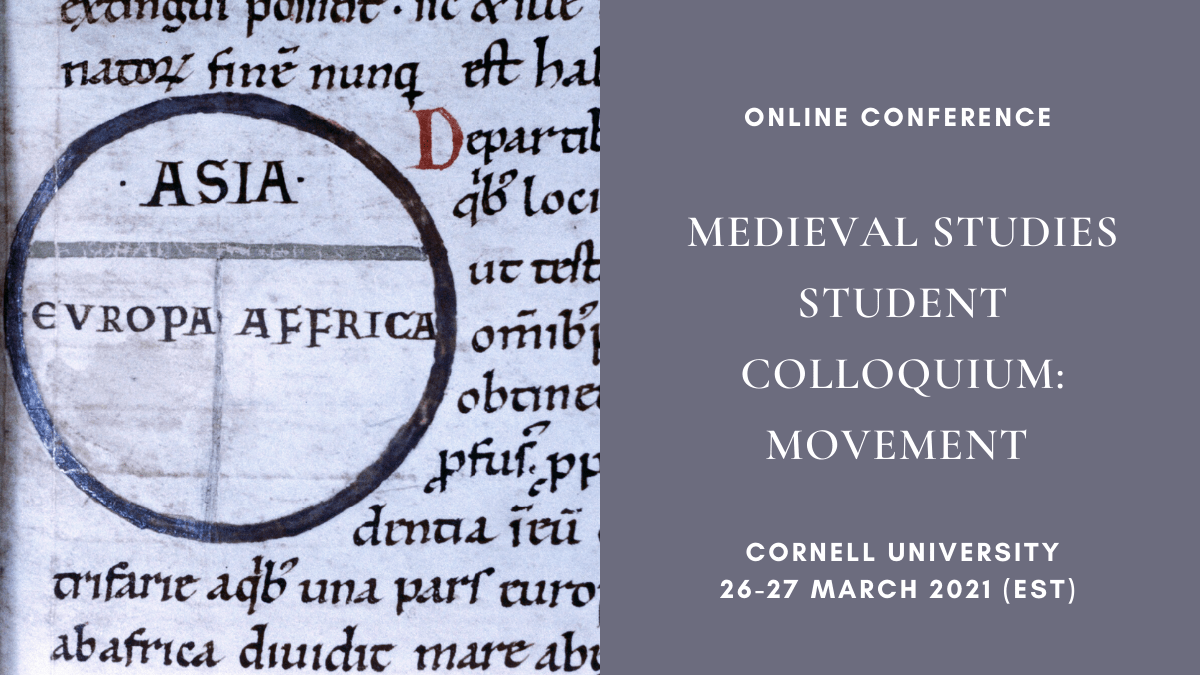
We are pleased to announce the thirty-first annual Cornell Medieval Studies Student Colloquium which will be taking place virtually March 26th-27th, 2021 on the theme of “Movement”. We welcome all to attend. This year’s event has two distinguished keynote speakers as well as thirty presenters. You will receive the full conference program as a downloadable pdf file upon registration (the program contains the Zoom links to the conference sessions and the keynote lectures). Please register here.
Our keynote addresses will be delivered by Sharon Kinoshita and Michael Gomez:
Friday, March 26th, 3:00-4:30pm EST
- Sharon Kinoshita: On the Road with Marco Polo: Movement and Space in Le Devisement du monde
Saturday, March 27th, 3:00-4:30pm EST
- Michael Gomez: The Concept of “Movement” in Early West Africa: A Fitting Framework
Please contact Alice Wolff at acw262@cornell.edu if you have any questions or if you need assistance.
Online Lecture: ‘Ps-Ptolemy’s Ὁ Καρπός and Byzantine Astrological Practice’, Darin Hayton, 1 April 2021, 16.00-17.00 (ET)

The Mary Jaharis Center for Byzantine Art and Culture at Hellenic College Holy Cross in Brookline, MA, is pleased to announce its final lecture for 2020–2021: “Ps-Ptolemy’s Ὁ Καρπός and Byzantine Astrological Practice.” Dr. Darin Hayton, Haverford College, will explore ps-Ptolemy’s Ὁ Καρπός to elucidate the culture of astrology in the later Byzantine empire.
This lecture will take place live on Zoom, followed by a question and answer period. Please register to receive the Zoom link. An email with the relevant Zoom information will be sent 1–2 hours ahead of the lecture. Registration closes at 11:00 AM (ET) on April 1, 2021. You can register here.
Abstract
The collection of astrological aphorisms that circulated under Ptolemy’s name raises a number of questions about the practice of astrology in the later Byzantine empire. The form and the content of the collection points to a thriving culture of astrology, one that possibly included social performances. In this lecture I will explore the various facets of this text — e.g., its material history and circulation, the aphorism as a form of authority and knowledge making, the arrangement and content of individual aphorisms and their sequence — in order to articulate some of those questions about the culture of astrology and to suggest some possible answers. Parts of this lecture will be speculative, but I hope generatively so.
About the Speaker
Darin Hayton is the Associate Professor of History of Science at Haverford College. He studied History and Philosophy of Science at the University of Notre Dame. He has held fellowships in Vienna, Munich, London, and Wolfenbüttel. He was also Research Officer at the History of Science Museum (Oxford), where he worked extensively with their collection of astrolabes. His research focuses on the various rhetorical and material ways scientific knowledge is recognized, articulated, and rendered authoritative. In particular, he studies the interplay between astrological practices and political authority in premodern Europe. His first book explored the place of astrology at the Holy Roman Court under Emperor Maximilian I. He is currently working on a series of case studies on the sciences of the stars that will illuminate the nature and practice of astrology in the later Byzantine Empire.
Contact Brandie Ratliff (mjcbac@hchc.edu), Director, Mary Jaharis Center for Byzantine Art and Culture, with any questions.
New Publication: ‘Imagining the Divine: Art in Religions of Late Antiquity across Eurasia’, edited by Jaś Elsner and Rachel Wood

This groundbreaking volume brings together scholars of the art and archaeology of late antiquity (c. 200−1000), across cultures and regions reaching from India to Iberia, to discuss how objects can inform our understanding of religions. During this period major transformations are visible in the production of religious art and in the relationships between people and objects in religious contexts across the ancient world. These shifts in behaviour and formalising of iconographies are visible in art associated with numerous religious traditions including, but not limited to, Buddhism, Christianity, Hinduism, Islam, Judaism, Zoroastrianism, religions of the Roman Empire, and paganism in northern Europe. Studies of these religions and their material culture, however, have been shaped by Eurocentric and post-Reformation Christian frameworks that prioritised Scripture and minimised the capacity of images and objects to hold religious content. Despite recent steps to incorporate objects, much academic discourse, especially in comparative religion, remains stubbornly textual. This volume therefore seeks to explore the ramifications of placing objects first and foremost in the comparative study of religions in late antiquity, and to consider the potential for interdisciplinary conversation to reinvigorate the field.
Table of Contents
Introduction (Jaś Elsner and Rachel Wood)
Chapter 1: The materiality of the divine: aniconism, iconoclasm, iconography (Salvatore Settis, with a response from Maria Lidova)
Chapter 2: Bodies, bases, and borders: framing the divine in Greco-Roman antiquity (Verity Platt, with a response from Dominic Dalglish)
Chapter 3: Kufa and Kells: the illuminated word as sign and presence in the 7th-9th centuries (Benjamin C. Tilghman and Umberto Bongianino, with an introduction by Katherine Cross)
Chapter 4: The Jewish image of God in late antiquity (Martin Goodman, with a response from Jaś Elsner and Hindy Najman)
Chapter 5: Empire and Faith: the heterotopian space of the Franks Casket (Catherine Karkov, with a response from Katherine Cross)
Chapter 6: Buddhapada: The Enlightened Being and the Limits of Representation at Amarāvatī (Jaś Elsner, with a response from Alice Casalini)
Chapter 7: From Serapis to Christ to the Caliph: faces as a re-appropriation of the past (Ivan Foletti and Katharina Meinecke, with an introduction by Nadia Ali)
Chapter 8: Uses of decorated silver plate in Imperial Rome and Sasanian Iran (Richard Hobbs, with a response from Rachel Wood)
Chapter 9: Material religion in comparative perspective: how different is BCE from CE? (Christoph Uehlinger, with a response from Stefanie Lenk)
Conclusion
Bibliography
Index
CFP: ‘Art and Religions in Antiquity: Crafting Religion in the Western Empire’, Society for Biblical Literature Annual Meeting (23 November 2021), deadline 23 March 2021

The Society for Biblical Literature calls for papers on ‘Art and Religions in Antiquity: Crafting Religion in the Western Empire’ as part of its 2021 annual meeting on 23 November.
‘Continuing a series of sessions that the Art and Religions of Antiquity program has held devoted to regional studies (Syria, the Aegean, etc.), we invite papers on art and religion in the Western Empire (Gaul, Spain, Italy, Britain). We particularly encourage studies that identify regional distinctiveness in art, religious practices, and even religious texts that can be connected to practices and/or arts unique to the region(s). We welcome papers examining not only spaces and objects typically seen as “religious” (churches, shrines, cemeteries and tombs, reliquaries, etc.) but also the ways art and religion were manifest in family estates, domestic spaces, and private commissions.’
Please email your proposal to program unit chairs Mark Ellison (mark_ellison@byu.edu) and Vasiliki Limberis (limberis@temple.edu) by 23 March 2021.
Please note it has not been confirmed whether or not the conference will be in person, or if presenters may contribute via Zoom if the meeting does meet in San Antonio (although a virtual option seems likely at this time)
CFP: ‘Materiality in the Eastern Mediterranean World’, Central European University, online (28-29 May 2021), deadline 5 April 2021
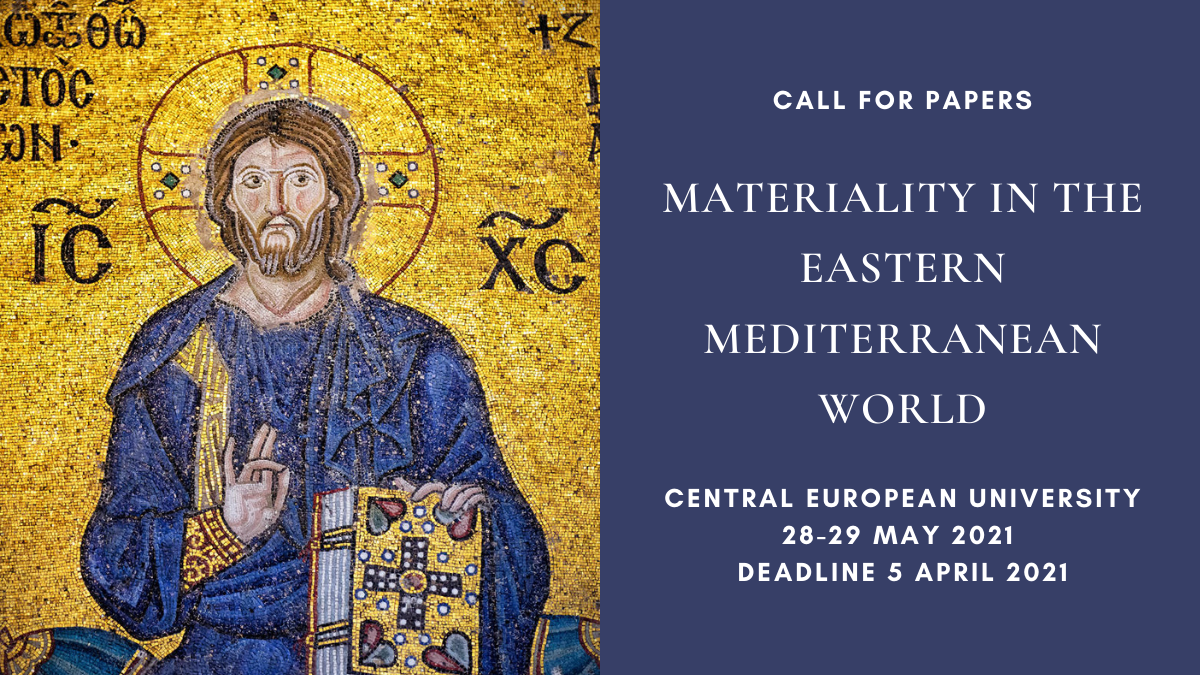
The Center for Eastern Mediterranean Studies (CEMS) at Central European University (Vienna/Budapest) is proud to announce the 7th International Graduate Conference on ‘Materiality in the Eastern Mediterranean World’, 28-29 May 2021. The conference will provide a forum for graduate and advanced undergraduate students working on the Eastern Mediterranean to present their current research, exchange ideas, and develop scholarly networks.
The aim of this conference is to explore how a turn towards materiality can help us to understand the Eastern Mediterranean world. The conference seeks research that investigates the role of physical “things” in history. How are material culture, technology, and the physical environment entangled in historical processes? How has the physical world shaped and been shaped by forms of social life in the Eastern Mediterranean? How have ideas and emotions been put into practice and how have they been embodied in material objects (e.g. artifacts, relics, and manuscripts)? How could materiality in the Eastern Mediterranean differ from other regions?
The committee welcomes approaches that focus on the relations between humans and their physical surroundings, the way they understand, perceive, and use them. Moreover, in turning towards the material, the conference intends to explore connections and entanglements between human/non-human, spiritual/physical, and phenomenological/epistemological.
The conference seeks innovative proposals by graduate students from all disciplines that relate to the Mediterranean world, including but not limited to Anthropology, Archeology, Art History, Classics, Environmental Science and History, Gender Studies, History, Languages and Literatures, Medieval Studies, Early Modern Studies, Philosophy, Religion, and Theology.
Possible paper topics might include, but are not limited to:
- Environmental and ecological histories
- History of health and disease
- Texts as objects; cultures of documentation, archiving, and printing
- Economic and political practices
- Architecture and urban history
- Commerce and trading systems
- The physical manifestation and material life of symbols
- Histories of affect and embodied physical experiences, such as pain, pleasure
- The role of material culture in everyday life history
- Material history of empires. The objects of imperial formations
- Histories of technology and science
- Materiality and mobility in diplomacy; e.g. the role of gifts, travelogues
- Aesthetics and design
- Research employing economic and political approaches
- Craftsmanship culture
- Practices of warfare. Weapons and military technology
- Rethinking units of analysis through materiality
- Comparisons between the Eastern Mediterranean and other regions through materiality
Please submit by 5 April 2021 a short paper proposal (no more than 250 words, together with a brief biography and contact information) to the following address: cemsconference@ceu.edu. Results will be announced by 20 April 2021.
Online Conference: ‘Until Death do us Part: Historical Perspectives on Death and those Left Behind, c.1300-c.1900’, Royal Holloway, 15-16 April 2021
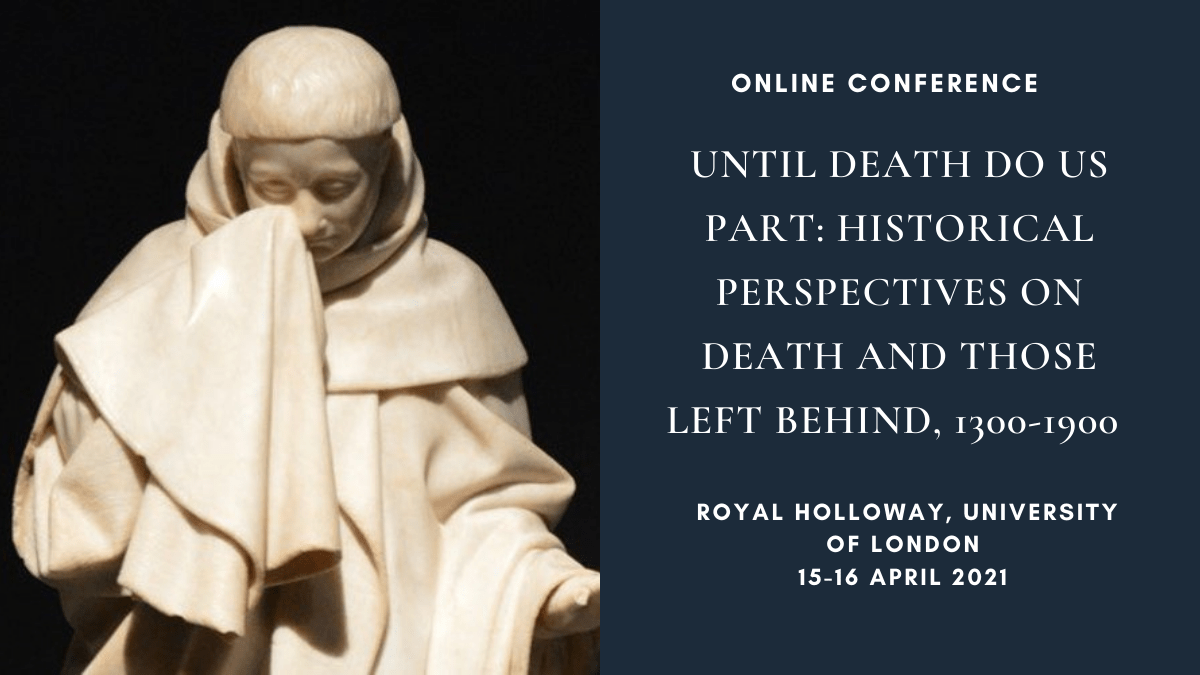
Royal Holloway, University of London, will host an online conference on the theme of historical perspectives on the impact death and dying had on those left behind. The keynote speakers for ‘Until Death’ are Professor Julie Marie-Strange (Durham University) and Dr Jessica Barker (Courtauld Institute of Art). The conference will take place on MS Teams on 15-16 April 2021.
The subject of death and commemoration has been well-treated in the historiography of all periods, but its social and psychological impact on individuals close to the deceased has been much less studied. As such, this conference aims to take a multi-disciplinary and cross-period approach to this topic, examining the ways in which the role of death and grief in society have changed over time. Broadly defined, this includes the reactions and responses to death (however it was expressed or experienced) of widows and widowers, orphans, friends, relatives, and wider communities, as well as its social and cultural impact and the sources and material culture which emanated from death.
Registration is free but essential– to register, please follow this link. Follow on Twitter: @RHULdeathconf
Conference Schedule
Thursday 15 April
9:30-9:45 – Introductions
9:45-10:55 – Panel 1: Performing death
- Dr Dan O’Brien (University of Bath) ‘Like a nightmare that haunts a murderer’s brain’: Imagining funeral workers’ feigned sorrow in eighteenth-century England
- Megan Shaw (University of Auckland) ‘Either really or in show’: Performance in the mourning portraits and commissions of Katherine Villiers, Duchess of Buckingham
- Dr Antonio Chemotti (Villa I Tatti – The Harvard University Centre for Italian Renaissance Studies) Music and Emotion in post-Tridentine Liturgies for the Dead
10:55-11:15 – Break
11:15-12:35 – Panel 2: The materiality of death
- Rachel Wilson (Cardiff University) ‘All Dublin is as black as black can be’: the material culture of Irish mourning for the Stuarts and Hanoverians, 1694-1801
- Frederick Lloyd Williams (University of Nottingham) Beyond the Material: The pilgrim badges of King Henry VI
- Dr Clodagh Tait (Mary Immaculate College, University of Limerick) ‘Ailliliu child, I’m perished with the cold’: Clothing the dead in Irish tradition
12:35-13:45 – Lunch break
13:45-14:55 – Panel 3: Belief and regulation
- Dr Polina Ignatova (Lancaster University) The (Un)dead and the Reformation: Change and continuity in the medieval and early modern perceptions of life after death
- Professor Helen Parish (University of Reading) Ars Moriendi?: Pandemics and the art of life and death
- Dr Andrew Vidali (University of Graz) Laying Down the Mourning Robes? Patrician families, ruling class, and the politics of grief in Renaissance Venice
14:55-15:20 – Break
15:20-16:40 – Panel 4: Death and the family: children, inheritance, and heirs
- Dr Eyal Levinson (Hebrew University of Jerusalem) ‘My beloved daughter Minne of blessed memory has brought me very low’: Paternal grief in Europe during the high and late middle ages
- Chris Woodyard (Independent) ‘Putting the nursery into mourning’: Children in crape
- Professor Laura Ugolini (University of Wolverhampton) Death, Loss and Inheritance: Middle-class fathers and sons in late Victorian England
16:40-17:00 – Break
17:00-18:00 – Keynote lecture
- Dr Jessica Barker (Courtauld Institute of Art) Love after Death in the Middle Ages
Friday 16 April
9:40-9:45 – Introductions
9:45-10:55 – Panel 1: Death in communities
- Nat Cutter (University of Melbourne) Death, Succession, and Community in the English House at Ottoman Tunis, 1695-1711
- Dr Miriam Wendling (KU Leuven) The Benefits of Death: endowments for students at the old university of Leuven
- Catriona Byers (KCL) ‘The gathering place of sin and death’: Social order and public perception at the Paris morgue
10:55-11:15 – Break
11:15-12:35 – Panel 2: The body after death: burial and physical responses
- Dr Billie-Gina Thomason (Liverpool John Moores) James Allen, Gender Passing, and the Body after Death
- Dr Taline Garibian (Oxford Centre for the History of Science, Medicine, and Technology) Dealing with Corpses after Mass Violence from the French Revolution to the First World War
- Dr Aoife Bhreatnach (Independent) Inclusion and Exile: Burying the destitute in Cork city, 1830-1880
12:35-13:35 – Lunch break
13:35-14:55 – Panel 3: The gendered experience of mourning: widows and widowhood
- Karolina Morawska (University of Warsaw) Death as a New Beginning: Position and perception of widows in late medieval Poland
- Andreia Fontenete Louro (Centre for the Humanities, NOVA University Lisbon) Life after husband’s death: Manorial management and widowhood of Infanta Isabel (1511/12-1576)
- Dr Amanda Bohne (University of Illinois) Mourning and Responsibility in Fourteenth-Century Deportment Books and The Wife of Bath’s Prologue
14:55-15:14 – Break
15:15-16:35 – Panel 4: Death and portraiture
- Dr Emily Knight (V&A) Portraiture as ‘melancholy consolation’: The case of Princess Charlotte
- Jean Marie Christensen (Southern Methodist University, Dallas) The king is dead: Transformation of the royal body and the dynastic portraiture of Charles I’s execution
- Holly Marsden (University of Winchester and Historic Royal Palaces) ‘We are the wound’: Studying the relationship between sickness and celebrity in the death of Queen Mary II
16:35-17:00 – Break
17:00-18:00 – Keynote lecture
- Professor Julie Marie-Strange (Durham University) ‘Loved, mourned & missed’: The emotional cosmos of pet death and grief in the long nineteenth century
All times in GMT; this schedule may be subject to change.
Online Conference:’Interdisciplinary Workshop in Textile Studies: Byzantine and Post Byzantine Productions’, University of Thessaloniki, 20-21 March 2021 (EEST)
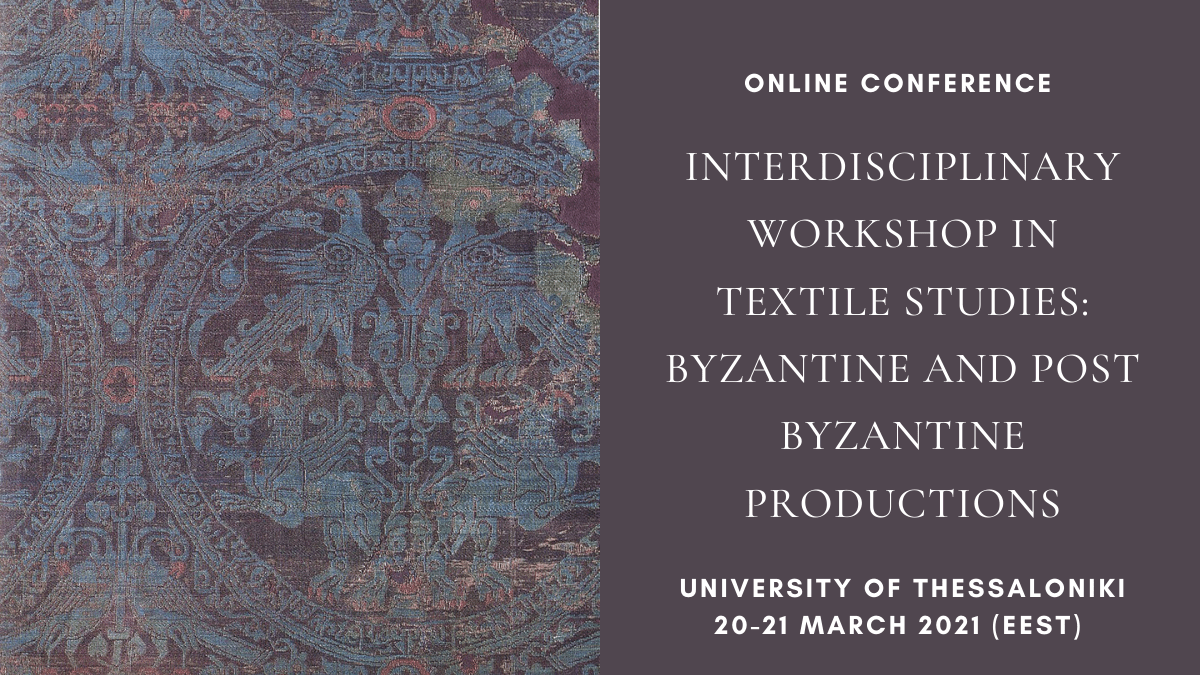
The University of Thessaloniki will host an online interdisciplinary workshop examining textile production in the Byzantine and Post-Byzantine eras, convened by Paschalis Androudis (Assistant Professor of Byzantine Archaeology and Art, Department of History and Archaeology, Aristotle University of Thessaloniki), and Elena Papastavrou (Director of the Ephorate of Antiquities of Zakynthos). The event will be hosted on Zoom, and can be accessed via this link.
Programme
Saturday 20 March (Eastern European Standard Time)
16.00-16.20 – Introduction: Paschalis Androudis, Elena Papastavrou
Α. Medieval Perspectives on the Material Culture of Religiosity (Chair: Pagona Papadopoulou, Assistant Professor of Byzantine Archaeology and Art)
- 16.20-16.40 – Arielle Winnik (Bryn Mawr College) Wrapping the Body in the Psalms: Inscribed Textiles in Coptic Christian Burials
- 16.40-17.00 – Marielle Martiniani-Reber (Musée d’art et d’histoire, Geneva) La chasuble de saint Ebbon de Sens, un vêtement liturgique, relique et reliquaire
17:00-17:20 – Break
- 17.20-17.40 – Nikos Toutos (Aristotle University of Thessaloniki) Sponsors and Dedicators of Palaiologan Embroidered Epitaphioi
- 17.40-18.00 – Ηenry Schilb (Index of Christian Art, Princeton University) Anomalies or Evidence? Variants in Categories of Iconography on Epitaphioi of the Fourteenth through the Sixteenth Centuries
18.00-18.40 – Discussion-Pause
Β. Dress, Textiles and Textility in Later Byzantium (Chair: Melina Paisidou, Associate Professor of Byzantine Archaeology and Art)
- 18.40-19.00 – Georgios Makris (University of British Columbia) Threading and Adorning the Aristocracy: Representations of Dress and Accessories in the Late Medieval Southern Balkans
- 19.00-19.20 Paschalis Androudis (Aristotle University of Thessaloniki) The Role of Textiles in the Transmission of Motifs and Patterns in Palaeologan Art (13th-15th c.)
- 19.20-19-40 Nikolaos Vryzidis (Aristotle University of Thessaloniki) From Constantinople to Konstantiniyye: Late Byzantine and Ottoman Textile Cultures in Comparative Perspective
19.40-20.00 – Discussion
Sunday 21 March
Α. Balkan Perspectives (Chair: Natalia Poulou-Papademetriou, Professor of Byzantine Archaeology and Art)
- 16.00-16.20 – Alice Isabella Sullivan (University of Michigan) The Romanian Embroidery Tradition and Byzantium (15th and 16th c.)
- 16.20-16.40 – Nikos Mertzimekis (Ephorate of Antiquities of Chalcidice and Mount Athos) Double-Sided and Signed Labarum from Zografou Monastery, Mount Athos (16th c.)
- 16.40-17.00 – Tatjana Vuleta (Independent Scholar, Vienna) On the Back of a Turtle: The Elibelinde Motif on Embroidery and Kilims in Late Medieval and Post-Byzantine Serbia
17.00-17.40 – Discussion-Pause
B. Technical Art Historical Perspectives (Chair: Anastasios Tantsis, Assistant Professor of Byzantine Archaeology and Art)
- 17.40-18.00 – Sumru Berger Krody (Textile Museum, George Washington University) Woven Comfort: Early Medieval Wool Textiles in Compound Weave
- 18.00-18.20 – Elena Papastavrou (Ephorate of Antiquities of Zakynthos) & Daphne Filiou (Byzantine and Christian Museum) Between Byzantium and Italy: Ecclesiastical Embroidery on the Ionian Islands (17th-18th c.)
- 18.20-19.00 – Fani Kalokairinou (Folklore Museum of Larissa) Block-Printed Textiles of Tyrnavos: From the Dying Workshops to the Folklore Museum of Larissa
- 19.00-19.20 Anna Karatzani (University of West Attica) Evolution of Metal Threads and their Use in Post-Byzantine Ecclesial Fabrics
19.20-19.40 – Discussion
End of Conference
CFP: Medieval and Early Modern Studies Summer Festival, Online Conference (18-19 June 2021), deadline 30 April 2021

The Centre for Medieval and Early Modern Studies at the University of Kent will host its 7th annual Summer Festival on the 18th and 19th June 2021. This two-day event celebrates Medieval and Early Modern history, 400 – 1800, and encourages a wide range of interdisciplinary topics, including but not limited to, politics, religion, economics, art, drama, literature, and domestic culture. MEMS Fest aims to be an informal space in which postgraduate students, early career researchers, and academics can share ideas and foster conversations, whilst building a greater sense of community. Undergraduate students in their final year of study are also welcome at the conference.
MEMS Fest invites abstracts of up to 250 words for individual research papers of 20 minutes in length on ANY subject relating to the Medieval and Early Modern periods. The research can be in its earliest stages or a more developed piece.
MEMS Fest also encourage 700-word abstracts proposing a three-person panel, presenting on a specific subject or theme in Medieval or Early Modern studies. If you have an idea and would like us to advertise for it, please contact us at memsfestival@gmail.com.
Deadline for all Paper and Panel Proposals is Friday 30th April 2021. All applications must be sent to memsfestival@gmail.com with ‘MEMS Fest 2021 Abstract’ as the subject of the email.This opportunity allows you to showcase your research in a friendly environment and to network with fellow scholars from far-reaching institutions. For more information please contact the team on Facebook, Twitter, or at memsfestival.wordpress.com. Please do not hesitate to ask questions.
CFP: ‘Liminality: Crossing Borders, Crossing Boundaries’, University of Edinburgh, online (June 2021), deadline 5 April 2021
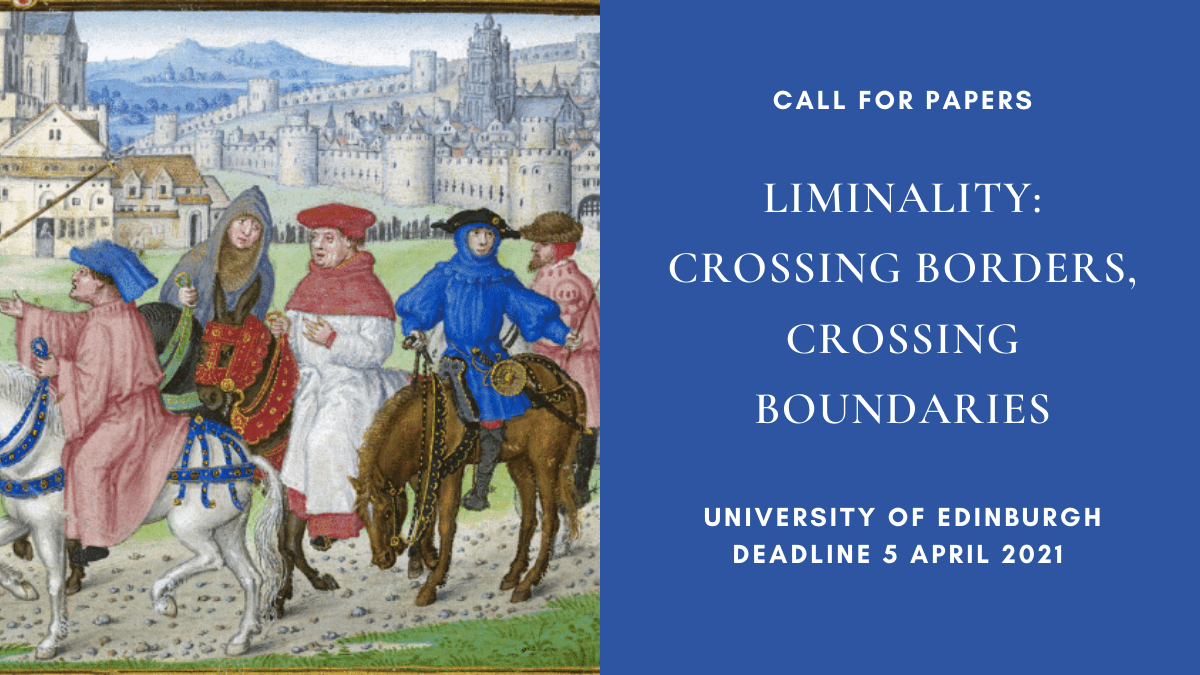
The Late Antique and Medieval Postgraduate Society (LAMPS) at the University of Edinburgh will host a one-day conference with the theme ‘Liminality: Crossing borders, crossing boundaries’, taking place virtually in late June 2021. This conference seeks to explore texts, events, and ideas that exist between and beyond traditional boundaries, and to further our understanding of a complex Late Antique and Medieval period that cannot be easily categorized and contained. It also aims to strengthen interdisciplinary connections within and outwith the University of Edinburgh, including but not limited to the fields of archaeology, history, classics, history of art, literature, language studies, Islamic studies, and theology.
The Society welcomes submissions for papers on the above theme and hopes to engage with a wider audience by providing a forum for postgraduate and early career scholars to present their research. Submissions for abstracts may include, but are certainly not limited to:
- Hybrid identities
- Journeys
- The supernatural
- Crossing linguistic borders
- Legislating difference
- Deviating from the norm
- Interdisciplinary approaches.
Early career scholars and postgraduate students are invited to submit abstracts of up to 200 words for a twenty-minute paper, as well as a short biography of up to 100 words to lampsedinburgh@gmail.com by 5 April 2021.
 Medieval Art Research