Online Conference: ‘Thomas Becket: Life, Death and Legacy’, 28-30 April 2021

Join Canterbury Cathedral and the University of Kent for three days of exciting papers, 28-30th April 2021, examining the history, visual and material culture, archaeology, architecture, literature, liturgy, musicology, and reception of Becket’s cult at Canterbury, across Europe and beyond, with keynote papers by Rachel Koopmans, Paul Webster, and Alec Ryrie. Be guided by experts on a series of Virtual Tours taking you right into the heart of Canterbury Cathedral and the surrounding area, allowing you to get up close with some of the stunning architecture and artefacts from Becket’s long and storied history.

The conference takes place over three days and each day has a specific focus.

The cult at Canterbury

The first day will focus on the art and architecture of the cathedral, with an examination of the material culture related to Becket and the growth of his cult alongside the developing tensions between Church and State. It will consider the building- its fabric, floors, stained glass windows, shrines, as well as graffiti. It will also look at reliquaries, ampullae and pilgrim badges.

Perceptions of Becket

The second day will focus on perceptions of Becket – including studies in diplomacy, liturgy, musicology, and hagiography – examining aspects of local and ‘global’ devotion. These papers will also examine various ways in which Becket was ‘pictured’ in the medieval church.

Becket, a global cult

The third day will explore the spread and diffusion of the cult of Becket across Europe and beyond, retracing its development until its destruction during the English Reformation.


Hashtags & Social Media

We encourage you to Tweet about the conference beforehand as well as while it’s happening. Please remember to tag @no1Cathedral and use the #BecketConference hashtag in your posts.

Practical Information

All tickets are sold through Eventbrite. You will receive an email confirmation of your order after booking your tickets. One week before the conference you will receive an email containing a link and instructions on how to join the conference, as well as a link to the Virtual Tours to watch them at your leisure.

Virtual Tours

  • Medieval gra­ti in the eastern crypt – Philippa Mesiano, and Ellen Meade
  • The Cosmati pavement – David Neal
  • Erasing Becket: Evidence in the Library & Archives of Canterbury Cathedral – David Rundle
  • The Mazer – a Becket relic? – Sheila Sweetinburgh

Find the PDF conference programme here. Get your tickets here!


Wednesday 28th April 2021 The Cult at Canterbury

9.00 – 9.15 — Zoom opens for all delegates

9.15 – 9.30 — Welcome from Canterbury Cathedral

9.30 – 11.10 — Session 1: Breaking new ground: New archaeological discoveries at Canterbury Cathedral, Chaired by Sheila Sweetinburgh

  • Paul Bennet, ‘Canterbury in the time of Becket’
  • Tim Tatton-Brown, ‘The Archeology of the Trinity Chapel’
  • John Crooks, ‘Becket’s Shrines at Canterbury’
  • Natalie Cohen, ‘The Archaeology of the Eastern Crypt’

11.10 – 11.30 — Comfort Break

11.30 – 13.10 — Session 2: Souvenirs of devotion: Badges, ampullae, & châsses, Chaired by Lloyd de Beer

  • Isabelle Bardiès-Fronty, ‘L’ampoule de pèlerinage à Thomas Becket de Cantorbéry, un témoin précieux’
  • Lydia Prosser & Ian Bass, ‘Thomas Who? The Curious Case of Anderson Type II.30 Ampullae’
  • Annemarieke Willemsen & Michael Lewis, ‘Identifying the Cult of St Thomas of Canterbury through signs in Britain and the Continent’
  • Lucy Splarn, ‘A ‘pilgrimage’ through the Canterbury Collection of Becket pilgrims’ souvenirs’

13.10 – 14.00 — Lunch Break

14.00 – 15.40 — Session 3: Becket, the Church, and the State, Chaired by Danica Summerlin

  • Cary J. Nederman, ‘Why Can’t We Be Friends? John of Salisbury, Thomas Becket, and the Discourse of Amicitia’
  • Rebecca Courtier, ‘Feminine Jurisdiction: St Thomas Becket as Mother of the Church’
  • Ryan Kemp, ‘Becket’s ‘admonitio’: a comparative approach’
  • Claudia Quattrocchi, ‘From Canterbury to Anagni and back: The “Invention of Saint Thomas Becket” in papal visual rhetoric’

15.40 – 16.00 — Comfort Break

16.00 – 17.40 — Session 4: New visualisations, Chaired by Emily Guerry

  • John Jenkins, ‘Variations on a Vision: Gervase of Canterbury and St Thomas in the fifteenth century’
  • Ryan Eisenman, ‘F(r)acturing Becket’s Body on Limoges Enamel Chasses’
  • Kathleen Doyle, ‘Becket in pictograms’
  • The Becket BM Curatorial Team, ‘Curating the exhibition ‘Thomas Becket: murder and the making of a saint’

17.40 – 18.00 – Comfort Break

18.00 – 19.00 – Keynote 1: Rachel Koopmans, ‘The First Days of Miracles: Becket’s Cult in 1171’ , Introduction: Emily Guerry


Thursday 29th April 2021 Perceptions of Becket

9.00 – 9.15 — Zoom opens for all delegates

9.15 – 9.30 — Welcome from Canterbury Cathedral

9.30 – 11.00 — Session 5: Perceptions of Becket: From diplomacy to mythology, Chaired by Barbara Bombi

  • Cecily Hennessey, ‘Thomas, Henry and Family Ties’
  • Jan Vanderburie, ‘The Cult of Thomas Becket in the Latin East 1191-1236’
  • Charlotte Gauthier, ‘To the Holy Land and Back Again: The Hospitallers of St Thomas of Canterbury’
  • Stephanie Plass, ‘The red rose of Canterbury and the white lilies of Lincoln: The use of Becket’s legacy in two saints’ lives written by Gerald of Wales’

11.10 – 11.30 — Comfort Break

11.30 – 13.10 – Session 6: Devotion to Becket: From local to global, Chaired by David Rundle

  • Innocent Smith, ‘Ad gaudia transtulisti: The Translation of St. Thomas Becket in a thirteenth-century Gilbertine Bible Missal (Cambridge, St. John’s College, N.1)’
  • Katherine Emery, ”Þu ert help in Engelande’: The Transmission of Vernacular Song Concerning Thomas Becket in the Twelfth and Thirteenth Centuries’
  • Caroline Vogt, ‘Thomas Becket’s Wardrobe – The vestments of a Martyr’
  • Cecilia Mazzocchio, ‘A Rediscovered Reliquary: Remnants of Thomas Becket’s cult in Siena’

13.10 – 14.00 — Lunch Break

14.00 – 15.40 — Session 7: Picturing Becket in the medieval church, Chaired by Cassandra Harrington

  • Carlos Sánchez Márquez, ‘The wall paintings of Santa Maria in Terrassa and the cult of Thomas Becket in the Crown of Aragon’
  • Angela Websdale, ‘Gone, But Not Forgotten: The Gothic Wall Paintings of St Mary’s Church, Faversham’
  • Meg Bernstein, ‘Parochialising Becket’
  • Alyce Jordan, ‘Remembering Thomas Becket in St Lô’

15.40 – 16.00 — Comfort Break

16.00 – 17.00 — Keynote 2: Paul Webster, ‘What happened in 1220? Saint, Archbishop, King, and Legacy’, Introduction: Louise Wilkinson


Friday 30th April 2021 Becket, a Global Cult

9.00 – 9.15 — Zoom opens for all delegates

9.15 – 9.30 — Welcome from Canterbury Cathedral

9.30 – 11.10 – Session 8: The spread of Becket’s cult I, Chaired by Emily Guerry

  • Stefan Hope, ‘The liturgical veneration of Saint Thomas of Canterbury in medieval Norway’
  • Alexandru Stefan, ‘Sigilographic Perspectives on the Cult of St Thomas Becket in Medieval Transylvania’
  • Tomasz Węcławowicz, ‘The Legacy of Becket’s Martyrdom and St Stanislaw’s Cult in Poland’
  • Jesse Harrington, ‘A tale of two Angevin archbishop ‘martyrs’: St. Thomas of Canterbury and St. Laurence of Dublin’

11.10 – 11.30 — Comfort Break

11.30 – 13.10 – Session 9: The spread of Becket’s cult II, Chaired by Barbara Bombi

  • Synnøve M. Myking, ‘The Cult of Thomas Becket in Medieval Norway’
  • Christopher Lakey, ‘The Plenar of Otto the Mild: The Guelph family patronage of Thomas of Becket in Germany’
  • Anne E. Lester, ‘The French Connection: Aristocratic Patronage, Religious Networks and the French Cult of Thomas Becket’

13.10 – 14.00 – Lunch Break

14.00 – 15.40 – Session 10: The making and un-making of Becket’s cult, Chaired by John Jenskins

  • Katie Hodges-Kluck, ‘Contextualizing the Apocryphal tale of Thomas Becket’s Parentage’
  • Anne Bailey, ‘‘Becket’ or ‘St Thomas’? The Religious Legacy of a Medieval Saint in Post-Reformation Britain’
  • Tristan Taylor, ‘Excising Becket: Becket Erasure in Sixteenth-Century England’
  • Kay Slocum, ‘Tennyson’s Becket, Eliot’s Murder in the Cathedral, and the Canterbury Chapter House: Tradition and Innovation’

15.40 – 16.00 –Comfort Break

16.00 – 17.00 – Keynote 3: Alec Ryrie, ‘Henry VIII, the Liberties of the Church of England and the Second Martyrdom of Thomas Becket’, Introduction: Kenneth Fincham

Call for Journal Submissions: ‘(re)Interpreted, (re)Imagined, (re)Constructed: Medieval art and Medievalisms in Central Europe after 1945’, Ikonotheka vol. 31, deadline 30 April 2021

In Central Europe, the year of 1945 brought about not only new borders but also a new socio-political system, accelerated modernisation, and the promise of a “brave new world” which was to be founded on the ruins of the past. However, the ideological drive towards the future was supplemented by a turn towards a specifically understood distant history, often phantasmagorical and imagined. Interestingly, it was the Christian Middle Ages, with its feudal system, visual culture, and its traces in the form of medieval artefacts and architecture, that gained an important role in establishing the communist and socialist utopia. It was not the first time that the Middle Ages had become the subject of medievalist practices and ideologies in Central Europe, including creative adaptations, programmatic redefinitions, nationalist appropriations, and ideological revaluations. “Rediscovery” of the Middle Ages in the Long Eighteenth Century and the appreciation of the medieval legacy, especially of the Gothic, followed by the formation of nationalisms and the negotiation of collective national identities in the 19th century, already ensured the Middle Ages a permanent place in the historical and national discourses of many states and national communities in Central Europe. 

The latest issue of Ikonotheka intends to trace the emergence of new interpretations and medievalist imagery over the last several decades, as well as the post-WWII fate of medieval art and architecture in Central Europe. We also wish to address a variety of medievalist discourses that emerged after 1945: particularly their origins, uses, reception, and legacy. In addition to investigating the post-WWII politics and aesthetics of heterogeneous medievalist narratives, we also hope to critically reflect on the enduring appeal of the Middle Ages – from the late 1940s until today. 

Ikonotheka invites contributions addressing the issue of medievalisms in Central Europe after 1945. Possible topics may include: 

  • transregional/transnational medievalisms in Central Europe 
  • medievalism and medieval art as contested heritage 
  • medieval pasts and multidirectional memory after 1945 
  • the “communist/socialist” Middle Ages 
  • the place and role of medieval art in the post-war public space and its symbolic, mythological, and subversive potential 
  • reconstruction, creation, and intentional destruction of medieval artworks, as well as social, political, economic, and diplomatic contexts of such actions, including manipulations and confabulations 
  • notions of originality, truth, and falsity in restored, reconstructed, and constructed works; the limits of conservation and ideological creation 
  • institutional appropriation and re-contextualisation of “foreign” medieval art in museums and academic discourse 
  • translation and adaptation of medieval artworks to new places, contexts, and settings 
  • new media and technologies used for reinterpretation, reimagining, and reconstructing of medieval art 
  • medievalism and the visual culture of Central Europe (film, television, theatre, etc.) 
  • medievalisms in the 21st century 

DEADLINES for the abstract: 30 April 2021 (notification by 15 May 2021) for the article: 30 September 2021 

Abstracts should be sent to ikonotheka@uw.edu.pl 

SUBMISSION | Guidelines and Dates Deadline for the abstracts: 30 April 2021, with successful notification by 15 May 2021. Abstracts should not exceed 300 words and include the author’s short biographical note with current academic affiliation (up to 150 words). The deadline for the final contributions will be 30 September 2021. Publication date: early 2022 The expected length of individual contributions is approximately 6000 words. All submitted papers will be subject to a double-blind peer review process. 

ABOUT THE JOURNAL Ikonotheka is a journal of the Institute of Art History University of Warsaw on the history and theory of the arts. Ikonotheka was founded in 1987 by Professor Jan Białostocki, with the first volume published in 1990. The journal seeks to demonstrate a wide range of approaches to the study of the art of the past and of the contemporary artistic practice. It encourages its authors to employ different methodologies and welcomes investigations into previously understudied art historical topics. The authors are invited to consider both mainstream and lesser known artists and/or artworks. The journal publishes solely original texts that have not been previously published elsewhere. The journal is annual and undergoes a double-blind peer review, which is carried out both for paper and digital (open access) editions. 

For more information, including guidelines for authors visit http://www.ikonotheka.pl 

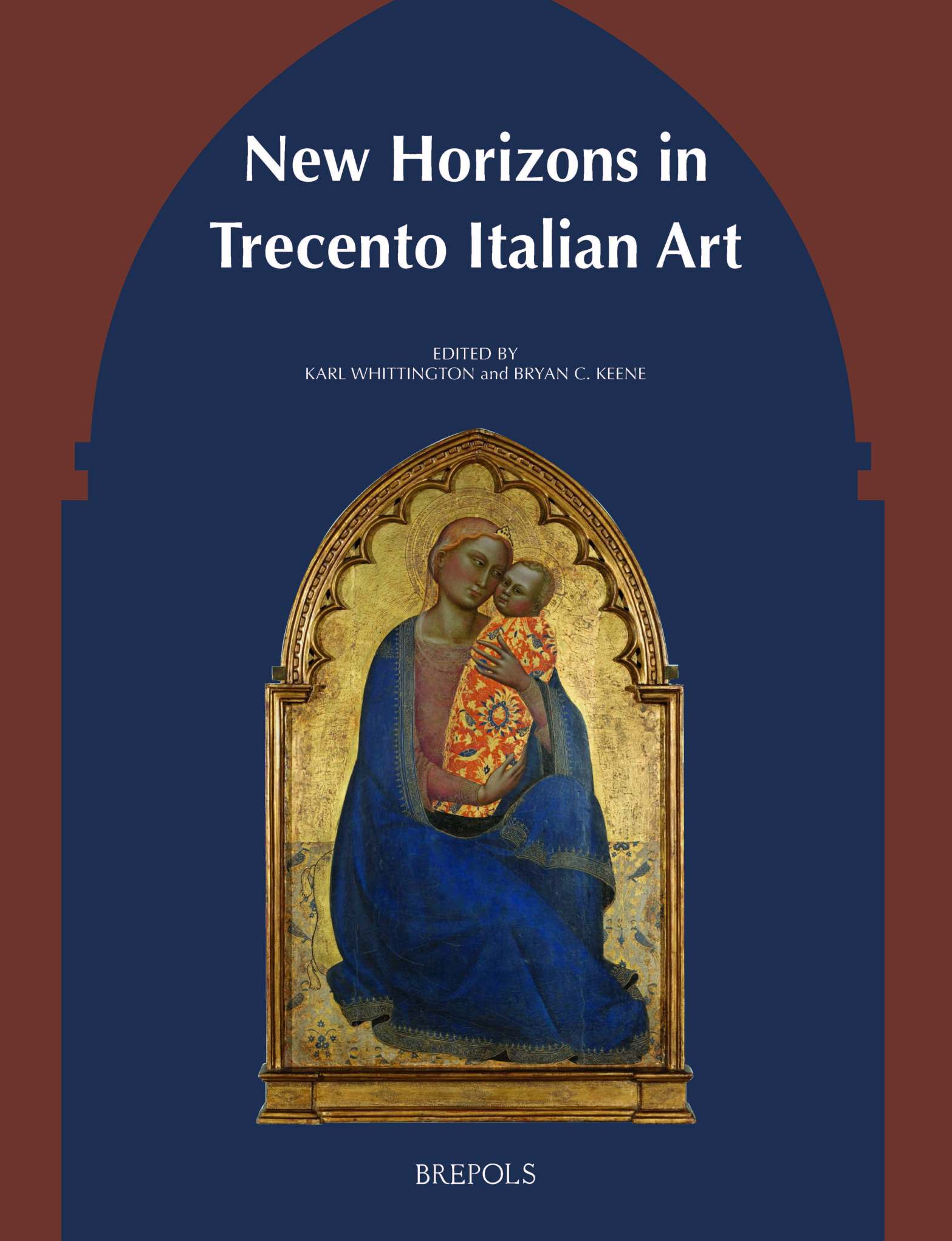
New Publication: New Horizons in Trecento Italian Art, edited by Bryan C. Keene and Karl Whittington

The fourteenth century in Italy, the age of Giotto, Dante, and Boccaccio, widely known as the trecento, was a pivotal moment in art history and in European culture. The studies in this volume present new approaches to art in this important but often neglected period of the late Middle Ages and early Renaissance. Scholars at various stages in their careers discuss a wide range of topics including architecture, cultural exchange, materiality, politics, patronage, and devotion, contributing to a new understanding of how art was made and experienced in this nodal century. These papers were originally presented at the Andrew Ladis Trecento Conference held at the Museum of Fine Arts in Houston in November of 2018.

Bryan C. Keene is associate curator of manuscripts at The J. Paul Getty Museum, and editor of Toward a Global Middle Ages: Encountering the World through Illuminated Manuscripts (Getty Publications, 2019) and contributing author to Florence at the Dawn of the Renaissance: Painting and Illumination, 1300-1350 (Getty Publications, 2013). Karl Whittington is associate professor of history of art at The Ohio State University, and the author of Body Worlds: Opicinus de Canistris and the Medieval Cartographic Imagination, published by the Pontifical Institute in Toronto in 2014.

Table of Contents

Some Reflections — Judith Steinhoff

Introduction — Bryan C. Keene and Karl Whittington

I. Matter and Material

Stone, Paint, Flesh: Fictive Porphyry Exteriors in a Group of Multipart Panel Paintings from Angevin Naples — Sarah K. Kozlowski

The Altar as Stage: Visual and Material Conditions of the Dramatized Nativity — Patricia Simons

Jacopo, Niccolò, and Paintings in Books for Santa Maria degli Angeli — George R. Bent

II. Narrative and Response

Painted Wood Caskets for Saints in Trecento Venice — Ana Munk

The Reliquary of the Column of the Flagellation: A Case for Narrative Reliquaries — Claire Jensen

Fragmented Narrative in the Chapter House of San Francesco in Pistoia — Laura Leeker

Seeing and Sensing Compassion: Giotto’s Naturalism in the Arena Chapel and Pietro d’Abano’s Theory of Sympathetic Response — Theresa Flanigan

III. Prototypes: Local and Global

Locating the Duomo of Milan in the European Trecento — Erik Gustafson

The Ilkhanid-Italian Relationship during the Trecento:  Medieval Persian Prototypes for Brunelleschi’s Dome in Florence — Lorenzo Vigotti

IV. Art and Identity

A Tribute to Dante: The Giottesque Portrait in the Palazzo del Podestà in Florence — Sonia Chiodo

Visual Representation of Women’s Legal Duties in Medieval Siena — Elena Brizio

V. Time and Knowledge

Towards a New Reading of the Fifteenth-Century Astrological Cycle at the Palazzo della Ragione in Padua — Anna Majeski

Giotto and Time — Luca Palozzi

Diagramming Triumph in Trecento Painting: Augustine and Thomas from Page to Wall — Karl Whittington

VI. Local Sanctities

Art of an Emblematic King: Robert I of Naples as King of Jerusalem in the Fourteenth Century — Cathleen A. Fleck

The Lignum Crucis and the Veneration of the Cross in the contado of Siena: Unmasking Some Neglected Images in the Cathedral of Massa Marittima — Sandra Cardarelli

The Bodies and Blood of Christ and the Virgin at Santa Maria Novella, Florence — Amber McAlister

VII. The Trecento in the Present

Rising from the Rubble of World War II: The High Altarpiece of Impruneta — Cathleen Hoeniger

Engaging with the Trecento — Caroline Campbell

Afterword — William Underwood Eiland

More Info: https://bit.ly/3qwhNyY

Grants & Bursaries: Grants for Art History, Association for Art History, deadline 31 March 2021 17.00 (GMT)

To further our mission to advance the study and practice of art history, the Association for Art History offer grants of up to £1,000 which provide support to aid scholarly research, to develop professional practice and to further the teaching and learning of art history at all education levels.

Find out more about the recipients of grants for art history.

What we fund

Grants to aid scholarly research include support for:

  • Organisation of symposia, conferences and workshops
  • Travel to libraries, archives and collections
  • Delivery of research findings at conferences
  • Catalogues and public engagement programmes for exhibitions
  • Access to images controlled by third party rights holders

Grants to develop professional practice within art history include:

  • Participation in museum and gallery training programmes in curatorial and public engagement areas

Grants to support the teaching and learning of art history in schools include:

  • Teachers’ continuing professional development
  • Formal and informal learning opportunities for students

Bursaries

Alongside our grants programme, the Association awards bursaries for doctoral students and early career researchers to attend our Annual Conference.

These competitive bursary tickets are available to those who would benefit from attending our Annual Conference. The application period for the 2021 online Annual Conference has now past, bursaries for the 2022 Annual Conference will be announce at the end of 2021.

Priorities

Within our grants categories, we look particularly favourably on:

  • Projects from a wide geographic distribution throughout the UK and those that will reach broad audiences
  • Projects that promote the participation of diverse audiences and encourage new perspectives within art and art history
  • Supporting research and practice where the applicant is without institutional affiliation or the access to funding that such association would provide

Outcomes

We expect that the outcomes of projects we fund will include:

  • Expanding the knowledge base of art history
  • Enabling more researchers and professionals in the field, particularly those who do not have other means of support, to access essential career development opportunities
  • Helping art historians and those in related professions to build and extend their networks to facilitate their work and professional development
  • Introducing wider audiences to art history through exhibitions, publications and other public programming
  • Facilitating the teaching and learning of art history in secondary schools and thereby increasing the engagement of students at all levels with the subject

Eligibility

Grants are open to members of the Association who may be:

  • Academics
  • Students
  • Independent researchers
  • Teachers
  • Museum and gallery professionals
  • Artists

If you are not a member of the Association for Art History and would like further information on member benefits and how to join us, please see here for details.

What we do not fund

Grants from the Association for Art History cannot fund further or higher education (university fees, course books etc), student living expenses or unpaid internships.

Staff members and trustees of the Association for Art History and their relatives and partners are not eligible for our grants.

Criteria

Research grants will be assessed according to their contribution to scholarship in art history, their academic rigour, and the relevance and need for the research in the specific area described.

Practice grants should demonstrate how the skills and experience obtained will contribute to professional development and, ultimately, to the public understanding of art history.

For all grants, the demonstrable financial need of the applicant as well as the availability of other grants to support the project or activity applied for will be considered.

Grants which leverage and help to attract additional funding are encouraged.

How to apply

Please complete the relevant application form and equality & diversity monitoring form, available to download and return to grants@forarthistory.org.uk. Next application deadline: 5pm 31 March 2021.

For full details, including T&C and an FAQ, please visit the Association for Art History website.

Online Lecture: ‘Let it fake bleed: Medieval Objects and Vegan Meat Substitutes’ with Kathryn Rudy, University of St Andrews, 23 March 2021, 17.15-18.15 GMT

What do animated medieval crucifixes have to do with Greggs’ vegan sausage rolls? In this illustrated talk, medievalist Kathryn Rudy considers diverse approaches to fake blood and flesh. Ideas to be discussed include jousting vegetarians, shepherdess pies, and medieval roasts served under a layer of feathers.

Please register to receive the event link (MS Teams).

Virtual Tour: ‘Medieval Women: Subjects and Makers of Art’ (Sam Fogg, online, 25 February – 31 March 2021), London Art Week, 23 March 2021, 17.00-18.00 GMT

Arranged with Sam Fogg in conjunction with their online exhibition, Medieval Women: Subjects and Makers of Art (25 February – 31 March 2021), enjoy a tour of the exhibition in its gallery setting, accompanied by commentary and an in-depth look at select individual works. With Dr Jana Gajdošová of Sam Fogg, curator of the Medieval Women exhibition and Dr Alexandra Gajewski FSA, reviews editor at The Burlington Magazine and from 2010-2015, senior researcher at the CSIC in Madrid on a European Research Council funded project called Reassessing the Roles of Women as Makers of Medieval Art and Architecture.

Register for the live virtual tour via the London Art Week website. Submit any questions you may have in advance here. 

Access the online exhibition until the 31 March 2021 via the Sam Fogg website.

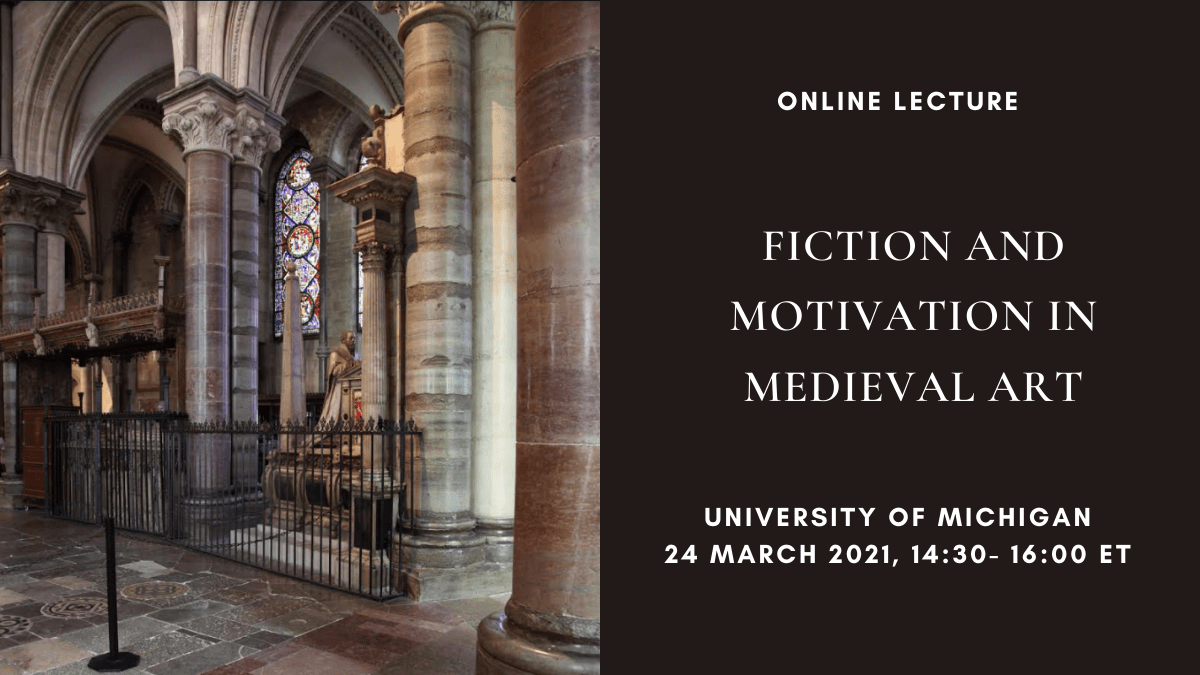
Online Lecture: ‘Fiction and Motivation in Medieval Art’ with Paul Binski, University of Michigan, 24 March 2021 14:30- 16:00 (ET)

Since the Ancient World, engagement with visual art has recognized that perception has tremendous powers to reconfigure ‘stuff’ imaginatively. Aquinas, for example, stated that it is possible to separate representation and configuration. Later aestheticians, informed by analytical philosophy, referred to this capacity as ‘aspectual seeing’: seeing something ‘in’ a configuration, or more radically seeing the configuration ‘as’ something. This lecture returns to ‘aspectual seeing’ in the belief that it illuminates current debates about materiality, illusion, emotion and fiction in medieval art. In particular, it will reflect on (if not solve) the question of what human engagement with fictions consists of, whether that engagement can motivate us to action and, if so, what that engagement tells us about the art-life divide as presently understood by some art historians and critics.

Paul Binski writes widely on general issues of aesthetics, rhetoric and the visual arts in the Middle Ages. He is Emeritus Professor of the History of Medieval Art at Cambridge University and a Fellow of Caius College, Cambridge. He is a Fellow of the British Academy and a Corresponding Fellow of the Medieval Academy of America, and was Slade Professor, Oxford University, 2006-7. He delivered the British Academy Aspects of Art Lecture, 2001, and the Paul Mellon Lectures, National Gallery, London and Yale University, 2002-3. His publications include Becket’s Crown. Art and Imagination in Gothic England 1170-1300 (2004), Gothic Wonder: Art, Artifice and the Decorated Style, 1290-1350 (2014) and most recently Gothic Sculpture (2019). Later this year he will be Franklin D. Murphy Lecturer at the University of Kansas.

To receive the Zoom link, please register here.

Call for Journal Submissions: ‘Image and Devotion’, Revista Cultura, Espaço e Memória (CEM), vol. 14 (2021), deadline 30 April 2021

The Transdisciplinary Research Centre for Culture, Space and Memory (CITCEM) invites the submission of article proposals for its journal Cultura, Espaço e Memória (CEM), vol. 14 (2021).

The fourteenth volume of CEM is dedicated to the theme of image and devotion and thus is framed within the scope of CITCEM ́s Tangible and Intangible Heritage Research Group. Following on previous scientific meetings focusing on the subject of image, namely the Research Workshop ‘Devotional practices and images’ organised by students of both the Masters Course in History of Art, Heritage and Visual Culture and the Doctoral Degree in Heritage Studies, this issue of CEM aims to promote a reflection on images and the devotional practices.

The proposals formulated by Herbert Kessler (2004) and Eric Palazzo (2010) for the study of the connections between art and liturgy focus themselves on the multidimensional approach to the artistic object and the exploration of its multiple aspects of functionality. Palazzo proposes, as an exploratory way, the study of the interaction between the artistic productions intended for the ritual, the images and the liturgical objects – and other elements that participate in the liturgy, sacred texts, light, smells, the ritual’s actors and the spatial organisation of the ceremony. The presence of light next to the sacred images corresponds to a very ancient practice. As demonstrated by J.-M- Sansterre, lamps accompanied the painted images on the church walls or in icons since the Early Middle Ages.
As summarized by García Avilés (2013), there have been important changes to history of art research in the last decades. From a perspective centred on the matters related to the production of the work of art, artist, promoters, aesthetic values, models, etc., a path has been taken towards the issues related to the reception of the Past’s visual culture. This evolution is forged in a double shift: iconic and anthropological.

Images miraculously moving into life, whose mentions are particular significant from the 14th century and throughout the Modern Age, actually have much earlier testimonies. García Avilés (2011) exemplifies how the Cantigas of Alfonso X reveal the effectiveness of prayer in evoking the action of Marian images as mediators of their sacred purpose. It has been widely debated in the last decades the complex functions of images in churches, defining them simultaneously as vehicle of the saint’s virtus represented by the art, as a material support for meditation or devotion and, as well, as elements that were part of the church symbolic decoration, where they could embody a certain objective presence of the represented supernatural reality (Sureda i Jubanay, 2012, 2013).

There are several interrogations on the function of images. What were their uses? Which practices and rituals were they a part of? How were images activated by gestures, words, sounds, rituals, prayers, deposition of ex-votos? Which other objects interacted with images? What was the importance of the travel in the diffusion of images? In which capacity can the image be understood as a support to cultural permeabilities? In which way is the devotion both a cause and effect of the artistic production?

We appeal for contributions on the study of images in the long duration and in an ample geographic context. Approaches that focus on the potential of the image as an appeal to the senses and transmission of meanings will also be valued. Beyond its thematic dossier, CEM accepts other works including news and critical reviews.

Author information

  • Accepted Languages: Portuguese, English, French and Spanish.
  • Submission proposal: Title, abstract (100 words – 150 words) and 3 to 5 keywords by April 30, 2021
  • Submission date: August 31, 2021
  • Notification date: October 15, 2021
  • Publication: December 2021

Authors must fully comply with the established deadlines, as well as the CEM’s norms of publication.

Contacts: citcem@letras.up.pt, tlf. +351 22 607 71 77 +info: www.citcem.org

Online Conference: ‘Testi e contesti. Fonti liturgiche e produzione artistica e tra Salerno e l’Europa nel Medioevo’, University of Salerno, 25-26 March 2021

On 25-26 March 2021, the international conference entitled “Texts and contexts. Liturgical sources and artistic production between Salerno and Europe in the Middle Ages ”, curated by Maddalena Vaccaro, Researcher of Medieval Art History at DISPAC (Dipartimento di Scienze del Patrimonio Culturale dell’Università degli Studi di Salerno), and Gionata Brusa, Researcher of Musicology at the University of Würzburg, will take place online.

The conference is dedicated to the relationship between artistic production, architecture and liturgical sources in the Middle Ages . Starting from Salerno and its heritage of illuminated manuscripts, the event opens up to the Campania context, Southern Italy and Europe with a plural approach between art, historical disciplines, liturgy and manuscript production.

The initiative foresees the participation of DISPAC teachers and Italian and foreign scholars, in collaboration with the Diocesan Museum “San Matteo” of Salerno and the Leone Museum of Vercelli, custodians of Salerno manuscripts.

To participate, you need to request the link by writing to testiecontesti2021@unisa.it 

CFP: ‘Art and Death in the Netherlands’, Netherlands Yearbook for History of Art 2022, deadline 15 April 2021

In premodern times, death was a more visible phenomenon than now, due to high mortality rates, but also to the fact that dying and death and the subsequent phases of deposition, bereavement and remembrance – more so than today – were collectively experienced, publicly performed, and commemorated in enduring monuments. Remembrance was held to extend into perpetuity, on personal grounds of love and affection, and for political and religious reasons, the latter normatively being related to the Christian doctrine of salvation, which, in Catholic contexts, called for unceasing prayer and other observances, like masses for the souls of the deceased. By continuing their existence in the afterlife, the dead remained present among the living.

Among the cultural responses and expressions related to dying and death, art and architecture had a prominent position. Art and cultural historians have made significant contributions to the study of the interrelatedness of art, dying and death. These range from focused studies of individual monuments or commemorative practices to more sweeping investigations of death as motivation for art. In Painting in Florence and Siena after the Black Death (1951), for example, Millard Meiss famously argued that the experiences of plague and large-scale death effected fundamental changes in the nature of the visual arts of central Italy. Many scholars have refuted parts of Meiss’s argument, but his book has gained renewed interest in our own time of plague as a cornerstone for exploring the relationship between art and death.

Volume 72 of the Netherlands Yearbook for History of Art is dedicated to the relationship of art and death in the Low Countries and its diaspora, from premodern times to the present. The editors welcome contributions on works of art and architecture (paintings, prints, sculptures, objects of applied arts, monuments, buildings) which in one or the other way can be related to the phenomena and cultural experiences of death, dying and deposition, as well as inquiries into how death and its public rituals shaped the visual arts. Contributions may deal with both human death and death and decay in plant and animal life.

It is essential for proposals to ask how these works not only expressed particular concepts and emotions (grief, fear, horror, hope, acquiescence, desire, etc.) related to (impending) death and afterlife, but also how they shaped and imprinted such ideas and aroused and channeled such emotions on the part of the living who engaged with them. Such engagement may include any physical or mental action or performance (moving, handling, touching, viewing, praying, singing, contemplating, etc.). These characteristically, though not exclusively, occurred within the context of a particular ritual or routine – personal or communal; private or public; secular or religious – related to the following: the preparation for death; deathbed observances, both pre- and post-mortem (e.g., the administration of the last sacraments, deathwatches); the post-mortem handling of the body (e.g., embalming, autopsy, dissection, anatomical lessons); funeral and burial preparations and their actual progress; commemorative activities (e.g., prayer, votive masses, services, gatherings); and consolation (e.g., pastoral visiting and counseling).

Any analysis of such engagement should take into account the social, demographic, ideological (including religious) as well as temporal and spatial circumstances and conventions under which it occurred. One may think here of: death in the public domain versus private dying and death; differences depending on political and social standing and meaning of the deceased (e.g., rulers, statesmen, national heroes); the theme of memoria and damnatio memoriae. Given the NKJ’s focus on Netherlandish art, we encourage prospective contributors to take into account circumstances specific to the Low Countries. In this respect, the topic of iconoclasm as the ‘death’ of the veristic object or veristic representation may be dealt with as well.

The works of art and architecture to be studied along the aforementioned lines of inquiry may include, but are not limited to:

  • memento mori and vanitas representations
  • illustrated consolation literature, funerary poetry; offices of the dead (as illustrated in books of hours and prayer books); artes moriendi
  • deathbed portraits; death masks; memory portraits (miniatures, lockets, rings, silhouettes, cameos); bereavement mementos
  • representations of funeral processions, burials and entombments
  • funerary decorations; burial customs and burial equipment; burial textiles; biers; grave gifts, coffins
  • mausoleums; funerary chapels, churches; mausoleums, churchyards and cemeteries
  • funeral monuments and tombs; tomb effigies; gravestones; wall memorials
  • public memorials for the dead
  • scenes of martyrdom; executions; killings; fatal accidents
  • last judgements and representations of heaven and hell
  • representations of anatomical lessons, autopsies and dissections
  • still lives/natures mortes

The NKJ is dedicated to a particular theme each year and promotes innovative scholarship and articles that employ a diversity of approaches to the study of Netherlandish art in its wider context. For more information, see: https://brill.com/view/serial/NKJ.

Contributions to the NKJ (in Dutch, English, German or French) are limited to a maximum of 7,500 words, excluding notes and bibliography.

Following a peer review process and receipt of the complete text, the editorial board will make final decisions on the acceptance of papers.

Please send a 500-word proposal and short CV by April 15, 2021, to the volume editors:

Bart Ramakers (b.a.m.ramakers@rug.nl)
Frits Scholten (f.scholten@rijksmuseum.nl)
Edward H. Wouk (edward.wouk@manchester.ac.uk)