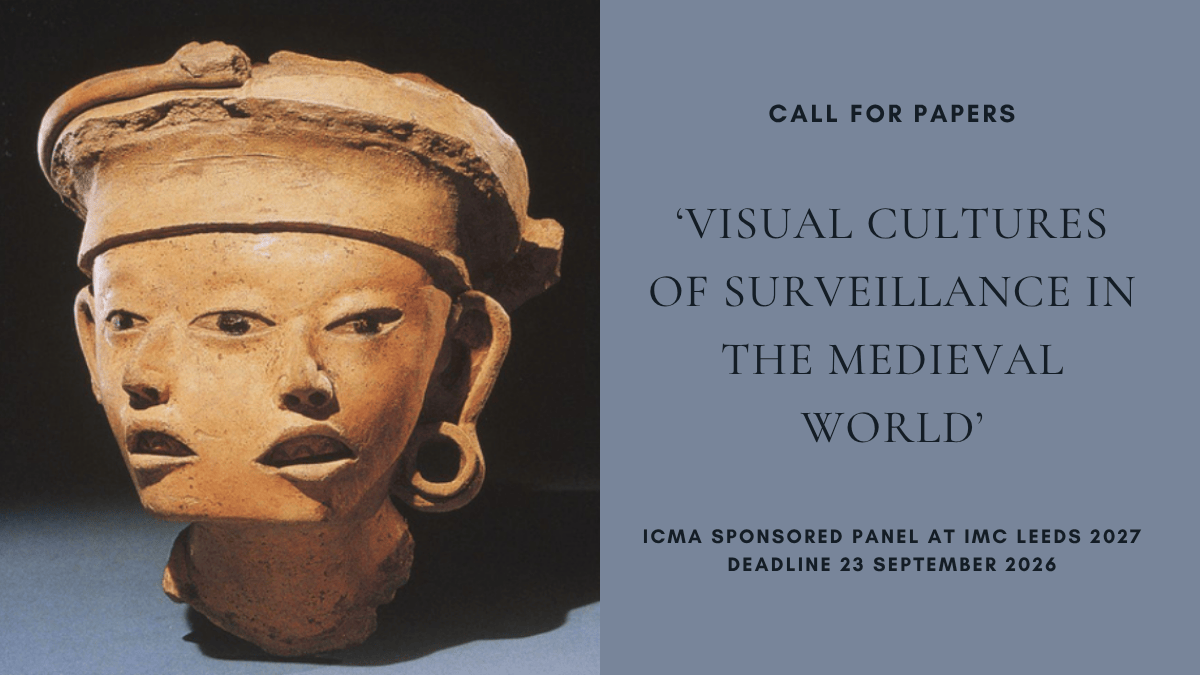
Medieval communities were subject to, and themselves produced, forms of surveillance. Among other forms of coercion — corporal punishment, rents and taxation, patriarchal authority, banishment — surveillance reinforced social and political power imbalances and shaped behavior both within and between communities. Social, bureaucratic, and carceral structures facilitating surveillance commonly marked the production of works of art: scribes and illuminators labored in Italian prisons, courts dictated the terms under which artists worked, and late-medieval artisans were legally required to shape their wares before open windows. Art was also often understood to possess its own powers of surveillance: oversize figural monuments presided over marketplaces, badges made legible their bearers’ political allegiances, and multiple miracle stories imagine the eyes of an icon tracking its devotees.
This panel asks how surveillance shaped the making of medieval art and how objects and images attest to, enact, or even expose medieval modes of surveillance. Attending to such intersections of the visual and the carceral, this panel seeks contributions that interrogate the liberatory assumptions that often underwrite the equation of art with
community.
Topics might include:
- Medieval “surveillance technologies”
- Coercive patronage
- Guilds and licensing organizations
- Medieval theories of privacy
- Works depicting surveillance
- Architecture and control
- Theories of optics and perception in their social contexts
- Mobility and its restrictions
- Strategies of occlusion
- Connections between medieval visual culture and contemporary activist artists
We are seeking proposals for papers 15 – 20 minutes in length. Please send an abstract (max. 300 words) and current CV to Luke Fidler (lfidler@usc.edu) and C.B.Boxer (c.boxer@bucknell.edu) by 23 September 2026.
Discover more from Medieval Art Research
Subscribe to get the latest posts sent to your email.

