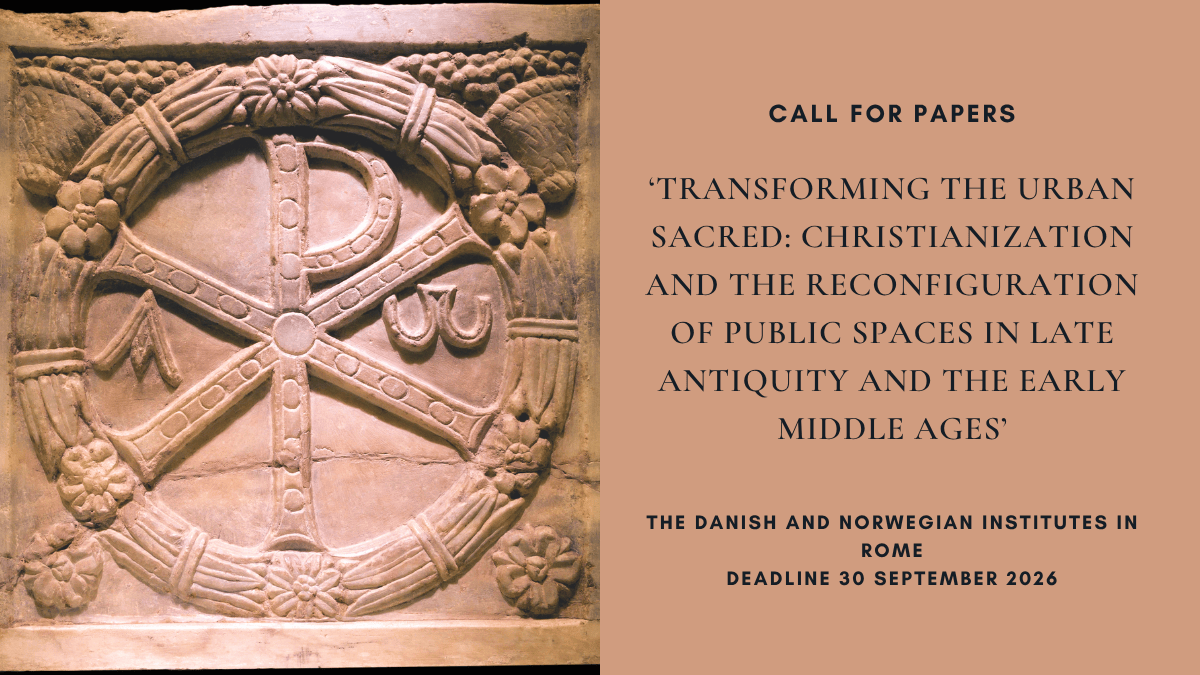
Deadline: 30 September 2026
Dates: 19th-21st January 2027
Location: The Danish and Norwegian Institutes in Rome
This interdisciplinary workshop explores the dynamic processes by which traditional Roman public spaces were reimagined, adapted, and transformed to accommodate emerging Christian identities and practices from the 4th to the 8th centuries CE. In this context, the ‘urban sacred’ is understood as a dynamic dimension of urban space, constructed through the interaction of ritual practice, social imaginaries, and material markers. It refers not only to formally consecrated places such as temples, churches, or shrines, but equally to streets, houses, workshops, cemeteries, and other civic arenas, where sacredness was experienced and redefined. Codes and signs, whether permanent, like built monuments, or ephemeral, like gestures, sounds, and ritual performances, inscribed the divine into the city, shaping boundaries between sacred and profane. The ‘urban sacred’ therefore draws attention to how religiousness, understood as both individual and collective, was embedded in the lived city, transforming it into a mosaic of sacred and profane spaces that mediated identity, hierarchy, memory, and power.
Key notes and confirmed speakers:
- Prof. P. Liverani (University of Florence)
- Prof. T. Myrup Kristensen (Aarhus University)
- Prof. B. Ward-Perkins (University of Oxford)
- Prof. C. Machado (University of St. Andrews)
- Prof. S. Malmberg (University of Bergen)
- Dr. C. Videbech (University of Bergen)
Bridging archaeology, epigraphy, art history, the study of religion, history and literary studies, the workshop investigates how these traditionally non-Christian spaces were gradually and sometimes radically converted into spaces fitting for the Christian cityscape. We aim to highlight the complexity of these transformations, focusing not only on imperial, aristocratic, or episcopal initiatives but also on the roles of local communities, pilgrims, and non-elite groups in claiming and shaping public environments.
The workshop encourages contributions that leverage a wide range of evidence: archaeological remains, iconography, inscriptions (especially graffiti), architectural modifications, and written sources to shed new light on how the Christian cityscape emerged from and overlaid the traditional Roman urban fabric. Innovative digital approaches, such as GIS mapping, 3D reconstruction, and digital epigraphy, are especially welcome for their potential to visualize and reinterpret these transitions.
The aim of the workshop is to offer a unique forum for interdisciplinary dialogue on the transformation of Mediterranean cities through Christianization, with special attention to the interplay between elite and popular agency and the creative use of digital methodologies.
We welcome proposals that engage with the following, or related, themes:
- The role of Christian graffiti and inscriptions in appropriating and reconfiguring traditional public spaces.
- Non-elite agency and popular expressions of faith within the urban fabric of cities within the former Roman Empire.
- Interactions between ecclesiastical authorities and popular Christian communities in shaping the city’s sacred topography
- Transformation of civic and non-Christian buildings for Christian liturgical or communal uses
- Graffiti and epigraphic evidence as markers of Christian presence and appropriation of public spaces
- The interplay between pagan memory and Christian innovation in urban topography
- Pilgrimage and the sacred geography of public spaces in Late Antiquity and the Early Middle Ages
- Comparative perspectives on the transformation of public spaces across the Late Antique and Early Medieval Mediterranean
- • Christian and pagan coexistence and interactions in archaeological and textual records
- Everyday Christian practices and the creation of sacred space beyond monumental churches
- Interactions between popular devotion, martyr cults, and urban topography
- Comparative analyses of elite and non-elite roles in Christianization processes
Submission Guidelines:
Please submit a 300-word abstract along with a short academic CV by 30th of September 2026.
Abstracts should demonstrate how they engage with the workshop themes, with particular attention to interdisciplinary perspectives and/or the use of digital methods.
We especially encourage submissions from early-career scholars. Selected contributions will be considered for publication in a peer-reviewed edited volume or a special journal issue; if you wish to be considered, please indicate this in your proposal. Send proposals to: Christina.videbech@uib.no
Discover more from Medieval Art Research
Subscribe to get the latest posts sent to your email.

