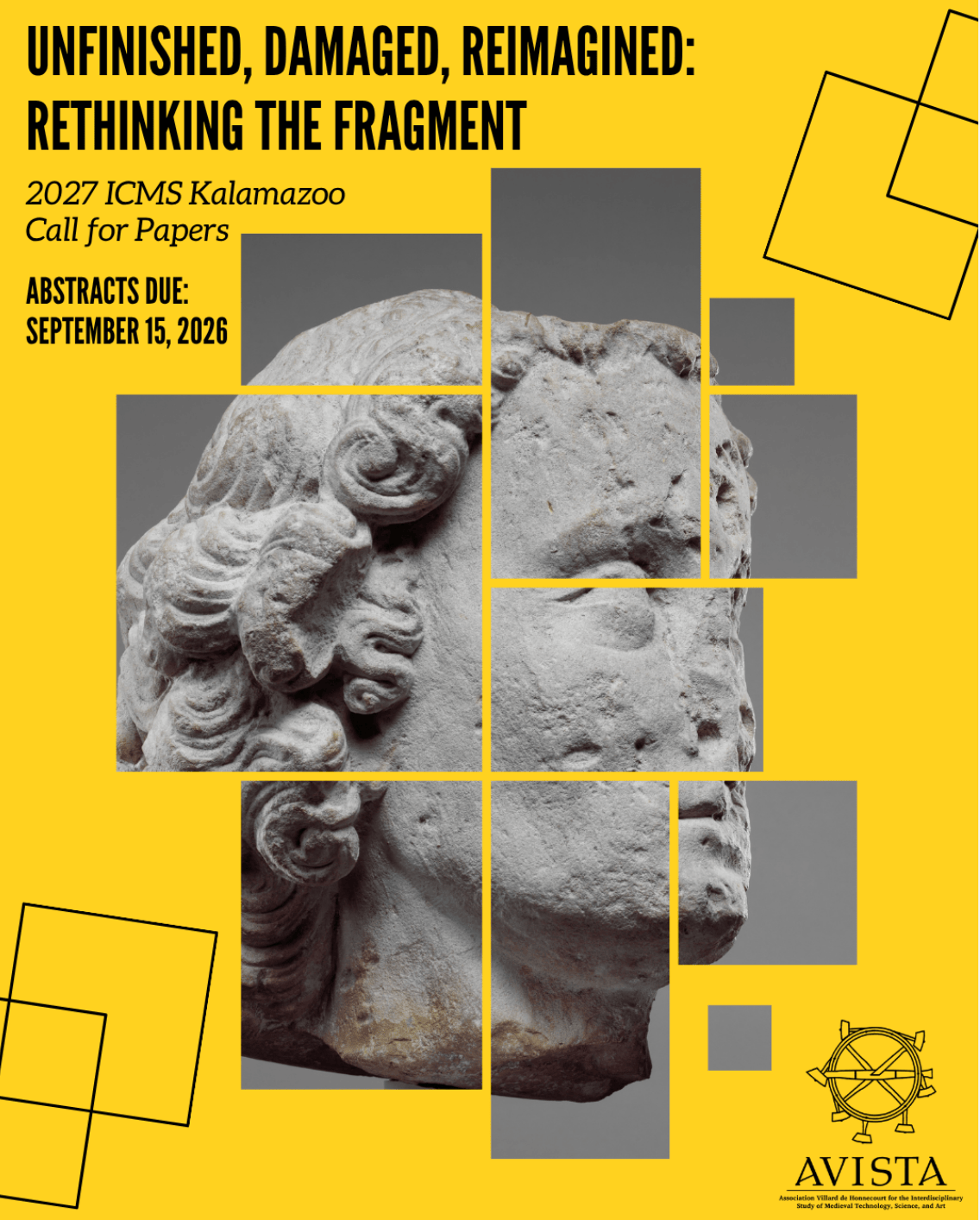
AVISTA is pleased to invite submissions to its sponsored hybrid session, Unfinished, Damaged, Reimagined: Rethinking the Fragment, at the 2027 International Congress on Medieval Studies (Kalamazoo, MI, 13–15 May 2027)
Rarely do material traces of the premodern world survive without damage or alteration. In response, the fragment has emerged in recent years as a productive theoretical framework for understanding the present condition of medieval objects, buildings, and archives. AVISTA’s emphasis has long been on the intersection of medieval art, craft, and technology. In line with this focus, this session seeks papers which present new case studies of the fragment. This includes medieval objects or buildings which have either been reconstructed or, in their current state, are incomplete or damaged. We also seek to broaden discussion of the medieval fragment to include works abandoned in process, or those which were not finished following their original plan. While this concept has gained traction in manuscript studies, the notion of the unfinished has been less discussed in architecture, even though there are many prominent examples (the cathedrals of Beauvais, Narbonne, and Siena to name a few). We invite interdisciplinary papers, representing all disciplines and geographies, to take up unfinished, damaged, or reimagined medieval objects.
Speakers may discuss, for example, repaired or transformed objects, architecture that was never completed or has since been lost, as well as medieval and modern efforts to complete the fragment. Objects, topics, and methodologies may include but are not limited to:
– Digital twins and reconstructions of lost objects and buildings
– Repair techniques and materials (such as lead, mortar, etc.)
– Abandoned or incomplete building campaigns
– Objects which incorporate found material, such as cameos, gems, or crystals
– Relics or their traces, such as relic labels or scraps of textile
– Manuscript fragmentology
– Case studies of building damage caused by fire, natural disasters, or structural collapse
– Spolia or other objects removed from their original context
– Examination of polychromy
– Reuse of building materials, such as stone, timber, or lead
– Broken and/or repaired sculpture
– Archeological finds including pieces of textile, metalwork, or ceramic
For additional information, including selected bibliography, please see the AVISTA website. All abstracts must be submitted by September 15, 2027 through the ICMS Confex portal: https://icms.confex.com/icms/2027/prelim.cgi/Session/8645. Interested presenters should email the organizers, Tori Schmitt (torischmitt@ucla.edu) and Gabriela Chitwood (gabriela.chitwood@gmail.com), if questions arise.
More information can be found on this website.
Discover more from Medieval Art Research
Subscribe to get the latest posts sent to your email.

