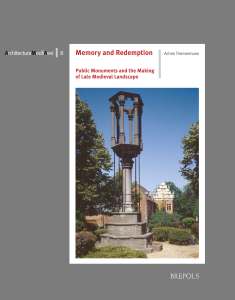
 Decorated Revisited
English Architectural Style in Context, 1250-1400
Edited by John Munns
ISBN 978-2-503-55434-1
Thirty-Five years after the publication of Jean Bony’s seminal work on the so-called Decorated style of English architecture (The English Decorated Style: Gothic Architecture Transformed, 1979), this volume brings together a selection of groundbreaking essays by the most promising emerging scholars of English medieval architecture, together with contributions by two of the leading established authorities on the subject: Nicola Coldstream (The Decorated Style: Architecture and Ornament, 1240-1360, 1994) and Paul Binski (Gothic Wonder: Art, Artifice, and the Decorated Style, 1290–1350, 2014).
The contributors revisit Bony’s work and reassess the scholarly legacy of the past three-and-a-half decades. Drawing on a range of innovative methodologies, they then present exciting new insights into the nature and significance of English architecture in the period, focusing particularly on its broader European context. The essays are developed from papers delivered as part of a major seminar series at the University of Cambridge in 2013-14.
John Munns teaches the history of medieval art at the University of Cambridge since 2011, where he is a Fellow and Director of Studies at Magdalene College.
More info: http://bit.ly/2lfNQ8K
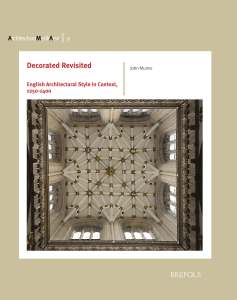 Memory and Redemption
Public Monuments and the Making of Late Medieval Landscape
By Achim Timmerann
ISBN 978-2-503-54652-0
Erected in large numbers from about 1200 onwards, and featuring increasingly sophisticated designs, wayside crosses and other edifices in the public sphere – such as fountains, pillories and boundary markers – constituted the largest network of images and monuments in the late medieval world. Not only were they everywhere, they were also seen by nearly everyone, because large sections of the populace were constantly on the move. Carrying an entire spectrum of religious, folkloric and judicial beliefs, these monuments were indeed at the very heart of late medieval life. This is the first critical study of these fascinating and rich structures written by a medievalist art historian. Focusing on the territories of the former Holy Roman Empire, this investigation considers such important edifices as the towering wayside crosses of Wiener Neustadt and Brno or the elaborate pillories of Kasteelbrakel and Wrocław, though less ostentatious works such as the Bildstöcke of Franconia and Carinthia or the high crosses of Westphalia and the Rhineland are equally examined. In addition, the study looks at the homiletic, literary, devotional and artistic imagination, in which wayside crosses and other such structures helped constitute a spiritual and allegorical landscape that very much complemented and put pressure on the physical landscapes traversed and inhabited by the contemporary public.
Achim Timmerann teaches medieval and northern Renaissance art and architecture at the University of Michigan, Ann Arbor. He is author of Real Presence: Sacrament Houses and the Body of Christ, c. 1270-1600.
More Info: http://bit.ly/2xELbLf
Discover more from Medieval Art Research
Subscribe to get the latest posts sent to your email.
 Medieval Art Research