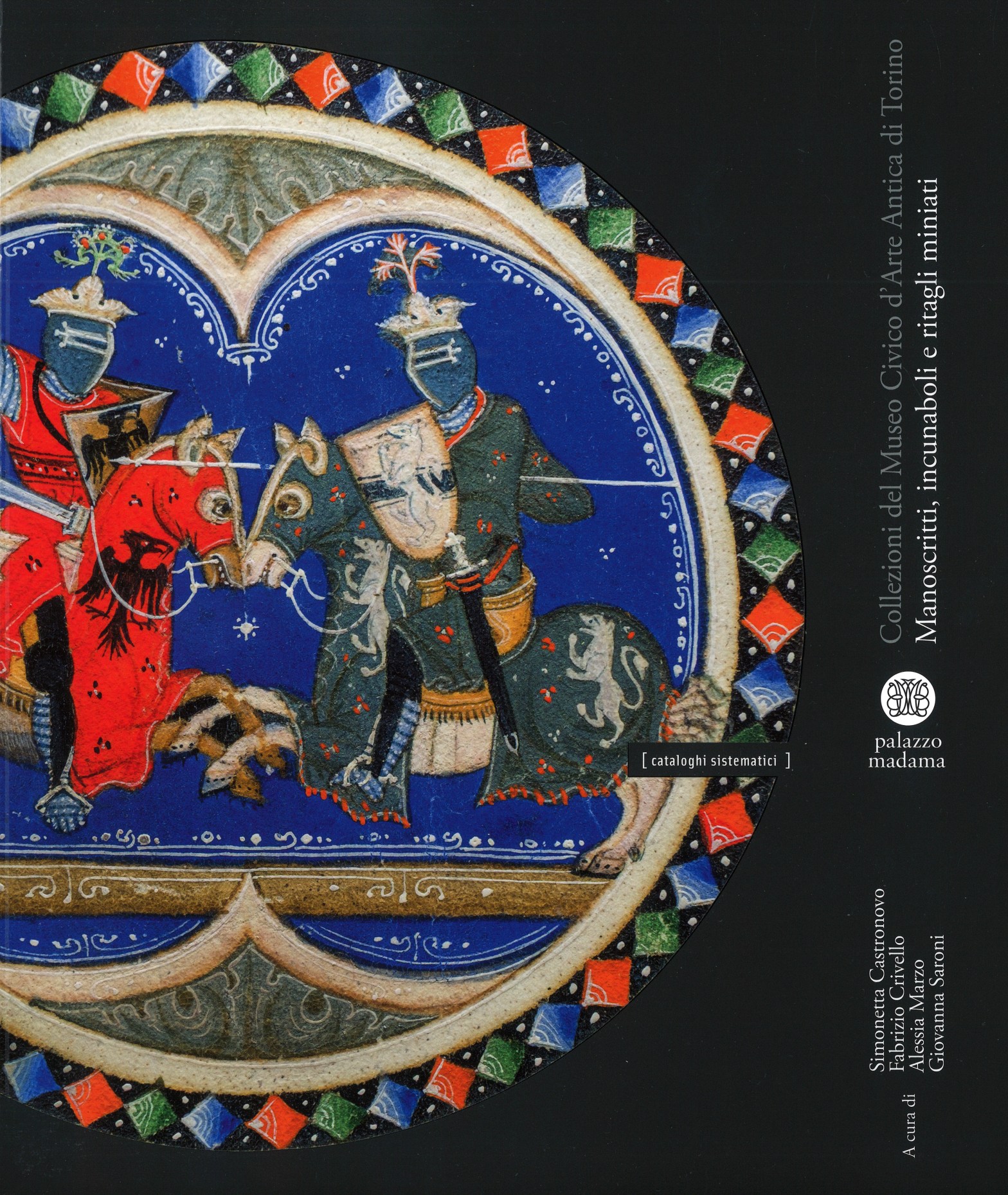
The catalogue of the Museo Civico’s illuminated manuscripts and cuttings has been realised thanks to a joint project between Palazzo Madama and Turin University, named “Miniature Rivelate”. The project started in 2020 and lasted five years, bringing together art historians, incunabula scholars, paleographers, liturgy specialists, chemists, photographers. This rich collaboration is reflected in the volume, which has contributions of 33 authors.
The collection counts twenty manuscripts and eighty-four fragments (almost all unpublished), dated between 1270 and 1510, seven illuminated incunabula and three pastiches. Among them, there are works by well known Italian illuminators, such as Nicolò di Giacomo, the Master of the Book of Hours of Modena (Tomasino da Vimercate), Francesco Marmitta; and, by French and Flemish artists (Antoine de Lonhy, Jean d’Ypres). But the collection also retains the only surviving manuscript by Jan van Eyck, the so called Heures de Turin-Milan: a collective masterwork, that combines illuminations by Jean d’Orléans, Jan van Eyck and his followers. Moreover, within the cuttings’ collection it has been possible to discover medieval fragments realised in Italian regions generally less well known to studies, such as Friuli, Genoa, and the Abruzzo.
The book also dwells on the theme of the “fortuna dei primitivi” in the XIXth century, between Italy and Europe. As is known, at the end of the nineteenth century the interest in the Middle Ages and the early Renaissance, evident in many artistic and cultural fields, also invested illuminated books. Following the Napoleonic suppression of the religious orders (1810), all the ancient volumes, until then preserved in monastic libraries, were alienated and often dismembered. The illuminations, cut out and placed on the antiques market, were in fact sought after by many collectors. It was precisely in this period that the manuscripts and fragments illustrated in the catalogue entered the Museo Civico of Turin, almost all acquired between 1863 and 1897.
For these acquisitions, the museum did not follow stylistic criteria or artistic geography, but judged the illuminations – according to the positivist approach typical of the art and industry’s museums of the time –, as precious evidence of Medieval and Renaissance book art and possible useful models for contemporary graphic designers, illustrators and publishers. This explains the heterogeneity of the collection, formed by manuscripts and cuttings of many geographical provenances and chronologies. Given this course, it is more understandable that, once faded the utopia of influencing the modern craftsmanship, the Museum totally dropped the interest in book illumination, insomuch that – apart from a few exceptions – no acquisitions are recorded after 1897, and only in very recent years- since 2000 – a few books have again made their entrance into the collection.
The catalogue, counting 545 pages and lavishly illustrated, also has an appendix discussing the results of the non-invasive analyses carried out on all the illuminations. Both the diffuse reflectance spectrophotometry (FORS) and the X-ray fluorescence spectrometry (XRF) techniques, have allowed to analyze inks and gildings and, above all, to learn the composition of the pigments and dyes employed by the artists, thus giving extra clues about the prestige of certain miniatures.
The book can be ordered from Amazon: https://amzn.eu/d/01J4pCiE or through this website: https://lartisticasavigliano.it/lartistica-editrice/ (ISBN 978-88-7320-493-0)
Discover more from Medieval Art Research
Subscribe to get the latest posts sent to your email.

