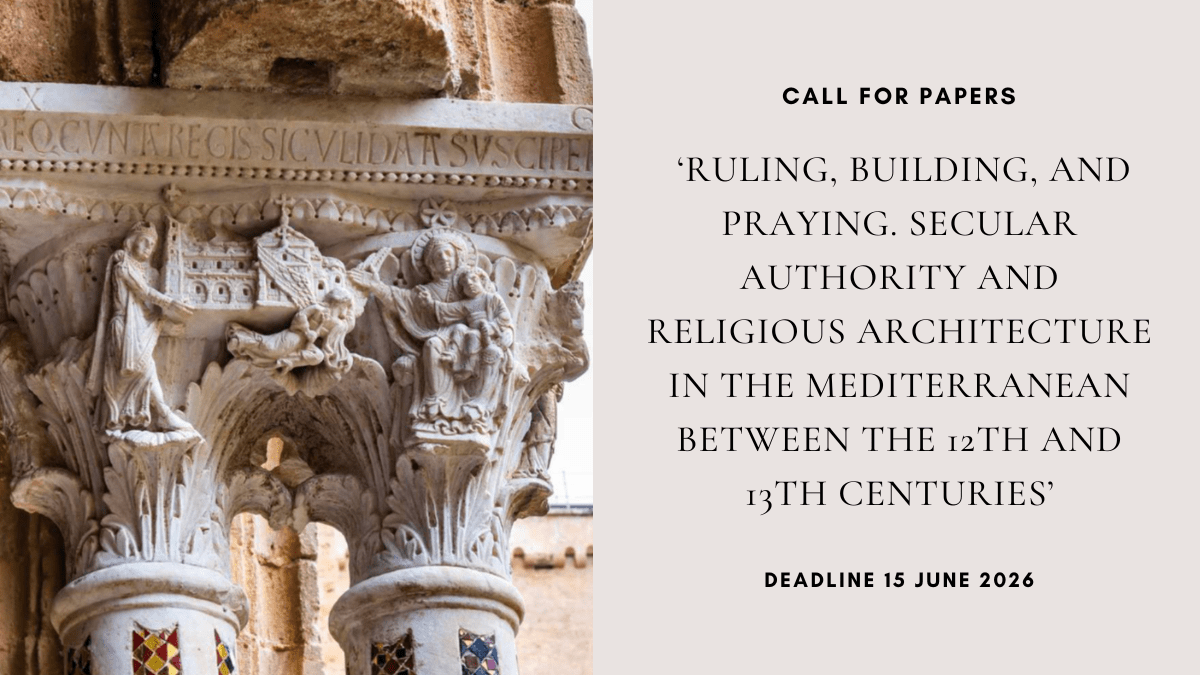
Between the 12th and 13th centuries the Mediterranean was a space of intense political transformation and cultural interaction. In this context, architecture became one of the most visible expressions of power, identity, and legitimacy. Religious buildings in particular often played a key role in representing the authority of rulers, serving not only as places of worship but also as instruments of political communication and symbolic control.
The conference aims to explore the relationship between secular authority and religious architecture in the Mediterranean world during this crucial period. Particular attention will be paid to the ways in which rulers, dynasties, and political elites promoted, transformed, or appropriated religious buildings to assert their power and shape the urban and territorial landscape.
Relevant examples include the architectural policies promoted by figures such as Frederick II, James II of Aragon, and other rulers who used religious architecture as a means of political representation and legitimation. The conference also welcomes studies on episcopal initiatives, monastic foundations, and other forms of patronage connected to the interaction between political authority and sacred architecture.
The conference will encourage interdisciplinary approaches combining history of architecture, art history, archaeology, and medieval studies, with particular attention to case studies, methodological reflections, and comparative perspectives across different regions of the Mediterranean.
Find out more on the conference website.
Proposals may address, but are not limited to, the following themes:
- Patronage and political strategies in the construction or transformation of religious buildings
- The role of rulers and political elites in shaping sacred architectural landscapes
- Architectural programs linked to processes of conquest, consolidation, or territorial control
- Interactions between secular and ecclesiastical authorities in the promotion of religious architecture
- Symbolic, liturgical, and representational functions of religious spaces connected to political power
Proposals must include:
- title of the contribution
- abstract (maximum 300 words)
- short CV of the author (maximum 150 words)
Proposals must be sent by 15 June 2026 to the email address: mediterraneomedievale@gmail.com
Papers should not exceed 20 minutes, and poster presentations should not exceed 10 minutes.
The Scientific Committee will evaluate the submitted proposals by 30 June and will communicate their acceptance, if any, as a paper or as a poster, inserting them in the session of the Conference deemed most suitable.
The contributions presented at the Conference will be published as a monographic volume within the series “Architettura Medievale” (edited by Silvia Beltramo and Carlo Tosco), published by All’Insegna del Giglio. Posters admitted to the dedicated session will also be granted adequate space in the publication.
The languages of the Conference are: Italian, English, French, and Spanish.
The Conference organization will provide participants and grant recipients with lunches on 2 and 3 October, dinners on 1 and 2 October, and coffee breaks.
Grants For Early-Career Researchers
Three scholarships are available for PhD candidates in History of Architecture, History of Art, and Archaeology. The grants will cover accommodation and meals, while travel expenses will be borne by the participants. During the days of the Conference, grant recipients will collaborate with the organizing committee in the management of activities. Applicants are required to submit an updated curriculum vitae and a letter of motivation to the email address mediterraneomedievale@gmail.com no later than 31 May 2026.
The selection will be carried out by the Scientific Committee, and the results will be communicated by 30 June 2026.
Funding for the scholarships is guaranteed by the contribution of the Fundació Institut Amatller d’Art Hispànic and the Parco Archeologico delle Isole Eolie.
Important Dates
- Deadline for submission of proposals: 15 June 2026
- Deadline for submission of scholarship applications: 31 May 2026
- Notification of acceptance of proposals and scholarship applications: 30 June 2026
- Conference dates: 1–2–3 October 2026
Scientific Secretariat: Fabio Linguanti
Organizing Secretariat And Information: Arianna Carannante, Fabio Linguanti
Info And Communications: mediterraneomedievale@gmail.com
Discover more from Medieval Art Research
Subscribe to get the latest posts sent to your email.
 Medieval Art Research