Location: Fondazione MIA, Bergamo, Italy
Dates: 21-22 May 2027 with an optional field trip on 23 May
Submission Deadline: 30 October 2026 (applicants will be notified of their participation by December 15, 2026)
Conference languages: English and Italian
Choir stalls sit at a unique intersection of liturgical function, architectural framework, and virtuosic craftsmanship. Located at the heart of the sacred interior, these wooden structures served not only as functional seating for the clergy but as primary sites for complex visual and intellectual play. This conference seeks to explore the conceptual, material, and sensory dimensions of illusion and imitation in European choir stalls from the medieval to the early modern periods.
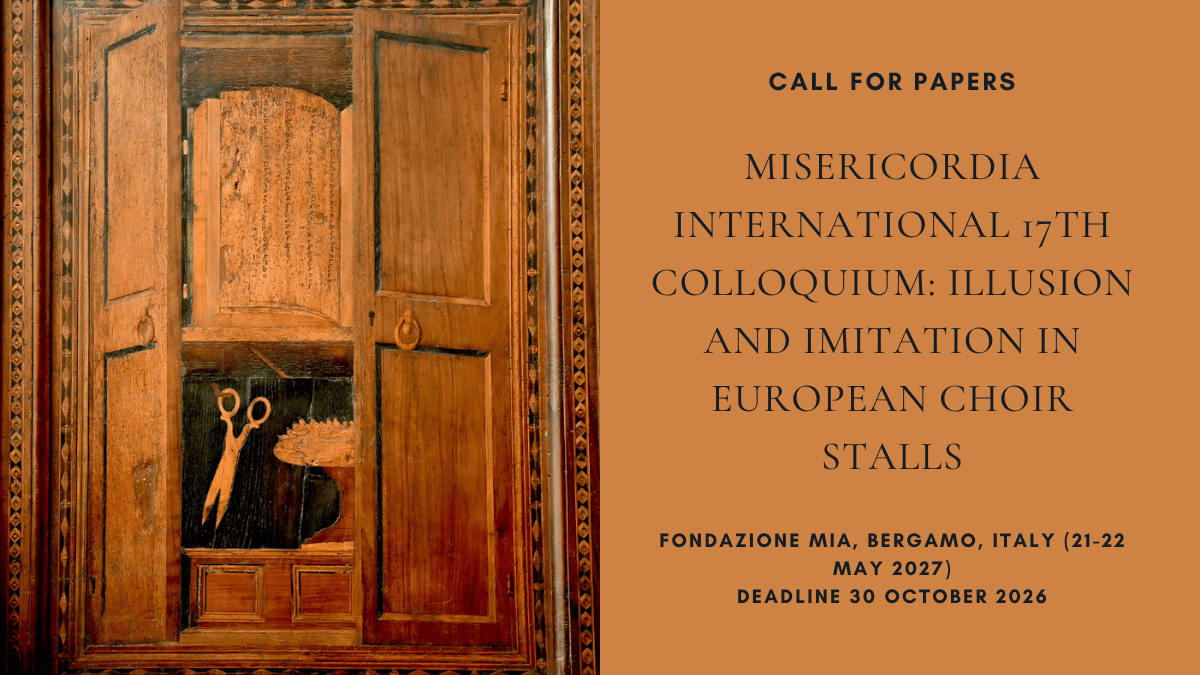
Far from being mere decorative backdrops, choir stalls frequently engaged in sophisticated visual deception. From the dazzling perspectival illusions of Italian intarsia (wood inlay) to carvings that deliberately manipulate their own materiality, these spaces challenged the eye and the mind. They functioned as micro-architecture, mirroring the grand designs of cathedrals, while simultaneously testing the boundaries between the real and the simulated.
We invite papers that investigate how these woodcarvings played with the senses, collapsed spatial boundaries, and negotiated the tense relationship between truth and falsehood within a sacred environment.
Suggested Themes & Topics
We welcome interdisciplinary proposals addressing, but not limited to, the following themes:
- Perspectival Illusion and Spatial Deception: The development of trompe l’œil and perspective in Italian intarsia; how flat surfaces were manipulated to create deep, simulated spaces (urban and architectural views , cupboards, landscapes, liturgical objects)
- The Mimesis of Materiality: Wood carved or painted to imitate other media (textiles, metalwork, or stone); the theoretical and theological implications of material deception in a sacred space
- Micro-Architecture and Scale: Choir stalls that imitate, miniaturize, or subvert grand architectural forms; the dialogue between the wooden stall and the stone church fabric
- Models, Copies, and Circulating Designs: the transmission of motifs through drawings, prints, sculpture, or the movement of artists and artisans
- Engaging the Senses: How illusionary carvings interacted with the multisensory environment of the choir (liturgical music, candlelight, incense, tactile touch); the tension between sight and somatic experience.
- Theology, Truth, and Lie: The paradox of using visual “deception” (illusion) to elevate the sacred; late medieval and early modern debates on artificiality and devotion.
Submission Guidelines
We invite proposals for 20-minute papers. Submissions from established scholars, early career researchers, and curators are all highly encouraged.
Please submit an abstract of no more than 300 words along with a brief biography (maximum 150 words) to Lorenzo Mascheretti lor.masche@gmail.com and Joanne Allen drjoanneallen@gmail.com by 30 October 2026.
Discover more from Medieval Art Research
Subscribe to get the latest posts sent to your email.

