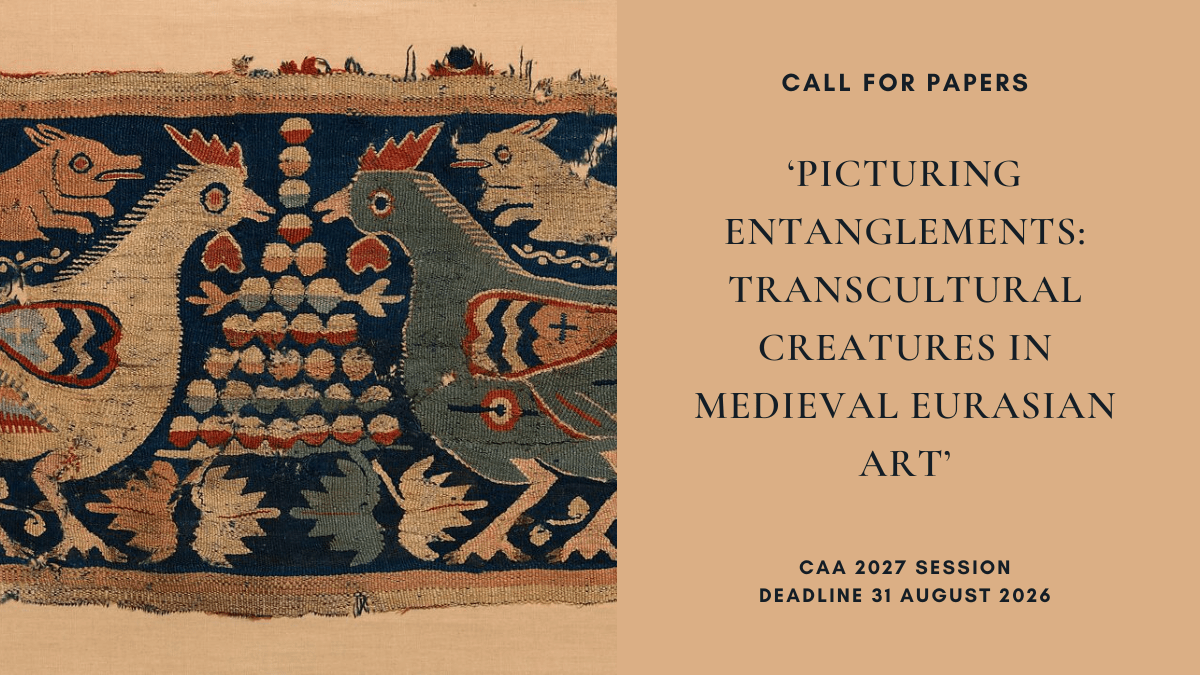
Picturing Entanglements: Transcultural Creatures in Medieval Eurasian Art, session at the College Art Association 115th Annual Conference, New York City, February 3–6, 2027
The session will be held on location.
From the simurgh perched on Sasanian textiles to dragons coiling through Yuan porcelain, creatures—real and imagined—were among the most mobile and mutable figures of the medieval Eurasian visual world. They migrated across textiles, metalwork, ceramics, paintings, manuscripts, and prints, shedding and acquiring attributes as they crossed linguistic, religious, and political frontiers. A phoenix in East Asia was not quite a simurgh in the Islamic world, yet the two could share a silhouette, or hybridize altogether. Such creatures did not merely illustrate cross-cultural exchange; they were the very vehicles through which artists, patrons, and viewers co-produced meaning, continually transforming and reinvesting these figures with new significance in the process.
This panel convenes scholars working across the art histories of the Eurasian visual world to examine how zoomorphic imagery materialized transcultural entanglement between roughly 500 and 1500 CE. We invite papers that treat creatures as agents rather than ornaments: as carriers of diplomatic meaning, as sites of iconographic negotiation, as problems of translation, and as catalysts for artistic invention. Why did artists adapt foreign beasts to local visual idioms? What was lost, gained, or generated in the passage? How might attention to creaturely imagery help us move beyond diffusionist models toward richer accounts of medieval connectivity? Interdisciplinary approaches, including those drawing on the environmental humanities and material studies, are especially welcome.
The call for papers is open until 31 August. Please log on to the CAA website to submit your title, abstract and CV.
Session chair: Yuxi Pan, SOAS University of London
Discover more from Medieval Art Research
Subscribe to get the latest posts sent to your email.

