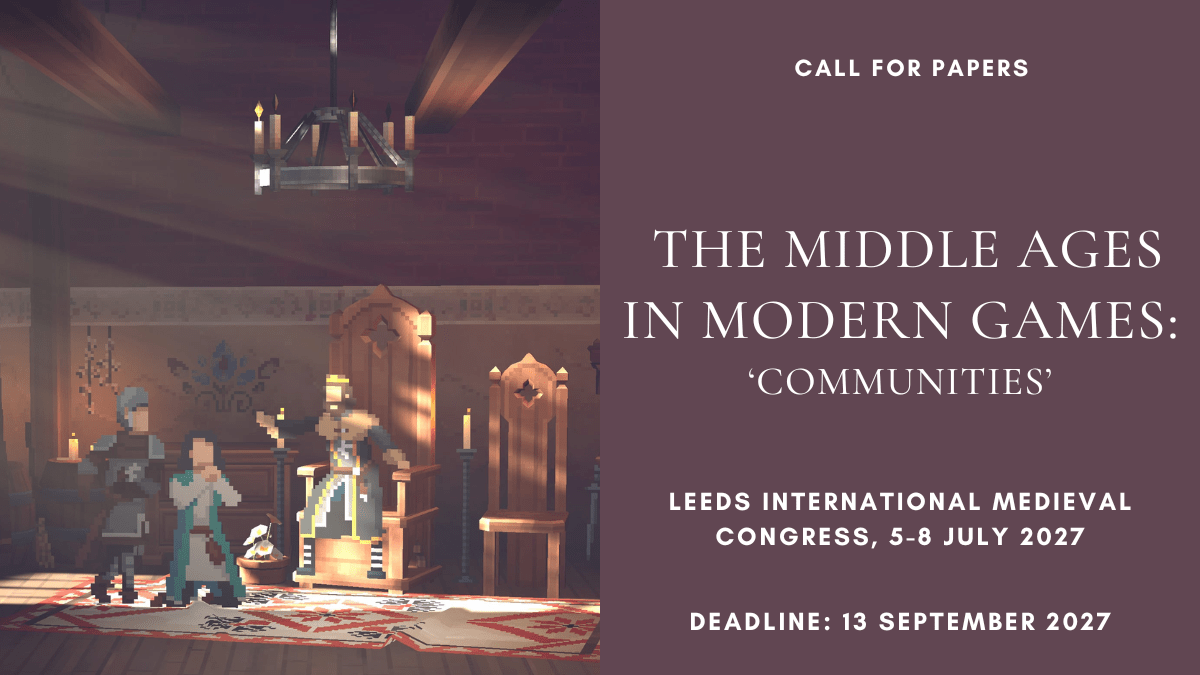
The Centre for Medieval and Renaissance Research at the University of Winchester is pleased to sponsor The Middle Ages in Modern Games strand at the Leeds International Medieval Congress, 5 to 8 July 2027. This strand examines the use of social groups, hierarchies, and other themes related to the congress theme of “Communities” in the design, representation, reception, and discussion of the Middle Ages in modern games.
Games of all varieties engage communities in some way or another. In its most fundamental state, communities are social structures which organize people according to shared characteristics. Within medievalist games, these structures organize characters–both playable and non-playable–around shared identities, ideologies and practices. In-game communities are encounterable as interactive systems that players can dynamically influence through mechanics of cooperation, governance, reputation, trade, conflict, and beyond. As an interactive media, relationships with in-game communities can directly influence player choices and narrative outcomes, making player-community interactions an integral way to sort and categorize player behavior. The influence of these community structures extend beyond the games in which they appear: as reflections of medieval and modern perceptions of society, they can reflexively shape public understandings of communities within the historic medieval past. Furthermore, beyond games, players self-sort into communities such as guilds and clans, often reflecting medieval ways of social organization.
We welcome pieces dealing with any region of the globe, and within a broad definition of ‘medieval’—including the fantasy genre. We invite papers and sessions (of 3-4 papers) addressing any aspects of the medieval period or medievalism in any forms of digital or tabletop games, but we particularly welcome any submissions which engage with ‘Communities’ broadly defined.
Topics may include (but are not restricted to):
- Teaching Medieval Communities through Games
- Membership and inclusion within communities; “the Other”
- Religious groups within medievalist games
- Migration and mobile communities
- Race, ethnicity, and cultural identity-based communities
- Gender, sexuality, and queer communities
- Chosen families and alternative kinship structures
- Colonialism, indigeneity, and community representation
- Assimilation, hybridity, and multicultural communities
- Community lines along social class and/or castes
- Enclaves, splinter cells, and secession
- Communities of violence and disruptive communities
- Cooperation and obligation within medievalist games
- Relationship and favorability mechanics in medievalist games
- Guild systems in massive multiplayer online games (MMOs)
- Language and visual signifiers of communities
- Player communities of medievalist games
- Positive and negative community exchanges
We encourage submissions from medievalists or games and media scholars and professionals at any point in their career—Postgraduate Students, Early Career Researchers, Independent Scholars and members of any groups under-represented within the academy are particularly welcome.
The strand will be submitted to the International Medieval Congress at Leeds and participation will be subject to the terms and conditions of the Congress. As in previous years, the conference will be fully hybrid and will allow for in-person or virtual participation.
Inquiries should be directed to midagesmodgames@gmail.com. Please submit abstracts of no more than 300 words, accompanied by brief biographies, as Word attachments by Sunday 13 September 2026.
Visit https://middleagesinmoderngames.net/ for more information.
Discover more from Medieval Art Research
Subscribe to get the latest posts sent to your email.

