École des Hautes Études en Sciences Sociales, Centre de Recherches Historiques (CNRS-EHESS), International Research Project MUDANZA
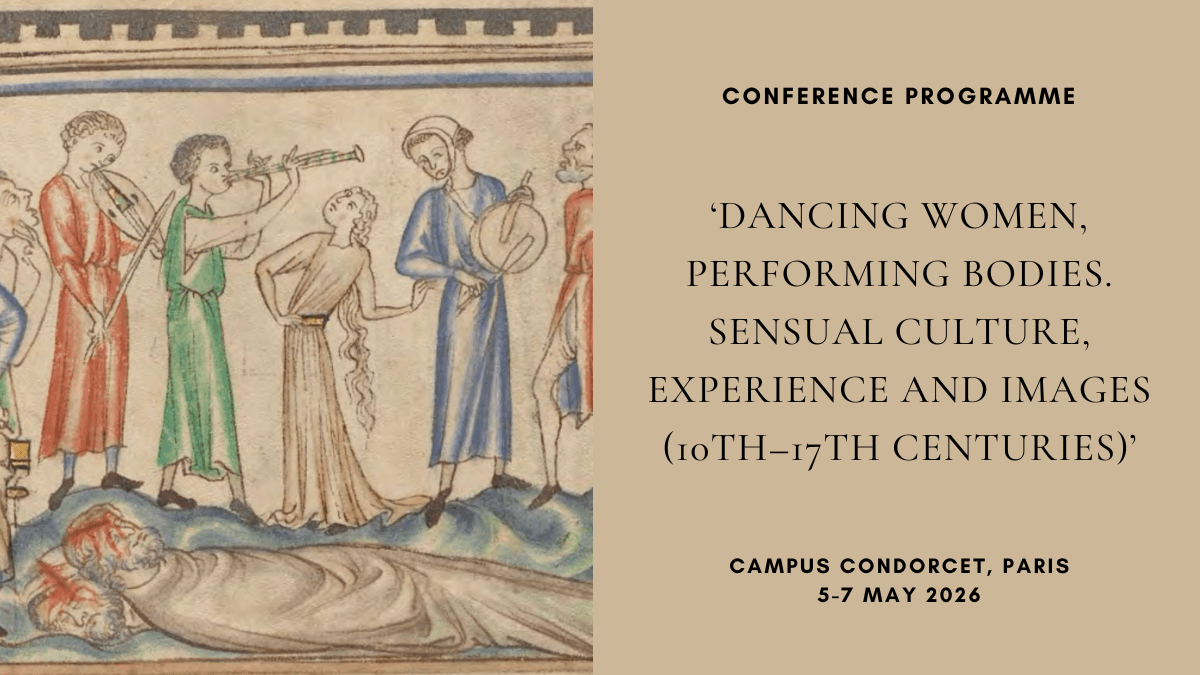
An international conference to be held in Paris (Campus Condorcet, Aubervilliers) on 5–7 May 2026 will explore the cultural and visual significance of dance in the medieval and early modern periods, with a particular focus on the female body.
Organised within the MuDanza research project (CNRS–EHESS), the event examines representations of dance in images and texts as key entry points into the study of social practices, rituals, and sensory experience. Special attention will be given to the role of women as central figures in both sacred and secular contexts, and to the ways in which dance reflects broader conceptions of the body, gender, and emotion between the 10th and the 17th centuries.
View more information about this conference on the conference website.
Tuesday 5 May, 2026
14h00 – Welcome Coffee
15h00: Opening Statements
15h30-18h30: Performance
Chair, Elizabeth Claire
- Barbara Crostini “Regaining Women’s Real Presence: Personifications and Allegories of Victories and Virtues as Legitimization for Female Performers”
- Lynneth Renberg “Mapping Sámi Movement: Gender, Race, and Dance in Premodern Scandinavia”
- Lindsey Drury “The bells, bells, bells, bells, bells, bells, bells. Dance and a clangoring tale of terror”
- Sara Petrella “Quand les objets parlent et les femmes agissent. Danser les Amériques, des représentations coloniales à la culture matérielle autochtone”
20h00 – Welcome Dinner For Speakers
Wednesday 6 May, 2026
8h30 – Welcome Coffee
9h30-12h30: Senses
Chair, Alessandro Arcangeli
- Carla Maria Bino “Saltare di gioia. Alcuni appunti sulla semantica psicofisica di gioia e danza tra Antico e Nuovo Testamento”
- Sari Katajala Peltomaa “Modelling experience, dancing and penance in the 15th century pastoralia of Vadstena Abbey”
- Martine Clouzot “Folies dansantes dans les images médiévales (XIIIe -XVe s.). Des corps performants et sensoriels de tous les genres, ou sans genre ?”
- Isabella Gagliardi “Più forte della morte è la danza: donne che ballano nei cimiteri medievali” [video-conference]
14h30-17h30: Dancing Women
Chair, Licia Buttà
- Alessandro Campeggiani “Le spectacle des corps des danseuses entre expérience mondaine et mystique. Un cas d’étude sur l’œuvre de Jacques de Vitry et les marginalia du Psautier rouge (XIIIe siècle)
- Maria Victoria Curto “Women who dwelt in non-duality: rupture, integration and transcendence through dance”
- Francesc Massip “La femme qui danse: chorégraphie en féminin à l’automne médiéval. La cour, la rue et l’église”
- Kathryn Dickason “Deca-dance in Motion: La Danse macabre des femmes and Twentieth Century Ballet” [video-conference]
Thursday 7 May, 2026
8h00 – Welcome Coffee
9h00-13h30: Images
Chair, Licia Buttà
- Eduardo Carrero Santamaria, “Singing and dancing the Cantigas de Santa Maria: Sources and Hypotheses”
- Adrien Belgrano, “Activer les sens et susciter les émotions. La carole de la Chatelaine de Vergy, du texte à l’image” Giulia DI PIERRO “Rejoicing Through Sinful Dance: The Death of the Witnesses in the Anglo-Norman Apocalypses (13th-14th C.)”
- Marina Nordera, “Troubles dans les plans du récit: vies de femmes dans La danse de sainte Marie Madeleine de Lucas de Leyde (1519)”
Closing Remarks: Alessandro Arcangeli, Licia Buttà, Elizabeth Claire
Discover more from Medieval Art Research
Subscribe to get the latest posts sent to your email.

