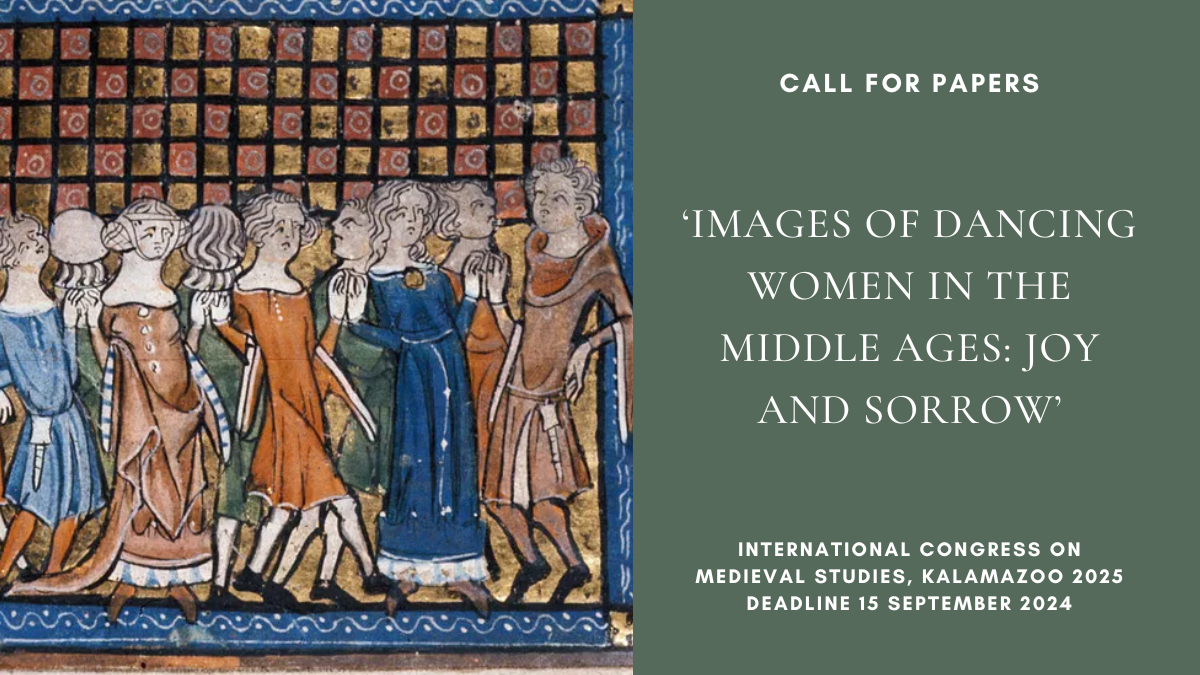
The session focuses on the close relationship that has been established since antiquity between the female body and choreographic movements. The iconography of dance has gained increasing ground in studies on the Middle Ages. Since the pioneering work of musicologist Tilman Seebass and art historian Jonathan J.G. Alexander, it has been clear that dance images, like the texts describing choreographic performances, are an exceptional means to deal with the history of the conception of the body and the centrality of religious and secular rituals, as well as a vehicle for interpreting exegetical approaches to sacred texts. Whatever the dance scenario, the importance of the dancing female body is evident both in the sacred sphere, with dance and celestial choruses of exaltation and praise to God, and in the imagination that stages idolatry, diabolical rites, or the perverse use of the body in earthly performances.
The tale of the young Muse, who converts the wholly worldly joy of dance into a prayer, becoming part of the choir of saints following the Virgin, or the dance of uncontainable joy of Miriam, sister of Moses, who celebrates the crossing of the Red Sea, are just two examples in which the joy that springs from movement deeply modifies the scenario and the protagonists of the narrative. In many medieval exempla, female dance turns into pain and suffering at the exact moment at which the female body is possessed by the devil. Literary, allegorical, and even historical dancing women reflect the medieval conception of the body and embody the dichotomy of joy and sorrow, which is expressed in the narrative capacity of gestures.
Through the study of the representations of dance, the aim of this session is to investigate the emotions linked to choreographic narratives. The objects of study could include the enjoyment of the celestial dance and its earthly mirror: the courtly dance, narratives of death and diabolical torments, ecstasy and possessions. Allegorical-courtly literature offers countless examples of dances of joy, as in the Roman de la Rose. Moreover, Islamic and Sasanian art left traces of the importance of dance in court ceremonials, as well as rituals, as in the case of the frescoes of Qusayr Amra or the several Sasanian silver bowls and ewers. In the production of material culture, objects also introduce the tactile dimension, in addition to sight and hearing, as the choreomusical scenes depicted on a plate, a jar or a gemellion were observed but also manipulated, understood and experienced in accordance with the rites in which they were displayed.
This session seeks to investigate the emotions generated by dance and music both in the performer and in those who observe the dance. The proposal is developed in the field of cultural history and the visual culture of dance in medieval Europe, Byzantium, Islam and beyond, and aims to provide a new vision of the role of the woman as dancing body, as a key element for investigating the history of emotions in the Middle Ages. The session will focus on approaches that take into account a methodology of image analysis with an anthropological and sociological dimension.
Delivery Mode: In-Person (The ICMA offers small travel subventions for the participants in this session)
Principal Sponsoring Organization: International Center of Medieval Art (ICMA)
Organizer: Licia Buttà, Rovira i Virgili University (licia.butta@urv.cat)
Proposals for papers will be accepted through September 15 and need to be submitted at: https://icms.confex.com/icms/2025/paper/papers/index.cgi?sessionid=6333
Discover more from Medieval Art Research
Subscribe to get the latest posts sent to your email.
 Medieval Art Research