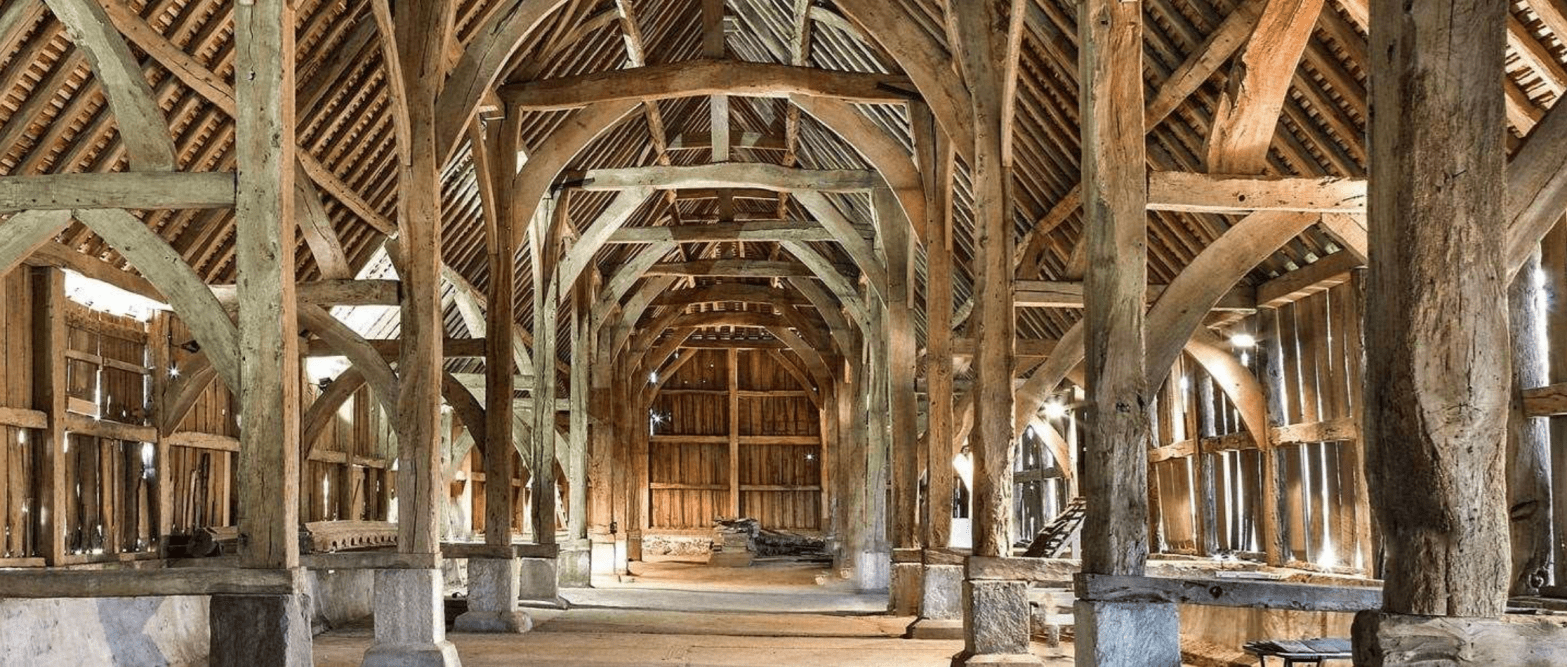
A conference hosted by English Heritage and the Friends of the Great Barn at Harmondsworth
Friday 4 – Saturday 5 September 2026
2026 marks the 600th anniversary of the construction of the ‘New Barn’ at Harmondsworth, the largest surviving medieval timber-framed barn in England. To celebrate this remarkable example of medieval architecture, English Heritage and the Friends of the Great Barn at Harmondsworth are hosting a conference in the Barn and the adjacent church of St Mary.
Described by the former Poet Laureate, John Betjeman, as ‘a cathedral’, Harmondsworth Barn was built in 1426. William of Wykeham, Bishop of Winchester, had bought the manor of Harmondsworth in 1391 as part of the endowment for Winchester College. Their medieval records show that the barns on the demesne farm were soon beyond economic repair and a replacement was planned in 1425. It is the longevity of this ‘New Barn’ we are celebrating. All those who now visit it are, like Betjeman, struck by the size, proportions and atmosphere of this magnificent structure, even though it was not designed as polite architecture. Its function was to store the agricultural produce from the manor.
Today the Barn’s significance lies in its extraordinary scale (over 58 metres/190 feetlong), the near-complete survival of its medieval structural timbers, its precocious features, and the exceptional survival of documentary evidence relating to its construction, ownership and use. Yet, despite its importance and more recent scholarship on comparable structures, there has only been one comprehensive study of Harmondsworth Barn this century. This conference aims to act as a catalyst for new research into medieval vernacular buildings, using Harmondsworth Barn as both case study and inspiration.
The name of Harmondsworth will be familiar to many not from its long history but from recent media reports of Heathrow Airport’s wish to build a third runway. It is still some years before a final decision on this will be taken by the Government, but the Barn, the village, and their surroundings are again threatened. It is thus an appropriate moment to celebrate the Barn’s survival and to remind ourselves of its significance, both national and local.
Themes and Scope
We invite proposals from everyone, including postgraduate students, early-career and more established researchers for papers that engage with Harmondsworth Barn and/or the construction and use of related buildings. Contributions may address, but are not limited to, the following themes:
- The architectural history, construction, and materiality of medieval barns
- Vernacular architecture and large-scale agricultural buildings in medieval England and northern Europe
- Documentary, archaeological, and scientific approaches to medieval agricultural structures
- Medieval farming, crop storage, and land management practices
- The relationship between vernacular architecture and ecology, landscape, or environmental history
- Conservation, repair, and heritage management of medieval timber-framed buildings
- The social, political, and economic contexts of medieval agricultural architecture
- Memory, community, and lived experience of Harmondsworth Barn as part of a working farm
- Threats to heritage sites from modern infrastructure and development
Interdisciplinary approaches are particularly encouraged, including perspectives from architectural history, archaeology, history, agricultural studies, environmental studies, conservation, and heritage practice.
A word from the hosts
English Heritage is a charity that is responsible for the conservation and enhancement of the National Heritage Collection of more than 400 historic sites and monuments across England, and a collection of over 1 million objects. Through these sites, English Heritage promotes public enjoyment, knowledge and education of our shared history and heritage, with the belief that heritage is for everybody.
The Friends of Harmondsworth Barn were founded in 2005 following a public meeting called by John McDonnell, the local MP, after the company that then owned the Barn went into receivership. The Friends’ committee work to secure the preservation, maintenance and upkeep of the Barn as a heritage building, and to promote access to the Barn for the general public. When English Heritage acquired the Barn in 2011 the Friends were invited to manage it for EH.
This conference has been made possible with generous support from the Paul Mellon Centre for Studies in British Art.
Speakers and Audience
The conference will welcome a broad audience, including academics, students, heritage professionals, members of English Heritage and architectural and archaeological societies, and the general public. Reduced-rate tickets will be available for local residents and students.
Submission Guidelines
In your paper proposal, please include:
- Title of your paper (please keep this concise)
- Brief abstract (max 250 words)
- Oral or poster presentation. If oral, preferred speaking time (20 or 30 mins)
- Biography including affiliations (or if independent/freelance) (max 100 words)
- Email address
- Social media handles
Please send abstracts and biographies to: harmondsworth600@english-heritage.org.uk
The submission deadline is Friday 20 March 2026 at 12 noon.
You will be notified if your paper has been accepted by 4 May 2026.
Further details regarding the programme, accessibility, and travel will be circulated once speakers have been confirmed. For any other queries, please do email the address above.
Discover more from Medieval Art Research
Subscribe to get the latest posts sent to your email.
 Medieval Art Research