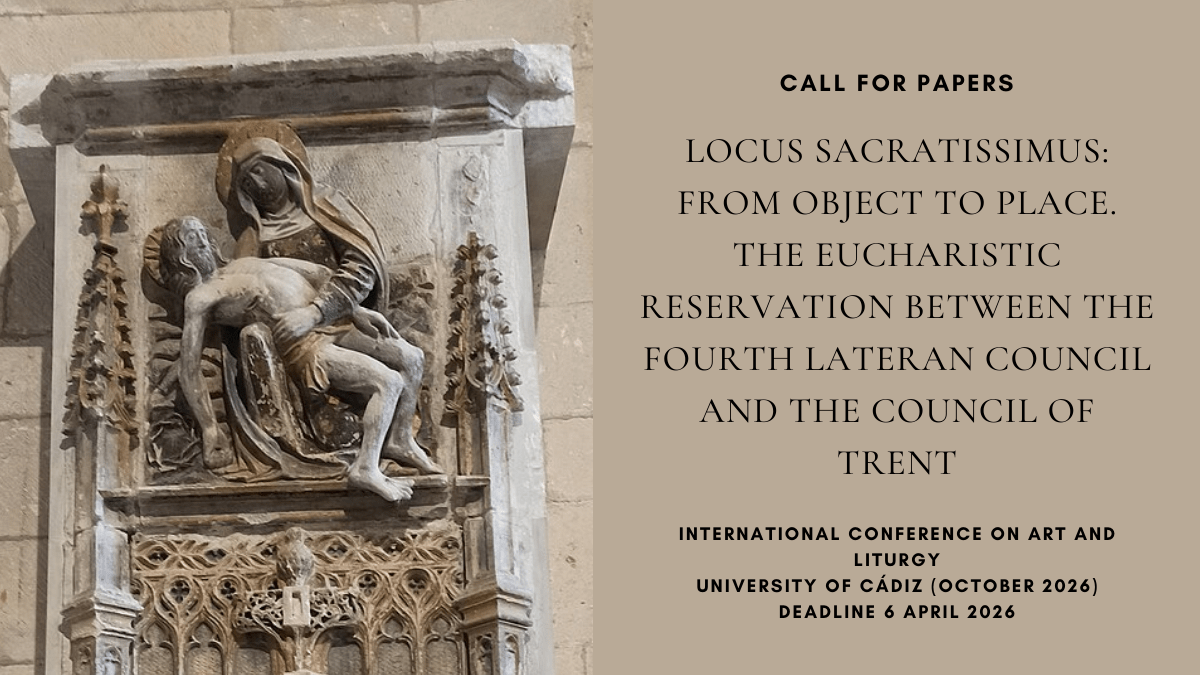
We are pleased to inform you that next October, the III International Conference on Art and Liturgy at the University of Cádiz will take place. This specialised conference, now in its third edition, is entitled “Locus Sacratissimus: From Object to Place. The Eucharistic Reservation between the Fourth Lateran Council and the Council of Trent.”
The conference will be held from 15 to 17 October 2026, and the deadline for submitting proposals is 6 April 2026. We would be most grateful if you could circulate the attached call for papers to colleagues who may be interested in participating.
Further information is available on the following website.
Between the Fourth Lateran Council (1215) and the Council of Trent (1545–1563), Europe witnessed one of the most profound and decisive transformations in the history of the Christian liturgical space: the gradual conversion of the tabernacle from a simple container into an architecturally qualified place, charged with theological, symbolic, and visual significance. This transition was neither immediate nor uniform, but rather the result of a complex process in which doctrinal development, liturgical practice, and devotional growth converged with an unprecedented artistic ambition.
At Lateran IV, the dogmatic definition of the real presence of Christ in the Eucharistic species, as articulated by Scholastic theology, intensified attention toward the reservation of the Sacrament, raising new questions of visibility, custody, decorum, and security. During the Late Middle Ages, the Body of Christ ceased to be solely consumed and became also an object of contemplation, adoration, and vigilant safeguarding. In this context, the tabernacle was transformed into a true “house for the Body of Christ,” whose form was required to express both the sacredness of its content and its centrality in the spiritual life of the Church.
Thus, from the earliest chests and pyxes, there emerged—especially from the late thirteenth century onward—solutions of remarkable formal ambition: sacrament houses, autonomous architectural tabernacles, Eucharistic towers, monumental aedicules, and complex micro-architectures dialoguing with the great Gothic structures. These constructions—situated halfway between reliquary, tomb, tower, and temple—not only addressed functional concerns, but also articulated genuine visual discourses on the mystery of the Eucharist, the Incarnation, the Passion, the Death, and the Resurrection of Christ, integrating themselves actively into the ecclesial topography of the church interior.
Far from being a marginal phenomenon, this development achieved extraordinary diffusion throughout Europe, with particular intensity in the territories of the Holy Roman Empire, France, the Low Countries, and the Iberian Peninsula. In the Spanish case, medieval and transitional tabernacles reveal a remarkable typological diversity and an early sensitivity to the symbolic dimension of the Eucharistic locus, anticipating solutions that would be fully crystallized after Trent. It was then that the tabernacle would be definitively fixed upon the high altar, from which it would hierarchically preside over the entire liturgical space of the church.
This conference seeks to examine this long and fruitful historical itinerary, from the first medieval experiments to the Tridentine consolidation of the tabernacle as the visual, theological, and devotional center of the Christian temple. Through an interdisciplinary perspective—integrating art history, liturgical history, theology, religious anthropology, and visual culture studies—it invites reflection on the tabernacle not merely as an artistic object, but above all as a constructed locus of presence, where architecture, rite, and faith are inseparably intertwined. The conference will feature the participation of renowned specialists such as Aintzane Erkizia, Justin Kroesen, Eduardo Carrero, and Ferruccio Botto, among others.
The conference will be organized around the following thematic panels:
- Thinking Presence: Concepts, Sources, and Practices of Eucharistic Reservation
- Monumentalizing the Eucharist: The Holy Roman Empire, France, England and the Low Countries
- The Tabernacle as Center: Models and Meanings in the Hispanic Kingdoms
- Tradition, Form, and Centrality: Italy and the Mediterranean World
Proposals may be submitted in Spanish, English, Italian, or French and should be approximately 500–700 words in length. Each proposal must clearly indicate the panel to which it is addressed and include a brief curriculum vitae of the presenter, as well as their institutional affiliation, if applicable. Proposals should be sent to arteyliturgia@uca.es no later than 6 April 2026.
The publication of the contributions is planned (book format with a publishing house of recognized academic prestige). Final versions of accepted papers must therefore be submitted by 30 November 2026.
Registration Fees (Speakers): Regular speakers: 50 €; CEHA members: 25 €. In both cases, the registration fee includes a complimentary copy of the volume containing the conference proceedings.
Once acceptance of the paper has been confirmed, participants will have until 15 June 2026 to complete the registration payment. Payment must be made by deposit or bank transfer to the University of Cádiz bank account: Banco Santander IBAN: ES48 0049 4870 8529 1609 2739 – SWIFT: BSCHESM; IMPORTANT: The bank transfer must include the reference code ARTEYLITURGIA, followed by the speaker’s SURNAME(S) AND FIRST NAME. A copy of the bank transfer receipt must be sent by email to: arteyliturgia@uca.es
Scientific Coordinators: Pablo J. Pomar Rodil. Universidad de Cádiz; Diana Olivares Martínez. Universidad Complutense de Madrid; Elena Escuredo. Universidad de Sevilla
Scientific Secretariat: Francisco de Asís García García Universidad Autónoma de Madrid; Pedro Manuel Martínez Lara. Universidad de Sevilla
Technical Secretariat: Noelia Muñoz Arjona. Universidad de Cádiz
Scientific Committee: Eduardo Carrero Santamaría. Universidad Autónoma de Barcelona; Irma Patricia Díaz Cayeros. Universidad Nacional Autónoma de México; Aintzane Erkizia Martikorena. Universidad del País Vasco; Fernando Gutiérrez Baños. Universidad de Valladolid; Stefan Heid. Pontificio Istituto di Archeologia Cristiana; Justin Kroesen. Universidad de Bergen; Teresa Laguna Paúl. Universidad de Sevilla; Fabio Massaccesi. Universidad de Bolonia; María Rodríguez Velasco. Universidad San Pablo-CEU; María Dolores Teijeira Pablos. Universidad de León; Giovanna Valenzano. Universidad de Padua; Cécile Vincent Cassy. CY Cergy París Université
Discover more from Medieval Art Research
Subscribe to get the latest posts sent to your email.
 Medieval Art Research