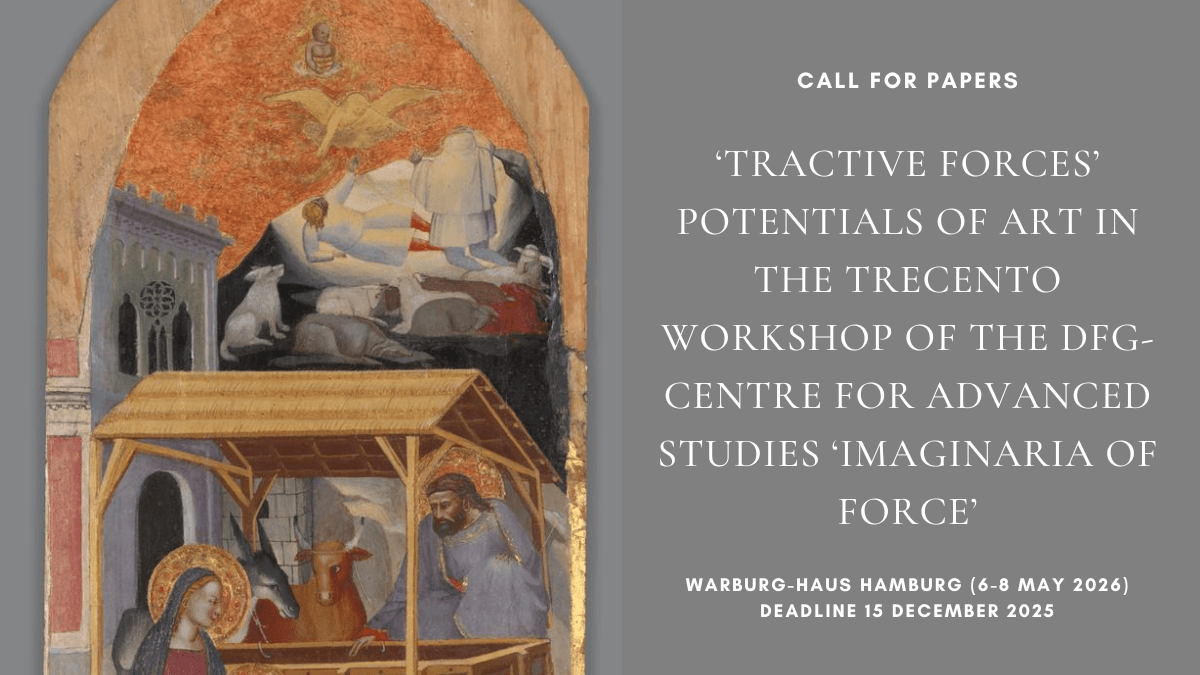
Workshop of the DFG-Centre for Advanced Studies »Imaginaria of Force« May 6–8, 2026, Warburg-Haus Hamburg / lecture room at Gorch-Fock-Wall 3
More information can be found on the DFG-Centre for Advanced Studies ‘Imaginaria of Force’ website.
Organised by Wolf-Dietrich Löhr and Gerd Micheluzzi
Pull, draw, attract, and captivate. The question of ‘tractive forces’ in fourteenth-century Italian art has so far received only limited scholarly attention. Yet these forces illuminate qualities that allow us to examine production processes, materiality, and mediality, as well as motifs and their beholders, in their physical, metaphysical, technical, and aesthetic dimensions. It is not by chance, we hypothesise, that Francesco Petrarca speaks of a “force” (vis) in his Remedies for Fortune Fair and Foul (De remediis utriusque fortunae, 1350–1366) to warn his readers of the power of art – its capacity to make beholders “cling” (inhaere) to paintings and even to “capture” (capere) their intellect.
The workshop takes such »tractive forces« in an expanded sense as its point of departure, bringing art-historical analyses into dialogue with approaches from the history of science, literature, and philosophy. How are ‘tractive forces’ modelled in Trecento works of art? Are they primarily derived from iconographic sources, or do they reveal a particular interest in tracing visible and invisible chains of effect? To what extent does this perspective allow us to consider works of art in relation to their reception? What visual strategies and technical procedures are adopted, refined, or developed to depict and generate pull and attraction? What roles do architectures, frames, and other devices (such as curtains, parapets, and grilles) play in the dynamics of attraction and distancing? Which literary, rhetorical, natural-philosophical, or moral-theological considerations underlie these dynamics?
‘Tractive forces’ (lat. trahere; ital. trarre, tirare, etc.) refer, in the Aristotelian sense, first of all to a physical movement compelled by direct external force – “motion from something else to oneself or to something else […].” (Physics 244a) As such, »tractive forces« appear in the Trecento across a wide range of motifs: the pulling of carts, the drawing out of nails, the gentle tug or violent tearing at garments or hair, and in the form of pulleys of all kinds. Giotto’s frescoes in the Cappella degli Scrovegni (c. 1303–1307), Altichiero’s Miracle of St Lucy and the Bulls (c. 1379–1384), or the two wooden forearms mounted on a crossbeam in the Sala del Mappamondo of Siena’s Palazzo Pubblico, by means of which lamps could be raised before Simone Martini’s Maestà, are by no means the only examples in which ‘tractive forces’, in differing variations and intensities, are brought prominently into view.
Beyond mechanical force, however, ‘tractive forces’ in the fourteenth century also encompass dynamics that manifest without direct contact between mover and moved. The key term here is ‘attraction’ (lat. attractio, allicere, etc.). As such, it has left traces not only in scholastic treatises on natural philosophy – appearing, for example, in discussions of magnetism, gravitation, optics, magic, and alchemy. It also recurs as a literary motif in various texts of the fourteenth century. For instance, in Purgatorio XXXII of the Divina Commedia (c. 1307–1321), Dante Alighieri recounts how Beatrice’s “holy smile” attracts (a sé traéli) the gaze of his alter ego so powerfully that turning away is possible only at the forceful call (con forza) of the Virtues: “Too fixedly!” (Troppo fiso!)
In Trecento art, ‘attraction’ can likewise be situated within the tension between admiration and moral-theological critique. At times condemned as “lust of the eyes”, at others praised as an expression of artistic discernment, the gaze – and with it the beholder – enters into a dialogue with the form and finish of the artwork, its materiality and scale, and ultimately with the artists and their technical capacities. In this context, the “ritratto” may be mentioned as a literal “drawing out” or “pulling forth” (lat. protrahere) from nature, from a model, or from memory. One might also think, among other things, of artistic details and small-scale formats that force beholders to move closer in order to engage with them.
The focus on ‘tractive forces’ opens up new ways of engaging with Trecento art and the phenomena underlying it across diverse thematic and disciplinary perspectives.
Contributions to the workshop should address one of the following topics:
- Attractions: imaginaria of moving and being moved between natural philosophy and art
- Immersions: intensifications of gaze between absorption and captivation
- Suspensions: withdrawal of time and corporeality
- Framings: arrangements of focusing and distancing
- Thresholds: bridges to and disturbances of reception
- Vanishing points: strategies of perspective
- Directives: spatial configurations and structures of guidance
- Scalings: modes of formatting and detailing
- Contractions: entanglements through gesture and gaze
- Materials: allure and irritation of material and surface qualities
- Techniques: practices and theories of preparation and creation
Submissions for a paper may be in German or English; passive comprehension of both languages is expected. We particularly welcome contributions that adopt an inter- or transdisciplinary perspective on ‘tractive forces’ and their aesthetic articulations.
In addition to an opening evening lecture on 6 May at the Warburg-Haus Hamburg and the individual papers presented across several sections on 7 and 8 May in the seminar room of the DFG-Centre for Advanced Studies »Imaginaria of Force«, the workshop will allow ample time for discussion and exchange, and – if desired – for collective reading sessions.
An excursion to the Bibliotheca Christianei is also planned, during which we will jointly examine an illustrated manuscript of the Divina Commedia (the so-called Codex Altonensis, c. 1360) and Boccaccio’s Filostrato (c. 1360).
Please send your proposals, including an abstract of no more than one page and the keyword ‘Tractive Forces’ in the subject line, by 15 December 2025 to: imaginarien.der.kraft@uni-hamburg.de
The cost of travel and accommodation can be covered by the organisers.
Contact:
- DFG-Centre for Advanced Studies ‘Imaginaria of Force’, Gorch-Fock-Wall 3, 1st floor (on the left), D-20354 Hamburg
- E-Mail: imaginarien.der.kraft@uni-hamburg.de
- Website: www.imaginarien-der-kraft.uni-hamburg.de
Discover more from Medieval Art Research
Subscribe to get the latest posts sent to your email.
 Medieval Art Research