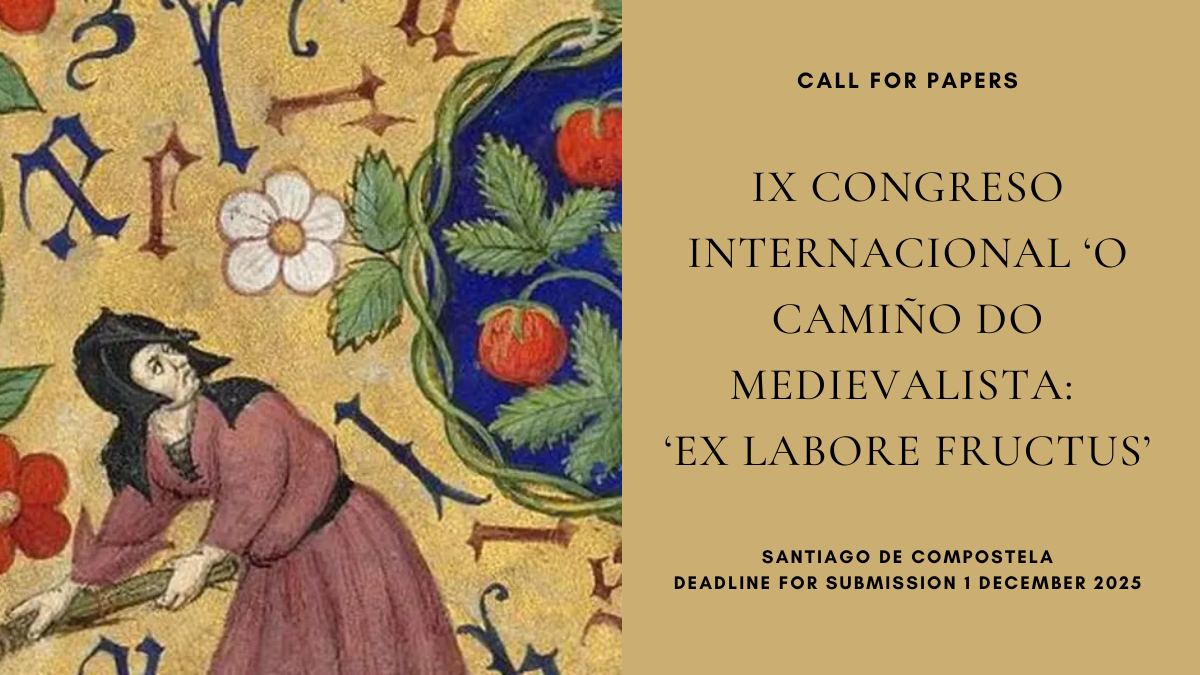
Santiago de Compostela, 25-27 March 2026
In the Middle Ages, the vegetal world was constantly associated with learning. Genesis presents the tree of the knowledge of good and evil as something threatening, its fruit causing the downfall of humankind with the expulsion of Adam and Eve from Eden. Yet trees did not always bear a negative connotation in medieval thought, where they also acquired symbolic values of wisdom and learning. Thus, nature remained closely linked to education, especially that intended for children, sharing in the interplay between vegetal motifs and the teaching of the first grammatical notions through images and
mnemonic games in manuscripts.
In line with this, the scene recovered from the Heures de Marguerite d’Orléans (15th century), chosen as the image for this new edition, reinforces the message of the title, Ex labore fructus (“From work, fruit”). In imitation of the pair represented in full labour, we seek to promote the gathering of particular fruits: those derived from the cultivation of letters and the harvest of study.
Once again, we are pleased to invite you to take part in this meeting, which aims to be a place of encounter for those who are beginning their research journey into the Middle Ages, where young medievalists join once more in this fruitful tradition. With this ninth edition of the International Congress O Camiño do Medievalista, we intend to create an interdisciplinary space where diverse lines of research converge, in order to gather and
sow knowledge contributed by each field of study on the medieval world.
As in previous editions, we intend to offer a meeting open to all branches of Medieval Studies that we summarize in seven non-exclusive paths, since any other topic will be
Welcome:
1. History: power, society, economy and culture.
2. Art and Iconography.
3. Philology, language and literature.
4. Written culture and archives.
5. Historiography, Innovation and Digital Humanities.
6. Philosophy and Thought.
7. Archaeology
PhD students and PhDs who have read their thesis after January 1, 2022 may apply.
Proposals must be sent by completing the next form: https://forms.gle/pRkMXqAg8QTu9dFq8.
The proposals, which must be original (not previously presented or published), must include a brief CV (150 words) and a summary (between 250 and 500 words) written in one of the accepted languages: Spanish, Galician, English, French, Portuguese or Italian.
Find out more on the International Congress O Camiño do Medievalista website.
Discover more from Medieval Art Research
Subscribe to get the latest posts sent to your email.
 Medieval Art Research