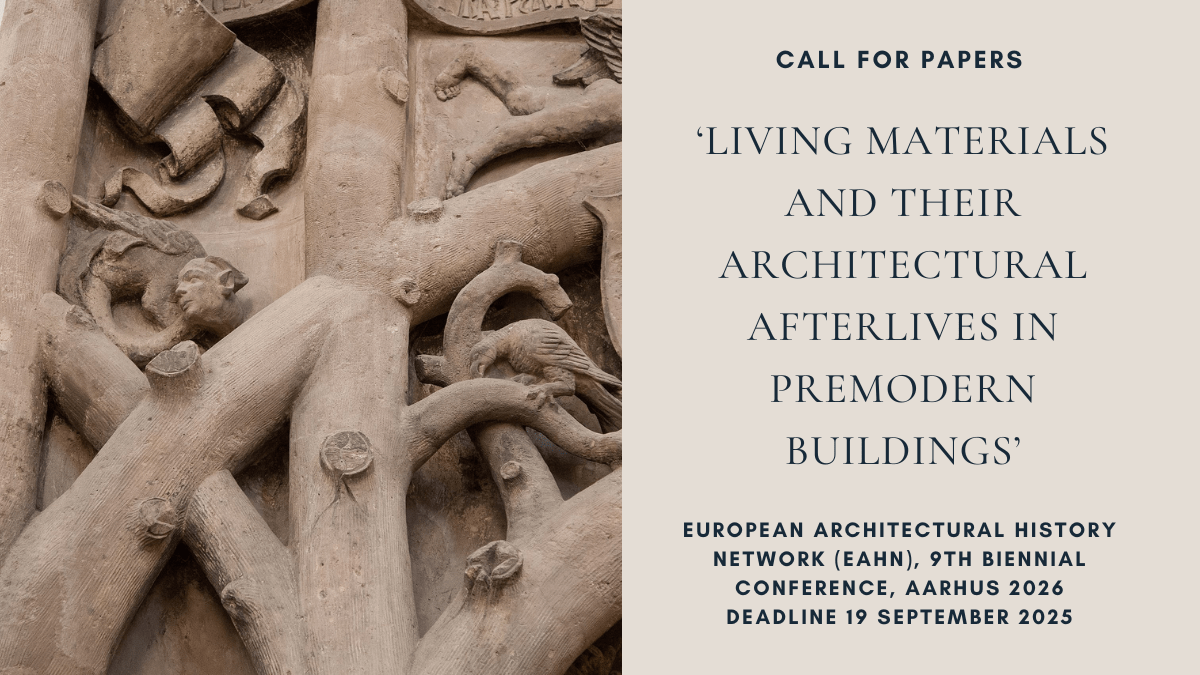
European Architectural History Network (EAHN), 9th Biennial Conference, Aarhus 2026
‘Although plants have no sense of touch, they nevertheless suffer when they are cut […] for their roots function as a mouth, to receive food; and the bark as skin; and the wood as flesh; and the knots or branches as arms with their nerves and veins’ writes Vincenzo Scamozzi discussing the use of wood as a building material in his The Idea of Universal Architecture (Venice, 1615), citing Aristotle. Scamozzi’s reflection about natural suffering surrendering to human necessity embodies a collision of ecological consciousness and anthropocentric values that also animates modern debates around natural and cultural heritage.
In addition to wood, coral, palms, reeds, bark, and turf (as in Scandinavian ‘sod roofs’) have long been used in architecture for their strength, flexibility, and insulating properties. In pre-modern epistemologies, even stone was seen as ‘alive’ and endowed with human qualities (Scamozzi’s pietra viva). Central to pre-modern building practices, yet side-lined in stories of architecture (with some exceptions, e. g. Payne 2013), living building materials offer a new angle to rethink the discipline from the perspective of the more-than-human, the cyclical, and the living.
Ecocritical and post-anthropocentric studies have challenged the long-established dualism between nature and culture. Proposing new ways of understanding such relations, from “vibrant matter” (Bennet 2010) to “naturalism” and “animism” (Descola 2005), such research urges a reconsideration of the historical entanglements between human and nonhuman dimensions. This panel wishes to engage with these debates by foregrounding the architectural traces of such
interconnection: where life becomes form, and ecosystems are refigured as structures. Building as a form of human manipulation participated in a process of material as well as conceptual conversion: it turned animate, ecologically embedded life-forms into static, structural
components of human spaces. Architectural structures thus emerge as hybrid entities, natureculture bodies that resonate with memories of the former lives of their natural materials.
We invite papers exploring these and related questions across all geographic areas during the premodern period (from antiquity to ca. 1750). Papers may investigate the architectural
“afterlife” of living materials, with particular attention to how such transformations were understood, represented, or ritualized in historical contexts. What were the ecological, spiritual, or symbolic implications of turning the natural environment into the built “environment”? How
did premodern societies conceptualize or mediate the shift from life to lifelessness, from ecological actor to architectural object? And how might examining these material histories
illuminate broader understandings of human-nature entanglements in the premodern world?
We particularly encourage contributions considering multiple materials or contexts from a microhistorical or comparative perspective. Further topics may include:
- The architectural use and symbolic transformation of wood, coral, leather, bone, shell, stone or other once-living (or understood-to-be-living) substances;
- Reuse and recycling of organic matter in construction practices, including its material decay;
- The environmental impact of organic material extraction, production, and exchange;
- Cosmologies, ontologies, and ecologies underlying material choices;
- Theoretical approaches to material vitality, decay, and transformation.
Submission Guidelines:
Abstracts of no more than 300 words should be submitted directly to the chairs, along with the applicant’s name, email address, professional affiliation, address, telephone number and a short curriculum vitae (maximum one page).
Please submit your proposal via email to:
- Costanza Beltrami, Stockholm University costanza.beltrami@arthistory.su.se
- Saida Bondini, University of Zurich / Kunsthistorisches Institut in Florenz – Max-Planck-Institut Saida.Bondini@khi.fi.it
Discover more from Medieval Art Research
Subscribe to get the latest posts sent to your email.
 Medieval Art Research