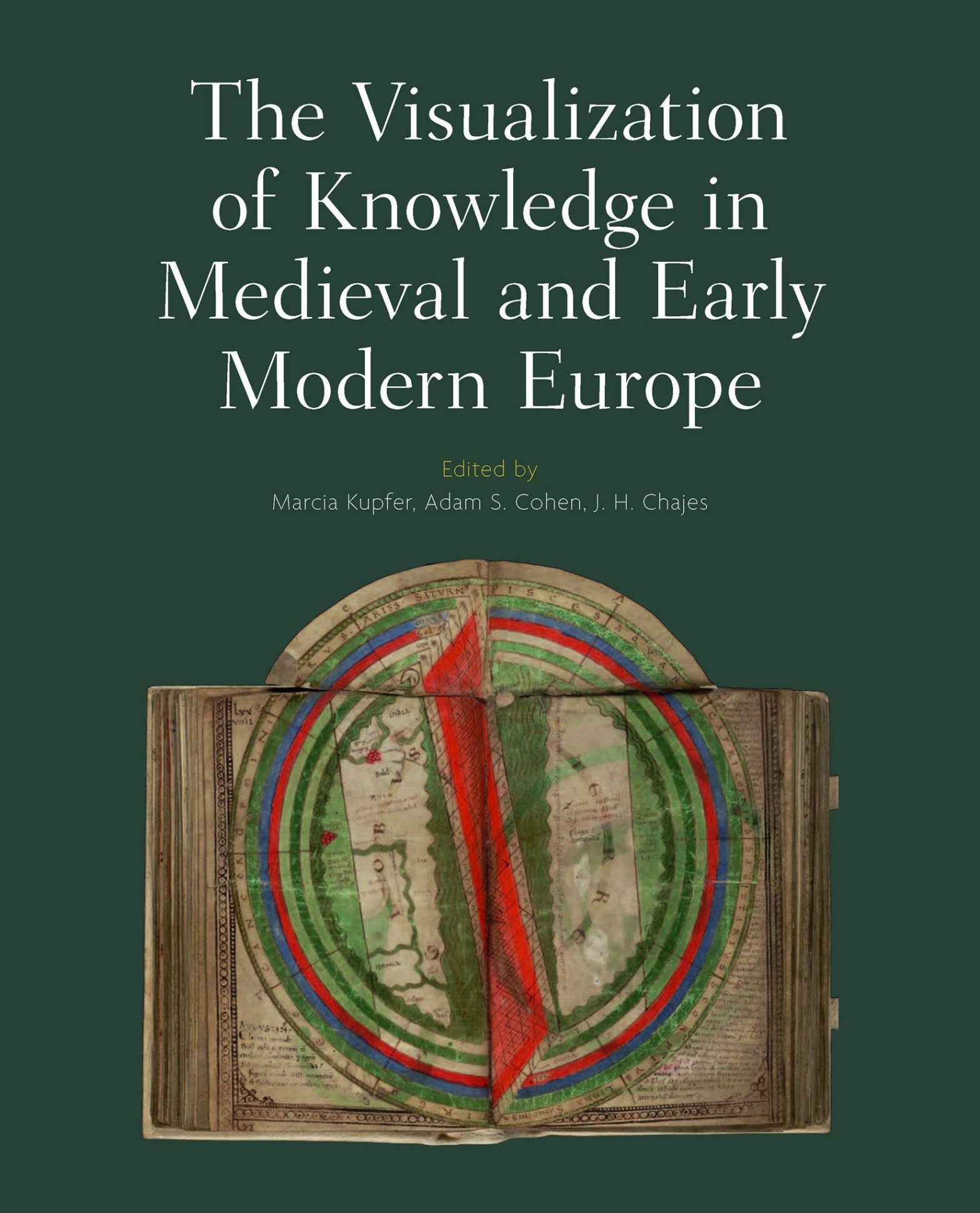
This collection of essays by leading scholars reflects new interest in how graphic devices contributed to the production of knowledge during a formative period of European history.
All of us are exposed to graphic means of communication on a daily basis. Our life seems flooded with lists, tables, charts, diagrams, models, maps, and forms of notation. Although we now take such devices for granted, their role in the codification and transmission of knowledge evolved within historical contexts where they performed particular tasks. The medieval and early modern periods stand as a formative era during which visual structures, both mental and material, increasingly shaped and systematized knowledge. Yet these periods have been sidelined as theorists interested in the epistemic potential of visual strategies have privileged the modern natural sciences. This volume expands the field of research by focusing on the relationship between the arts of memory and modes of graphic mediation through the sixteenth century. Chapters encompass Christian (Greek as well as Latin) production, Jewish (Hebrew) traditions, and the transfer of Arabic learning. The linked essays anthologized here consider the generative power of schemata, cartographic representation, and even the layout of text: more than merely compiling information, visual arrangements formalize abstract concepts, provide grids through which to process data, set in motion analytic operations that give rise to new ideas, and create interpretive frameworks for understanding the world.
Table of Contents
Marcia Kupfer, Introduction
I. Visualization between Mind and Hand
Mary Carruthers, Geometries for Thinking Creatively
Lina Bolzoni, Visualization of a Universal Knowledge: Images and Rhetorical Machines in Giulio Camillo’s Theatre of Memory
Jeffrey F. Hamburger, Mindmapping: The Diagram Paradigm in Medieval Art – and Beyond
II. The Iconicity of Text
Beatrice Kitzinger, Framing the Gospels, c. 1000: Iconicity, Textuality, and Knowledge
Lesley Smith, Biblical Gloss and Commentary: the Scaffolding of Scripture
David Stern, The Topography of the Talmudic Page
Ayelet Even-Ezra, Seeing the Forest beyond the Trees: A Preliminary Overview of a Scholastic Habit of Visualization
Yuval Harari, Functional Paratexts and the Transmission of Knowledge in Medieval and Early Modern Jewish Manuscripts of Magic
A. Mark Smith, More than Meets the Eye: What Made the Printing Revolution Revolutionary
III. Graphic Vehicles of Scientia
Barbara Obrist, The Idea of a Spherical Universe and its Visualization in the Earlier Middle Ages (Seventh–Twelfth Centuries)
Marcia Kupfer, The Rhetoric of World Maps in Late Antiquity and the Middle Ages
Faith Wallis, Visualizing Knowledge in Medieval Calendar Science: a Twelfth-Century Family of ‘Graphic Glosses’ on Bede’s De temporum ratione
John Haines, The Visualization of Music in the Middle Ages: Three Case Studies
Peter Murray Jones, Visualization in Medicine between Script and Print, c. 1375–1550
IV. Diagrammatic Traditions
Linda Safran, A Prolegomenon to Byzantine Diagrams
Adam S. Cohen, Diagramming the Diagrammatic: Twelfth-Century Europe
Madeline H. Caviness, Templates for Knowledge: Geometric Ordering of the Built Environment, Monumental Decoration, Illuminated Page
Lucy Freeman Sandler, Religious Instruction and Devotional Study: The Pictorial and the Textual in Gothic Diagrams
J. H. Chajes, The Kabbalistic Tree
Discover more from Medieval Art Research
Subscribe to get the latest posts sent to your email.
 Medieval Art Research