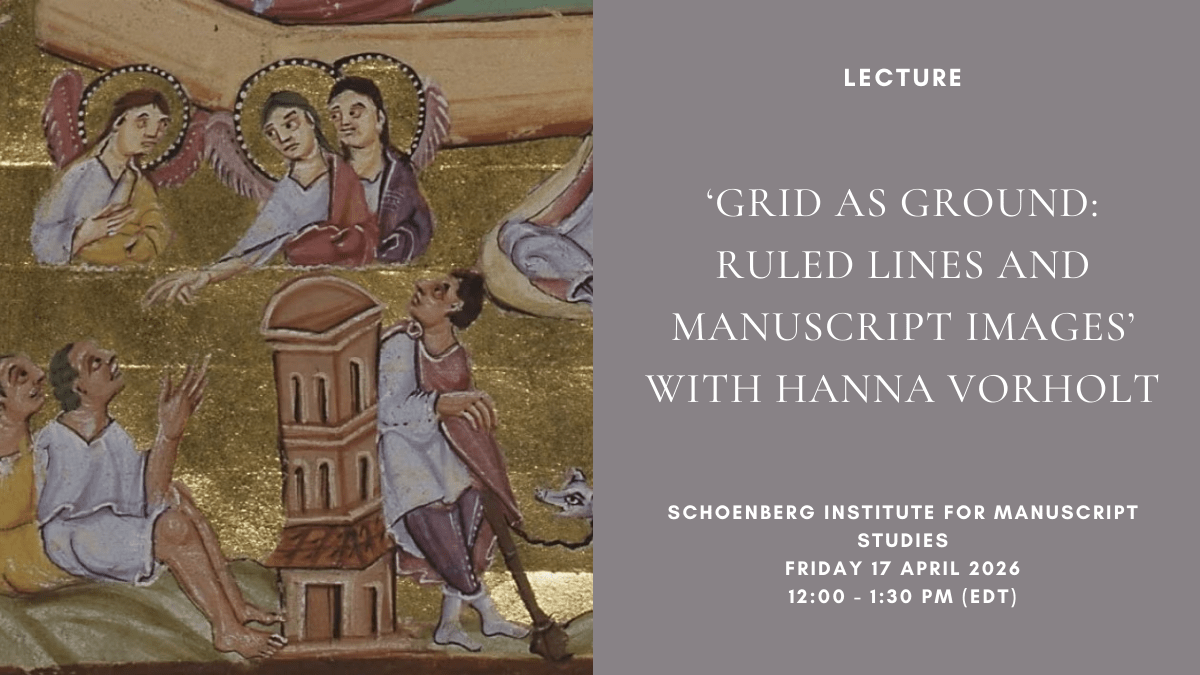
Find out more about the lecture and register on the Schoenberg Institute for Manuscript Studies website.
Most printed and electronic documents, like this one, show text organized along invisible horizontal and vertical lines. In medieval Europe, where the primary text technology was the manuscript, lines formed visible grids on the parchment or paper surface. Scholars have examined the resulting patterns and analysed their role in the layout of the written text. While manuscript images were frequently executed on the same ruled surfaces as the written text, their relationship to the ruling has rarely been the subject of research. Hanna Vorholt’s forthcoming book Grid as Ground provides the first sustained analysis of this topic across the wide range of image types encountered in manuscripts, from tables, maps, and diagrams, to figural imagery across different domains of learning. The lecture introduces the project and some of the opportunities this analysis presents for humanities research on lines and grids as tools for cognition, creativity, and control.
Hanna Vorholt
Hanna Vorholt is Senior Lecturer in Art History at the University of York. She was previously employed at the Fitzwilliam Museum and the British Library and received fellowships from the Warburg Institute, Cambridge University Library, the British Academy and the Leverhulme Trust. Her publications include Shaping Knowledge: The Transmission of the Liber Floridus (2017) and, as co-editor, Imagining Jerusalem in the Medieval West (2012), Visual Constructs of Jerusalem (2014) and Between Jerusalem and Europe (2015). Her forthcoming book Grid as Ground is under agreement with Harvey Miller Publishers.
Discover more from Medieval Art Research
Subscribe to get the latest posts sent to your email.
 Medieval Art Research