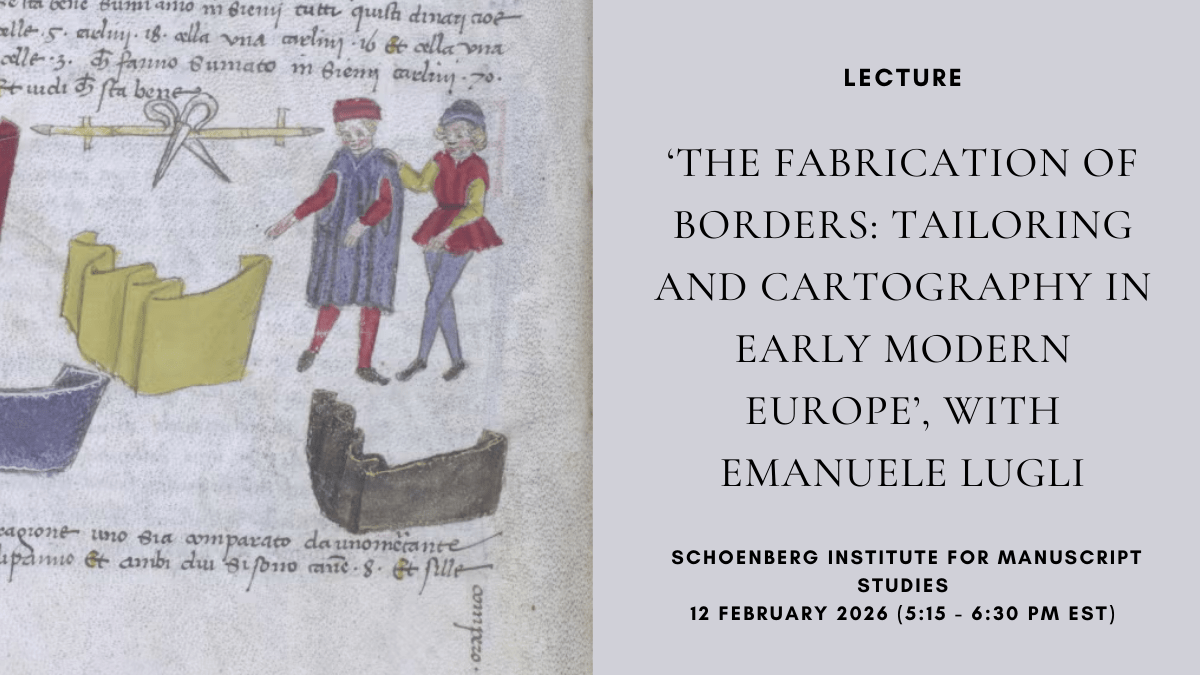
- Thursday, February 12, 2026, 5:15 – 6:30 pm EST
- Online and Kislak Center, Class of 1978 Orrery Pavilion, Van Pelt-Dietrich Library Center, 6th Floor
Find out more about the lecture and register on the Schoenberg Institute for Manuscript Studies website.
Emanuele Lugli, Stanford University & the 2025-2026 Schoenberg Institute for Manuscript Studies and the Center for Italian Studies Fellow in Italian Manuscript Studies
In early modern Europe, fashion and cartography shared far more common ground than is usually acknowledged. Popular costume books, much like geographical atlases, helped shape emerging ideas of nationhood, while maps disseminated notions of local dress across the world. Yet despite these shared aims, the connection between the two fields has gone largely unnoticed. This talk argues that this overlooked convergence is precisely where fashion, as we understand it, first took shape. Fashion is not simply the expression of the self through clothing, nor merely the perpetual recycling and trivializing of cuts; it is a specific mode of engaging with dress—one deeply shaped by early forms of nationalism.
The talk develops this argument by tracing the origins of both practices, showing how tailoring and cartography alike grew out of geometria practica, the practical application of geometry to represent three-dimensional forms on flat surfaces. It then follows the long afterlife of this relationship, demonstrating its continued force into the twentieth century, most visibly in the designs of Christian Dior.
Discover more from Medieval Art Research
Subscribe to get the latest posts sent to your email.
 Medieval Art Research