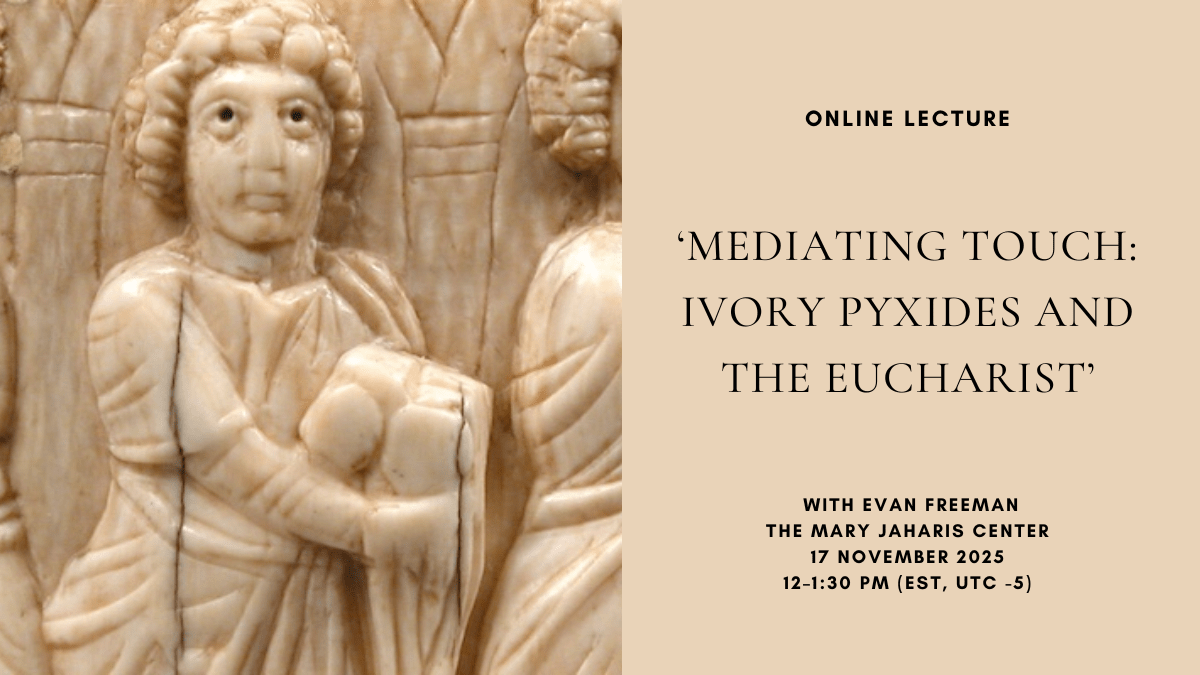
The Mary Jaharis Center is pleased to announce the next lecture in our 2025–2026 lecture series: ‘Mediating Touch: Ivory Pyxides and the Eucharist.’
In this lecture, Evan Freeman, Simon Fraser University, will consider the use of ivory pyxides for receiving Communion in church. A large body of these round ivory boxes survive from late antiquity. Several boxes display motifs associated with the Eucharist.
This talk offers a close examination of ivory pyxides that may have been used for receiving Communion in church as described by canon 101 of the Quinisext Council. It argues that these boxes and their iconographic motifs were designed to appeal to the senses of sight and touch. If they were used for receiving Communion as described by the Quinisext Council, such boxes would have mediated physical contact with the Eucharist, warned and protected against the dangers of faithless and unworthy touch, and offered biblical models for worshippers to imitate as they sought salvation in the celebration of the Eucharist
A large body of round ivory boxes, also known as pyxides, survive from late antiquity. Each pyxis was cut from a section of elephant tusk and decorated with carvings. Most were likely produced around the Eastern Mediterranean between the fifth and seventh centuries CE, but the precise origins and functions of these objects are difficult to pinpoint. Several boxes display motifs associated with the Eucharist, leading scholars to speculate that they may have been used to bring the Eucharist home, on journeys, or to those who could not come to church. More recently, it has been suggested that ivory pyxides were used by worshippers who felt unworthy to receive Communion directly in their hands, as prohibited by canon 101 of the Quinisext Council held in Constantinople in 691/692. This talk offers a close examination of ivory pyxides that may have been used for receiving Communion in church as described by this canon. It argues that these boxes and their iconographic motifs were designed to appeal to the senses of sight and touch. If they were used for receiving Communion as described by the Quinisext Council, such boxes would have mediated physical contact with the Eucharist, warned and protected against the dangers of faithless and unworthy touch, and offered biblical models for worshippers to imitate as they sought salvation in the celebration of the Eucharist.
This lecture will take place live on Zoom, followed by a question-and-answer period. Please register to receive the Zoom link.
About the speaker
Evan Freeman, Simon Fraser University
Evan Freeman is Assistant Professor and Hellenic Canadian Congress of British Columbia Chair in Hellenic Studies in the Department of Global Humanities and the Stavros Niarchos Foundation Centre for Hellenic Studies at Simon Fraser University in Burnaby, Canada. He researches art and ritual in the Byzantine world, recently co-editing the volume Byzantine Materiality (2024) with Roland Betancourt. He is also Contributing Editor for Byzantine art at Smarthistory, the Center for Public Art History, where he co-edited Smarthistory Guide to Byzantine Art (2021) with Anne McClanan.
Discover more from Medieval Art Research
Subscribe to get the latest posts sent to your email.
 Medieval Art Research