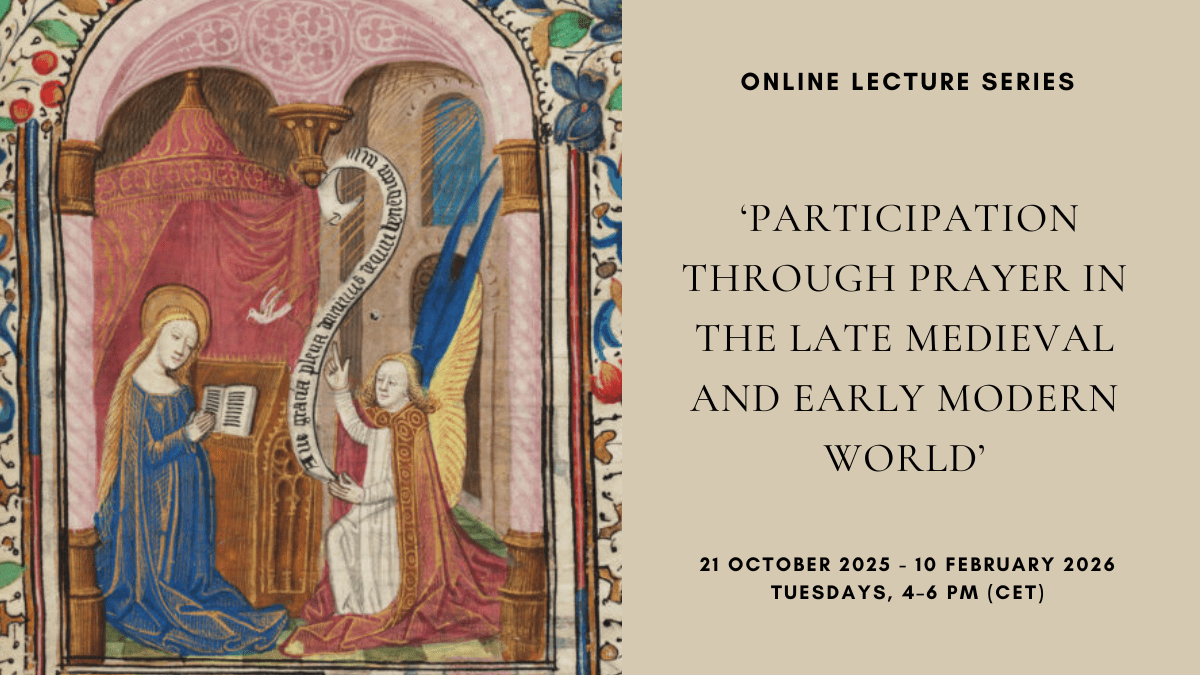
Idea and Concept: Dr Carolin Gluchowski (Universität Hamburg), carolin.gluchowski@uni-hamburg.de
With Support from:
- Prof. Dr Youri Desplenter (University of Ghent)
- Dr Anna Dlabacova (Leiden University)
PRAYTICIPYTE
Participation through Prayer in the Late Medieval and Early Modern World
COST Action CA23143
For centuries, prayer has been central to people’s worldview, to their education and formation, their experience of religion and the Divine, to the creation of societal communities, and to structuring everyday life throughout Europe. Despite the ‘religious turn’ in the humanities, prayer is still often seen as ordinary or even self-evident. This has hitherto prevented a thorough understanding of the history of this powerful and complex phenomenon in the late medieval and early modern world. From a European perspective, this period was formative for the role of prayer in public settings and in people’s personal lives.
The phenomenon is marked by plurality and diversity and the disparate nature of research on prayer calls for a strong collaborative international research network that will move toward creating a shared framework for the study of prayer in the Latin Christianity during the late medieval and early modern period. Studying prayer as a participatory practice on several levels (as a communal or social practice, using a variety of material devices (media, objects) that can evoke a spiralling, amplifying effect in the mind of the devotee) will lead to better understanding of prayer (and with it, the history of imagination, hope, and meditation) in its plurality.
For further details, please visit the website.
Praying with Objects
Prayer Practices in the Late Medieval and Early Modern World
Prayer was – and remains – a central devotional practice and a key form of communication in Christian life. Despite its prominent place in the history of Western Christianity, our understanding of prayer, particularly during the late medieval and early modern periods, remains hitherto limited. This lecture series seeks to address that gap by focusing on the material dimension of prayer.
Although Christian Europe in the later Middle Ages is often perceived as religiously unified, historical prayer practices were anything but uniform. Far from being a universal or static experience, prayer was expressed in a wide variety of forms shaped by local, social, and personal contexts. It could be public or private, communal or individual, domestic or (para)liturgical, and ranged from the spontaneous to the meticulously prescribed. Across all these forms, prayer was deeply embedded in the social and material fabric of its time. Yet prayer has often been overlooked in historical scholarship, in part because it is perceived as ordinary or self-evident. The term “Latin Christianity,” for instance, misleadingly implies a standardized religious practice. In reality, the development of urbanization, literacy, vernacular languages, and movements such as the Devotio Moderna or Observant reforms contributed to the growing diversity of Christian prayer across Europe from c. 1200 onward.
As Breitenstein and Schmidt (2019) have noted, drawing on Mauss, prayer is a “total social phenomenon”—a participatory act rooted in society and mediated through a wide range of material and textual forms. These include (memorized) texts, books, images (both mental and material), and devotional objects such as rosary beads, ex-votos, and relics. Prayer was not passively consumed; it was actively performed, felt, and experienced. This online lecture series aims to explore the diverse and embodied dimensions of Christian prayer in the pre-modern Western world—through the lens of objects.
Lecture Programme
Date: Tuesday, 4–6 pm c.t. (CET)
Location: Zoom (link here), Meeting Code: 47442626
Tuesday, 21 October 2025, 4–6 pm c.t. (CET)
Xosé M. Sánchez Sánchez (Santiago de Compostella, Spain), Praying at Home Private Devotional Objects and Domestic Devotions in Medieval Galicia (12th–15th Centuries)
Absract
This paper proposes an analysis of private devotional objects and items of religious and prayer significance and use that appear in the documentary sources of the NW of the Iberian Peninsula, from the twelfth to the fifteenth centuries, with particular attention to how these objects functioned as symbolic legacies in testimony of a personal devotion developed at private environments. The article will argue that changes in the general currents of European spirituality have an impact on private prayer materialities, so that changes in one imply material consequences in the others. To demonstrate that, through a diachronic examination of documentary sources preserved in monastic cartularies and episcopal archives, mainly wills, this study aims to document both continuities and transformations in the material expressions of lay and clerical piety over the evolution from centre to late Medieval devotional conditions.
The core of the analysis focuses on identifying which types of devotional objects—ranging from relics, prayer books, and rosaries to clothing, icons, or liturgical utensils—were most frequently bequeathed, and how their symbolic and spiritual value shifted over time. Changes in these bequests will be interpreted in relation to broader evolutions in the culture of private devotion in the cultural space of Galicia, including the growing interiorization of piety, the emergence of affective devotional practices, and the increasing importance of the household as a spiritual space. By mapping the changing protagonism and frequency of private objects, the paper will explore how personal religious and praying materiality was shaped not only by theological currents but also by gender, social status, and patterns of property ownership. Special attention will be given to the language and formulae used in the wills and testaments to describe these objects, revealing how devotion was articulated through the vocabulary of possession, memory, and salvation.
The kingdom of Galicia, in the NW of Iberian Peninsula, offers a particularly rich terrain for this inquiry. As a zone with strong monastic networks, early pilgrimage routes, and a complex relationship with both Latin and vernacular traditions, it enables a nuanced observation of how devotional cultures evolved in practice—not only in monastic or liturgical settings but also within the domestic and familial domain. Ultimately, the paper aims to shed light on the entangled relationship between ownership, devotion, praying materiality, and memory in medieval Iberia, and on the role of personal religious objects in negotiating the boundary between life, death, and the afterlife.
Tuesday, 28 October 2025, 4–6 pm c.t. (CET)
Marc Föcking (Hamburg, Germany), Praying with Boxwood. Meditation and the Poetics of Material Objects in Angelo Grillo’s Pietosi Affetti (1595)
Absract
The sonnet “Ad un suo Crocefisso di busso” (1595) by the Benedictine monk Angelo Grillo exemplifies the problems that sacred objects — in this case, a boxwood crucifix — pose as objects of prayer: if they were the recipients of prayer, this would provoke accusations of idolatry. However, by conveying the situation of prayer through the sonnet’s poetic form, Grillo offers the opportunity to simultaneously identify the problem and outline a solution: drawing a line between the crucifix as an occasion for prayer and support for memoria, and Christ as the actual addressee of the prayer. The materiality of the artifact thus becomes free for a new, metaphorical function: that of self-representation of the ‘hard’, sinful heart of the person praying.
Tuesday, 11 November 2025, 4–6 pm c.t. (CET)
Jolanta Rzegocka (Kraków, Poland), The Krakow Angelic Cross of St. Thomas Aquinas: A Palindromic Stone Prayer and Material Devotion
Absract
My talk examines the Crux Angelica (Angelic Cross) of St. Thomas Aquinas as a distinctive example of prayer understood as a participatory phenomenon—an active, embodied practice rooted in society and mediated through diverse material and textual forms. The Crux Angelica is a palindromic prayer arranged in a diagrammatic cross, allowing it to be read in multiple directions and encouraging focused contemplation. While legend attributes the prayer’s origin to Aquinas himself, earlier versions are found in 11th-century liturgical manuscripts, with textual roots in a 5th-century poem by Calbulus. In 1876, Pope Pius IX granted an indulgence for the devout recital of this prayer, underlining its devotional importance.
A prominent 17th century stone Angelic Cross survives in the Dominican monastery in Kraków, Poland, where the diagram is embedded in a monastic devotional context easily accessible today to the wider prayer communities. While I examine how this prayer-object shaped and facilitated religious practice within a medieval setting, I will also enquire to what extent the diagram’s visual form guided ritual gestures, such as kissing or touching the cross, transforming prayer into an embodied act In addition, I will explore the relationship of the Krakow Angelic Cross to the 18th century prints of Jakub Labinger from Lwów (Lviv), investigating its dissemination and influence within the region’s devotional culture.
I hope to address the core theme of the lecture series by exploring how prayer in the early modern Western world was not a passive act but an embodied experience, actively performed and deeply felt through a variety of objects—including devotional prints and material objects of the type of the Krakow Crux Angelica. On a broader theoretical level, I will examine how material forms act as tools that shape attention, guide ritual movement, and support theological reflection—rendering prayer a tangible, spatial, and sensory experience. At the same time, I will consider both the potential and the limitations of approaching prayer through the lens of material culture.
Tuesday, 18 November 2025, 4–6 pm c.t. (CET)
Helena Queirós (Paris, France / Porto, Portugal), The Touch of Devotion: Objects, Bodies, and Prayer in Portuguese Convents (18th century)
Absract
This paper explores the interplay between materiality, prayer, and bodily discipline in the devotional lives of early modern Portuguese nuns. Drawing from devote biographies, it investigates how a series of objects shaped, enabled, and reflected prayer practices within conventual settings. Though not bound to a single case study, the analysis follows the traces of key devotional items: a rope, a human-sized cross, a private altarpiece, a breviary, and a copy of Ignatius of Loyola’s Spiritual Exercises. Each was used by different nuns across varied temporal and geographical contexts, revealing an object-mediated devotion.
This presentation argues that prayer in these contexts was never solely verbal or mental, but materially enacted and physically inscribed through touch, gesture, and bodily regulation. The rope, for instance, functioned not only as a tool for ascetic practice but also as a ritual medium in a cooking context. The breviary and altarpiece mediated private liturgical devotion, enabling a sensory engagement with sacred time and space. The Spiritual Exercises, in turn, offered a textual object for disciplined interiority, whose discursive meditations were often accompanied by acts of bodily ascesis, such as fasting, sleep deprivation, or the use of disciplines. The paper also draws on data linking prayer to temporally structured rituals, such as the Christmas novena, showing how material practices and liturgical time co-structured devotional rhythms. Furthermore, it examines the alignment of discursive meditation with corporeal techniques, suggesting that prayer was not only spiritually transformative but also somatically formative.
Responding to the series’ call to view prayer as a “total social phenomenon” (Mauss), this talk situates these prayer practices within broader conventual, ecclesiastical, and gendered regimes of piety. While the fragmented nature of the sources prevents the construction of a unified case study, their diversity enhances the analytical lens, enabling a comparative and thematic exploration of object-mediated devotion in Portuguese female monastic life. Ultimately, the paper contributes to a richer understanding of how early modern prayer was felt, performed, and materially sustained, both in solitude and in community, both ritually and through inventive, embodied agency, through the objects that framed and carried it.
Tuesday, 25 November 2025, 4–6 pm c.t. (CET)
Davide Tramarin (Padua, Italy), Private Encounters with the Dead Christ. The Holy Sepulchre of Lichtenthal and Gendered Devotion Praying with Images in the Low Countries
Absract
Around 1470, the Observant reformer Johannes Busch visited the Nunnery of the Holy Cross in Erfurt and strongly condemned the nuns’ practice of keeping sculpted and painted images of Christ and the saints for private worship in their choir stalls. He consequently forbade their individual use and prescribed their integration into communal devotion (cf. Hamburger 1998). As attested by both historical documentation and material evidence, the practice of individual prayer with small devotional images – i.e. andachtsbilder – was widespread among female monastic communities of various orders in late medieval Germany.
Within this context, a particularly remarkable object is a Holy Sepulchre dating to the mid-fourteenth century, originating from the Cistercian Nunnery of Lichtenthal (Karlsruhe, Badisches Landesmuseum, V12465a-g). It consists of a small wooden case (63 × 31.6 × 25.6 cm) containing a detachable and manipulable sculpture of the dead Christ (51.5 × 11.4 × 12.4 cm), along with five fixed statuettes affixed to the inside of the lid: an angel, the three Marys bearing ointments, and the Swoon of the Virgin supported by the Apostle John. Furthermore, the case is closable and features a double bottom. Although only rarely discussed with regard to its function, this object has traditionally been classified as a Holy Sepulchre intended for the collective rituals of Good Friday (Kroesen 2000; Aballéa 2003; Herrebach-Schmidt 2005).
More recently, however, I have argued for its use in individual devotional practice, highlighting the bodily, sensory, and spiritual dimensions of its agency during the Paschal Triduum – particularly in relation to the adoration of Christ’s feet (Tramarin 2024). In this paper, I will offer a new and more extensive examination of the modes of private adoration and meditation associated with the case, and of its devotional influence in shaping the religious experience of the individual worshipper. This analysis will proceed through a detailed examination of the specific features that define the framework of Christocentrism which characterized medieval Cistercian spirituality. By bringing together and comparatively analyzing a range of theological, mystical, and devotional texts, I aim to shed new light on the broader implications of the use of such objects by nuns.
Tuesday, 2 December 2025, 4–6 pm c.t. (CET)
Lieke Smits (Leiden, Netherlands), Movement and stillness: The mise-en-page of image cycles in Middle Dutch books of hours
Absract
In this lecture I will discuss the bestselling book of the late medieval Low Countries, originating in the Modern Devotion: the Middle Dutch book of hours. It made monastic and liturgical prayer practices and religious knowledge and skill accessible to a large audience, not only through the vernacular prayer text but also, as I will argue, through the images that were included in some of the manuscripts. These image, often more narrative in nature than the texts, did not simply ease navigation through the book; they came with their own complexities, requiring skills in visual interpretation. In some cases the visual program was complex with intersecting narratives, and interpretation was aided by each narrative cycle having its own fixed place on the page. In other cases, the mise-en-page itself posed challenges to the user and required the forging of creative connections between different visual elements. The images in books of hours alternated in providing a narrative move forward through the book and opening up a reflective space and time in which these narrative events are ever present to the imagination. As such, they can be seen as instruments for prayer encouraging inwardness, immersion, and spiritual transformation.
Tuesday, 9 December 2025, 4–6 pm c.t. (CET)
Ingrid Falque (Leuven, Belgium), Praying and Meditating with and through Images in the Late Middle Ages: the Case of the Carthusian Monks in the Low Countries
Absract
In this paper, I propose to explore the variety of spiritual practices involving images of the Carthusians from the Low Countries in the late Middle Ages. More precisely, my aim is to explore what praying and meditating with and through images (in all their modalities, i.e. material but also mental images) meant for these monks. My presentation will be based on the corpus of images from these monasteries that I am currently compiling as part of a book project on the visual culture and meditative practices in Netherlandish charterhouses Netherlands from the 14th to the 16th centuries. Based on this corpus, my research project aims at acknowledging and understanding the role of all kinds of images available in the monasteries in the spiritual practices (i.e. prayer, meditation, contemplation, lectio divina…) of the Carthusians, whose daily routine was dominated by prayer, reading and meditative exercises, mainly in their cells but also in the church. Issues related to the distribution of images within the monasteries, the relationships between them and the nature of images involved in the spiritual practices of the monks are also addressed in this research project.
In the framework of this paper, I will analyze several artworks from these monasteries in close relation to devotional and mystical texts addressing the question of images and the imagination found in their libraries: a late 15th-century diptych showing a Carthusian monk in prayer before St. Anne, a miscellany on contemplation with diagrams from the charterhouse of Utrecht and the stained-glass windows from the Great cloister of the Leuven charterhouse. These three case studies will allow to provide a subtle overview of the kind of images that were available to the monks for their prayer and meditative activities. In the course of this paper, a particular attention will also be paid to the vocabulary of spiritual experience and images, in order to better understand the use of these works.
Tuesday, 16 December 202, 4–6 pm c.t. (CET)
Seán D. Vrieland (Copenhagen, DK), “I offer this third part of this holy psalter”. Continual production and use of a late medieval prayer book
Absract
Cherished as holy objects, privately owned devotional manuscripts lived dynamic lives during the Late Middle Ages. Late medieval devotees were able to customize their books of hours in what Katheryn Rudy has termed the modular method (Rudy, 2016). Customizations continued throughout the lives of prayer books following their initial production, as new sections could be added to an already existing manuscript, or two distinct manuscripts could be bound together to form a new object. With each stage of production, a new object was created, cherished, and used by a devotee. In this talk I highlight the continual production and renewed use of a fifteenth-century prayer book at the Danish Royal Library in Copenhagen (NKS 45 8vo; Borchling, 1900, p. 46). The manuscript originally consists of three distinct production units (on this term, see e.g. Gumbert, 2004; Kwakkel, 2002; Vrieland, 2019), each created separately by different scribes and with unrelated contents. A leather binding with blind tooling and brass clasps from the sixteenth century holds these units together into a single physical object, while an added prayer at the beginning of the manuscript ties the three seemingly disparate sections of the manuscript into a new object by dedicating the three parts of the “holy psalter” to Christ. Little, if anything, is known of the user who added this dedicatory prayer, apart from an ability to perform piety in multiple languages. Two of the production units, both containing offices of the hours, are in Latin, while the third contains intercessary prayers in Low German. The dedication prayer, written in Danish, adds not only a new layer of production, but also a third language of devotion.
Tuesday, 13 January 2026, 4–6 pm c.t. (CET)
Eva Veselovská (Bratislava, SK), Recycled Praying Objects. Medieval Musical Fragments from Slovakia and from Austria
Absract
Recycled cultural heritage represents a specific phenomenon on a global scale. Fragments of both tangible and intangible nature represent unique, precious pieces of evidence of various cultural traditions that have been used in their primary and, subsequently, secondary function. In the field of extant written sources, reused, in other words recycled, medieval manuscripts are important, and in many cases the oldest, examples of the scribal activity and of the oldest prayers with a musical component of specific localities that were important centers of education, culture and the arts. Disused codices were recycled both in the Middle Ages and in the younger periods. The parchment on which they were written found its new, secondary use as the binding of younger books, incunabula or other manuscripts around the world. However, they are difficult to access because they do not have their own shelf marks or other markings.
The paper presents selected information about two databases of medieval musical fragments from Slovakia (Slovak Early Music Database: https://cantus.sk) and from Austria (Medieval Music Manuscripts from Austrian Monasteries) from the period ranging from the late 10th to the early 16th centuries, which represent a unique source material in the Danube region (Digital Humanities). Disused codices were recycled both in the Middle Ages and in younger periods. The parchments, on which they were written, found its new, secondary use as the binding of younger manuscripts, incunabula, and prints. The specific phenomenon of parchment manuscript recycling appears throughout Europe. Fragments of precious manuscripts can now be found in the collections of several museums, archives and libraries. Materials preserved in this way form an important source base for various scientific disciplines (liturgics, linguistics, codicology, paleography, musicology, art history). In some countries, medieval written sources survive only in fragmentary form (e.g. Sweden, Norway, Finland) or complete codices appear only sporadically (e.g. Slovakia has only 18 complete music codices). Their registration is often insufficient (they are not always listed in catalogues) or even non-existent. Consequently, their accessibility is limited or impossible.
Tuesday, 20 January 2026, 4–6 pm c.t. (CET)
Oleksandr Okhrimenko (Birmingham, UK), How Book of Hours Bindings Wrapped Prayers
Absract
This paper examines the understudied role of book bindings in the devotional experience of Books of Hours users, analyzing approximately 50 bindings from French, Italian, Netherlandish, and English manuscripts held in Birmingham libraries and the Vernadskyi National Library of Ukraine (NBUV). Through material analysis of original 14th–15th century bindings and later rebindings, this study reveals how the physical covering of these prayer books functioned as integral components of devotional practice rather than mere protective elements. The investigation focuses on two distinct categories of bindings that reflect different approaches to prayer and book ownership. Original medieval bindings, predominantly leather with elaborate blind-tooled decoration, created multi-sensory devotional experiences through their tactile, visual, and symbolic properties. These bindings feature recurring iconographic programs including Christological symbols, Marian imagery, and saints’ attributes that complemented the manuscript’s content while providing additional layers of meaning accessible through touch and sight. The physical act of handling these textured surfaces became part of the prayer ritual, engaging the user’s sense of touch in ways that enhanced spiritual contemplation. In contrast, post-medieval rebindings reveal evolving attitudes toward these manuscripts as devotional objects transitioned into collectible artifacts. These later bindings, typically executed in simpler textile coverings, demonstrate standardized approaches that prioritize preservation over devotional functionality. Yet even these apparently utilitarian rebindings follow discernible patterns that suggest continued recognition of the manuscripts’ sacred character, albeit filtered through emerging antiquarian sensibilities. This research contributes to the growing field of material religion studies by demonstrating how the physical properties of devotional objects shaped spiritual experience. The findings challenge traditional scholarly divisions between “text” and “object” by showing how bindings functioned as active participants in prayer rather than passive containers. The paper also addresses methodological challenges in studying bindings as devotional objects, including the problem of survival bias (elaborate bindings more likely to be preserved) and the need to reconstruct original contexts for objects now housed in secular institutions. By examining both surviving original bindings and evidence for lost coverings through ghost impressions and historical records, the study attempts to present a more complete picture of how Books of Hours functioned as complete devotional systems rather than simply illuminated texts.
Tuesday, 27 January 2026, 4–6 pm c.t. (CET)
Marina Giraudeau (Lausanne, CH), Prayer Practices as Evidence of Regional and Women’s Religious Life: Case Study of BCUL, TP2858
Absract
Using the prayer book TP2858 (Bibliothèque cantonale et universitaire de Lausanne) as a case study within the “Praying with Objects” series highlights distinctive prayer practices. The manuscript assembles texts tailored to its production region—Cologne. Several prayers point to this origin through region-specific liturgical observances, notably the Magi (f. 9r), celebrated on 23 July in memory of the 1164 translation of their relics. The book was also conceived for women, as indicated by the main scribe’s feminine colophon (-s attached to schriver, f. 238v) and the accessible Ripuarian vernacular. To aid a female, regional audience, TP2858 employs clear structuring (rubricated keywords; thematic sections marked by miniatures) and begins with a Latin liturgical calendar that unifies the collection, linking feasts to associated prayers (e.g., Magi: calendar f. 9r; prayers f. 45r–48r). These features suggest daily use and broad intelligibility. Overall, TP2858 shapes prayer practice for a specific community and likely served in training novices entering religious life.
Tuesday, 3 February 2026, 4–6 pm c.t. (CET)
Thor-Oona Pignarre-Altermatt (Leuven, Belgium), Missing Objects: Documenting Domestic Prayer in the Low Countries
Absract
The final centuries of the Middle Ages witnessed an unprecedented phenomenon whereby the home, alongside the church, became a preferred place of prayer for laypeople. Domestic prayer involved the use of books, images and a variety of objects that were no longer confined to the sacred space of the church, but instead became increasingly accessible to a wider audience. Most research to date has focused on Renaissance Italy, and domestic prayer practices in the late medieval and early modern Low Countries remain understudied in comparison, despite the high level of literacy and material affluence of this amply urbanized region at the time. This can be explained by the paucity of material evidence, as the few extant medieval dwellings have often been significantly altered over time and stripped of their original material contents. Moreover, surviving objects that were used for domestic prayer are now displayed in museums, thereby being deprived of their initial context. Historians are therefore faced with a dilemma. How can we study past prayer if not through objects and images, which are the only traces left of its performance? On the other hand, an analysis based solely on objects does not provide the full picture, limiting our understanding of their original uses. One way to address this issue is to consider alternative sources that document the materiality of domestic prayer, such as archival and visual sources. This paper will present two case studies. The first one is based on a corpus of fifteenth-century wills from the city of Tournai, a rich source describing the material aspects of objects and allowing us to deduce how they were used and the role of images in domestic prayer. Studying these wills, which mostly concern the lay urban elite, helps counterbalance clerical prescriptions as the material organisation of prayer pertained to the agency of the faithful. However, it is impossible, in most cases, to link the objects mentioned in the wills with surviving objects. The second case study focuses on a corpus of early Netherlandish paintings of the Annunciation, depicting the Virgin at prayer surrounded by devotional instruments in domestic settings that resemble the actual interiors from the period. This iconography first appeared in the Tournaisian workshop of the Master of Flémalle in the mid-1420s, subsequently becoming standard in Netherlandish painting until the Council of Trent. A visual analysis of these paintings complements the results of the first case study, investigating how they can serve to document the material aspects of domestic prayer. Keeping in mind the inherent methodological limitations of each type of source, such as the fluctuating terminology employed in the wills to designate objects, and the symbolic character of objects depicted in paintings, this talk reflects on the ways of documenting domestic prayer in the Low Countries. Focusing on cases where actual objects are missing, it explores the potential of studying the material culture of prayer through sources other than the objects themselves.
Tuesday, 10 February 2026, 4–6 pm c.t. (CET)
Carolin Gluchowski (Hamburg, Germany), Concluding Lecture: Prayer Practices in the Late Middle Ages and the Early Modern World
Discover more from Medieval Art Research
Subscribe to get the latest posts sent to your email.
 Medieval Art Research