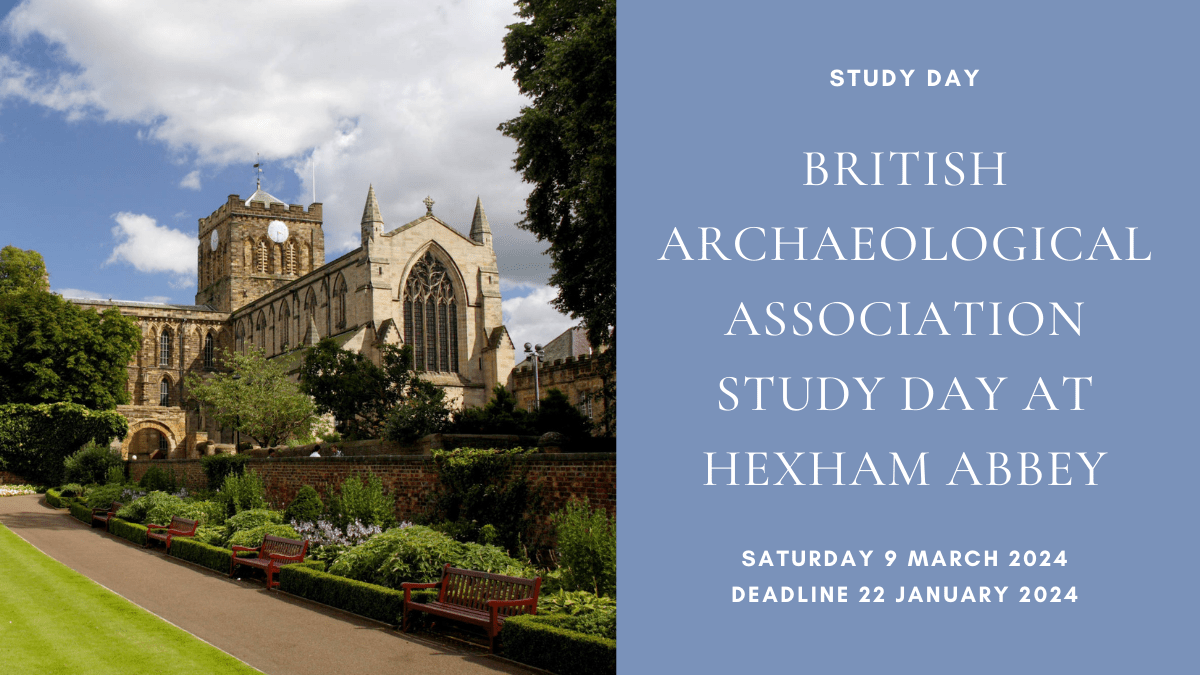
The main purpose of this informal event is to give members of the BAA an opportunity to explore the Roman and medieval sculpture, architecture and painting of Hexham Abbey in some detail. Hexham, seat of an Anglo-Saxon bishopric, and an Augustinian priory from the early 12th century until 1537, is unusually well placed to illustrate the chronology of its own development. Its 7th-century crypt, built for St Wilfrid’s monastery, is rich in Roman spolia, and significant Anglo-Saxon sculpture also survives. Much of this material is of national interest. The transepts and eastern arm were magnificently rebuilt c. 1180-1250 in the Early English style. Nave and west front were built later, subsequently destroyed, then replaced in the mid-19th and early 20th centuries (the nave of 1907-9 is by Temple Moore). The church is particularly rich in late medieval woodwork (pulpitum, parcloses, stalls with misericords) and panel painting (approximately 80 separate panels, including two in situ altarpieces).
Hexham also retains an imposing, fortified, moot hall of the 14th century, along with other points of interest, mainly associated with the priory site. The town is compact and charming.
Programme
The timings are intended to be generous enough to encourage on-site discussion.
10:00: Assembly and tea/ coffee in the Allendale Room, Hexham Abbey. The Allendale Room is attached to the refectory for the convenience of anyone arriving betimes.
10:15: Introductions in the Allendale Room, Hexham Abbey.
10:30: Roman sculpture, led by Nick Hodgson. This will include small-group visits to the crypt.
12:00: Lunch (the Abbey has a refectory and there are plenty of options close by in the town)
13:00: Medieval architecture, led by Eric Cambridge. (If there is time, then Eric will also explain something of the nave to us.)
14:30: Comfort break
14:45: Late medieval furnishings, led by Julian Luxford.
16:00: Depart.
Notes on travel and accommodation
For reference, Hexham is 300 miles north of London. To drive from the London area would take about 6 hrs 30 mins via the A1/A69 or M1/A1/A69. Trains run Euston-Carlisle or Kings Cross to Newcastle, changing to a local service (CrossCountry Trains, TransPennine Express, etc.) from either Carlisle or Newcastle. The latter is closer to Hexham (c. 25 miles east as opposed to c. 40 miles west). One may also easily travel to Hexham by train from Durham (c. 40 miles south-east).
Both Carlisle and Newcastle/Gateshead are well provided with accommodation options. Hexham itself has a Travel Lodge and various independent hotels and guesthouses.
The cost of the day will be £25 for members. The event is free for students, for whom travel grants (to a maximum of £100) are also available.
Places are limited to 20, of which up to 10 are reserved for students.
To apply, please e-mail studydays@thebaa.org– by 22 January 2024. Please state in the email whether you are a member of the BAA or a student. All names will be entered into a ballot for the study day, and the successful applicants will be notified by 23 January 2024.
Discover more from Medieval Art Research
Subscribe to get the latest posts sent to your email.
 Medieval Art Research