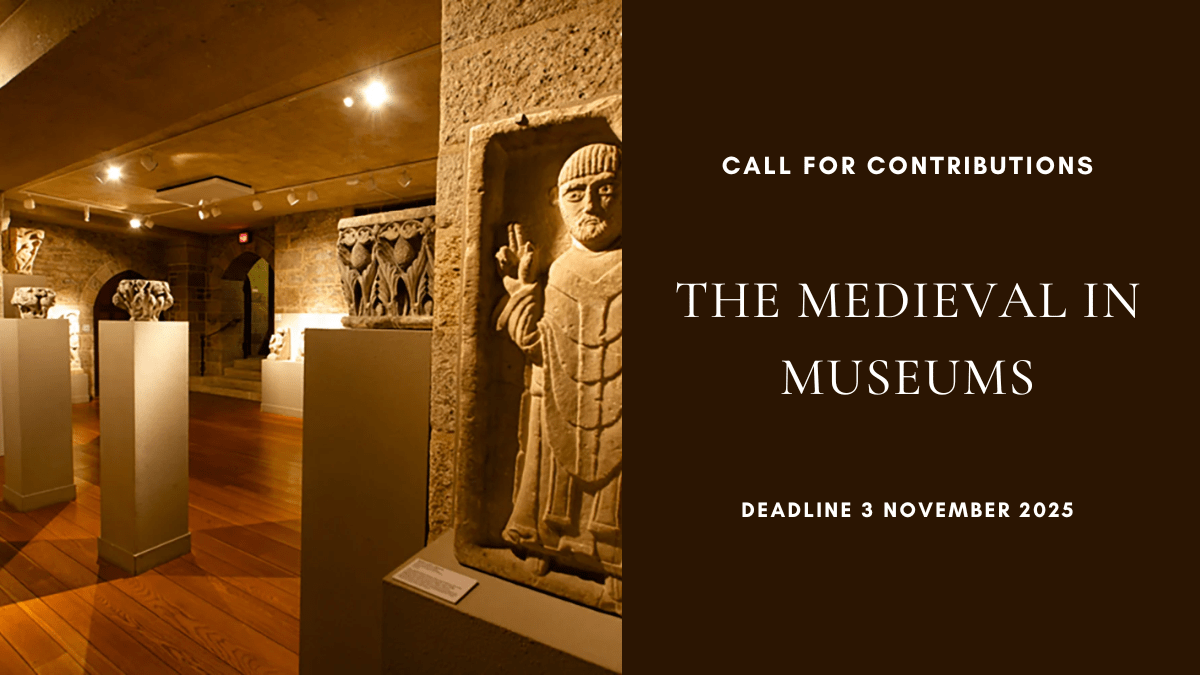
We invite short abstracts (100-200 words) in response to our call for chapters for an edited volume, ‘The Medieval in Museums’. Please send abstracts by 5pm GMT on Monday 3 November to Fran Allfrey (University of York) and Maia Blumberg (QMUL) fran.allfrey@york.ac.uk; m.blumberg@qmul.ac.uk. Please be in touch with us to discuss your idea more informally should you wish.
Additional information: The book proposal, with chapter abstracts, will be submitted to Arc Humanities Press. First drafts of full chapters will be due by 5pm GMT on Friday 3 April. Chapters will be 7,000-8,000 words in length including references and bibliography. The Arc uses the Chicago Manual of Style (‘Notes and Bibliography’) for presentation of citations. See the Chicago quick guide here: Notes and Bibliography Style, and Arc’s guidance here: Style Guide and Indexing Guides – Arc Humanities.
“The Medieval in Museums” seeks to demonstrate the cultural, aesthetic, political and historical stakes and effects of how medieval objects, texts, and histories are presented in museums. Our interpretation of ‘museum’ is broad, encompassing a range of ‘memory institutions’ including galleries, libraries, archives, and museums, and heritage sites both independently and government managed. We invite contributions which address the presentation of the medieval in physical galleries, landscapes, or other visitor-facing spaces in exhibitions and events programming; in behind-the-scenes archive and collections stores; and analogue or digital database or catalogue systems. Similarly, the ‘medieval’ here encompasses Late Antiquity to the Late Medieval, as a temporal marker which shifts according to geo-spatial-political realities across a ‘global Middle Ages’.
We particularly encourage contributions from scholars addressing the construction of ‘the medieval’ as a globalised chronological marker (including academic and practice-informed analyses of the rationales, methods, and consequences of using the ‘Middle Ages’ as a framework beyond Europe), and examining how heritage and identity are shaped in relation to the period in museums in Africa, South America, Asia, Australasia. We welcome approaches which interrogate the ownership, recording, interpretation, and display of non-European objects, texts, and histories identified as ‘medieval’ in non-European and European museums.
We welcome traditional chapters, and will also consider dialogues, interviews, or other creative-critical text-based formats. Contributions may be from individual authors or two or more co-authors. Please be in touch with us to discuss your ideas.
We reiterate and extend William J. Diebold’s contention that grappling with contemporary medievalism is central to the study of visual, material, and textual culture of the Middle Ages (2012): and that museums are vital spaces of medievalism, that is, places in which the medieval is encountered and remade (McLaughlin and Sandy-Hindmarch, 2024). Museums reflect and construct national and local identities, and may perpetuate myths of ethnogenesis or ethnonationalism (Sterling-Hellenbrand, 2021; Karkov, 2022; Jolly, 2022). Scholarly research is shaped by as much as it shapes the medieval in museums, with creative and innovative museum and heritage programming opening up expansive visions of the past and present with reference to the Middle Ages (Davies, 2018; Lees and Overing, 2019; Whalley, 2023).
Contributions may address:
- Constructions of heritage or identity through presentations of the medieval in or as a museum or heritage site, including but not limited to: landscapes, cemeteries, or buildings; original and replica medieval material culture; manuscripts and translated texts, narratives, and histories; digital and analogue catalogues, data, or finding aids.
- How the medieval is entangled with: institutional or state policies; funding structures or sponsorship; histories of European imperialism; calls for decolonisation and matters of social justice; practices of acquisition, record-keeping, curation, display, and interpretation.
- The distinct theoretical and practical challenges posed by medieval material and textual culture to heritage practices, policies, practitioners and institutions.
- How museums address questions of race, gender, sexuality, and other forms of social or environmental justice through medieval objects, spaces, and topics.
- Performances, events, or reenactments in museum spaces or heritage sites.
- Educational, creative, and community projects and public engagement events led by museums, or run by academics in collaboration with museums.
- How medieval studies research and museum practices may mutually and reciprocally inform one another: from exhibition and display, collections management systems, and programming.
- Digital museum presences, including websites, catalogues, digitised manuscripts or objects, social media, and virtual or augmented reality.
Key dates:
- 100-200 word abstracts due on Monday 3 November, 5pm GMT.
- First drafts of full chapters will be due on Friday 3 April, 5pm GMT.
References: Diebold, W, “Medievalism,” Studies in Iconography, 33 (2012), 247-256; McLaughlin, L, and Sandy-Hindmarch, J, “Special Collection The Public Curatorship of the Medieval Past: Introduction”, Open Library of Humanities (2023-2024); Sterling-Hellenbrand, A, Medieval Literature on Display: Heritage and Culture in Modern Germany (London: Bloomsbury, 2021); Karkov, C, Art and the Formation of Early Medieval England (Cambridge: CUP, 2022); Jolly, Karen, “Anglo-Saxons on Exhibit: Displaying the Sacred”, in Global Perspectives on Early Medieval England, ed. by Jolly and B Elliott Brooks (Woodbridge: Boydell and Brewer, 2022), pp. 217-244; Davies, J, Visions and Ruins: Cultural Memory and the Untimely Middle Ages (Manchester: MUP, 2018); Lees, C, and Overing, G, The Contemporary Medieval in Practice (London: UCL, 2019); Whalley, B, “Maldon and the Blackwater Estuary: Literature, culture and practice where river meets sea”, in St Peter-On-The-Wall: Landscape and heritage on the Essex coast, ed. by Johanna Dale (London: UCL, 2023).
Discover more from Medieval Art Research
Subscribe to get the latest posts sent to your email.
 Medieval Art Research