- Location: Birkbeck, 43 Gordon Square, Keynes Library and Online
- Date and time: 21 January 2025, 17:00 — 18:30 GMT
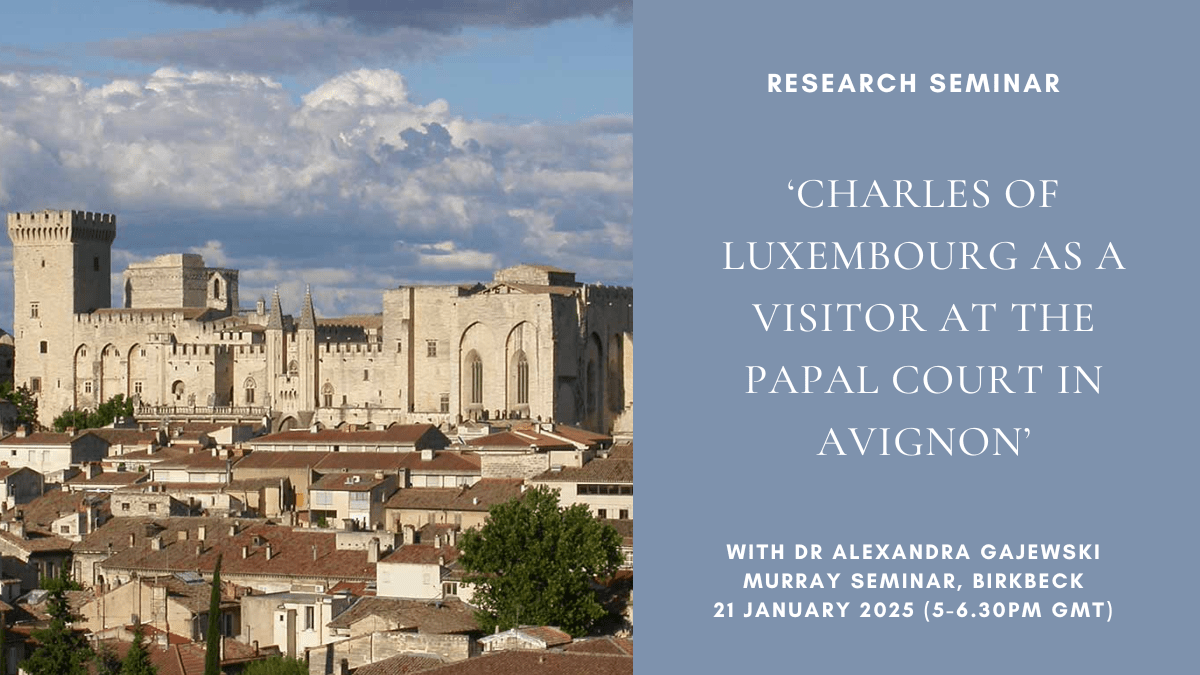
When on 23rd May 1365 Emperor Charles IV arrived in Avignon accompanied by five hundred knights, he encountered a city that had changed substantially compared to the Avignon he saw on his visits in c.1340, 1344 and 1346, when he was still Margrave of Moravia. The Porte Saint-Lazare, through which the imperial procession probably entered, had not existed in the 1340s, new city walls had been built from 1357/58. The city’s churches had been rebuilt. The Papal Palace had been enlarged with a new entrance, a new staircase and new chapel in the 1340s; dazzling new wall-paintings adorned the walls, a new kitchen been built and polyphonic music had been introduced. Charles slept in Petit Palais whereas in 1340 he had stayed in the Livrée of Pierre de Rosiers. Although, there are only snippets of evidence for the earlier visits, Charles’s adventus in 1365 is reported in a number of sources, in particular in the chronicles by John of Reading and Jan Neplach, who probably based their reports on eyewitness accounts. By crossing the sources relating to Charles’s visits with the topographical and architectural evidence, this paper hopes to show that the documents throw light on the unfolding of the emperor’s visit, in a way that has not been previously understood, and, more broadly, that the walls, the religious topography and the enlarged Papal Palace were active parts in making Avignon a fitting stage for the greatest moment in the city’s history, the entry of the emperor.
Alexandra Gajewski is the Deputy Editor of The Burlington Magazine and a Fellow at the Institute of Historical Research, London. She studied art history at the Courtauld Institute of Art, where she obtained her Ph.D. on Gothic architecture in northern Burgundy. Her research ranges from the twelfth to the fifteenth centuries, with a focus on regionalism, monasticism, the role of women, and, especially, late medieval Avignon.
Please Book Here for the In Person
Please Book Here for the Livestream
Discover more from Medieval Art Research
Subscribe to get the latest posts sent to your email.
 Medieval Art Research