Very short notice: to all on the Material Witness programme: Please email jaw62@kent.ac.uk if you’d like to come to this by the end of today (the 22nd). Cancellations have meant the event may not reach quorum, so if you are in London and can go, do sign up! The event will run 11-5 at the BL on Friday.

As an intangible art form, music poses a number of challenges for the researcher, especially when studying repertoire and practices which pre-date the advent of electronic recording. While we are incredibly lucky that such diverse and numerous sources (both musical and non-musical) have been passed down to us, these can also pose questions about the extent to which we can learn about past musical outputs from tangible media.
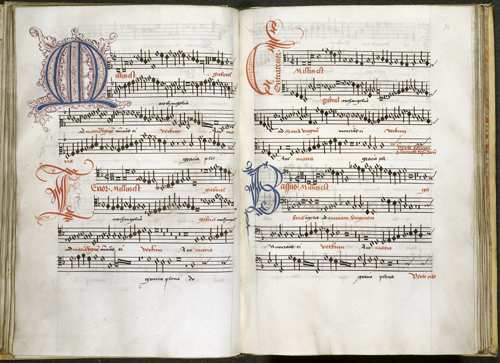 Opening from a Netherlandish manuscript containing 28 motets, 1513-c. 1525 (British Library, Royal 8 G VII, ff. 23v-24)
Our workshop ‘Sound as Artefact’, to be held at the British Library on 25th April, will consider some of the sources – and questions – musicologists deal with in their study of musical repertoire, practices and performances. After an introduction to the music collections of…
View original post 187 more words
Discover more from Medieval Art Research
Subscribe to get the latest posts sent to your email.
 Medieval Art Research